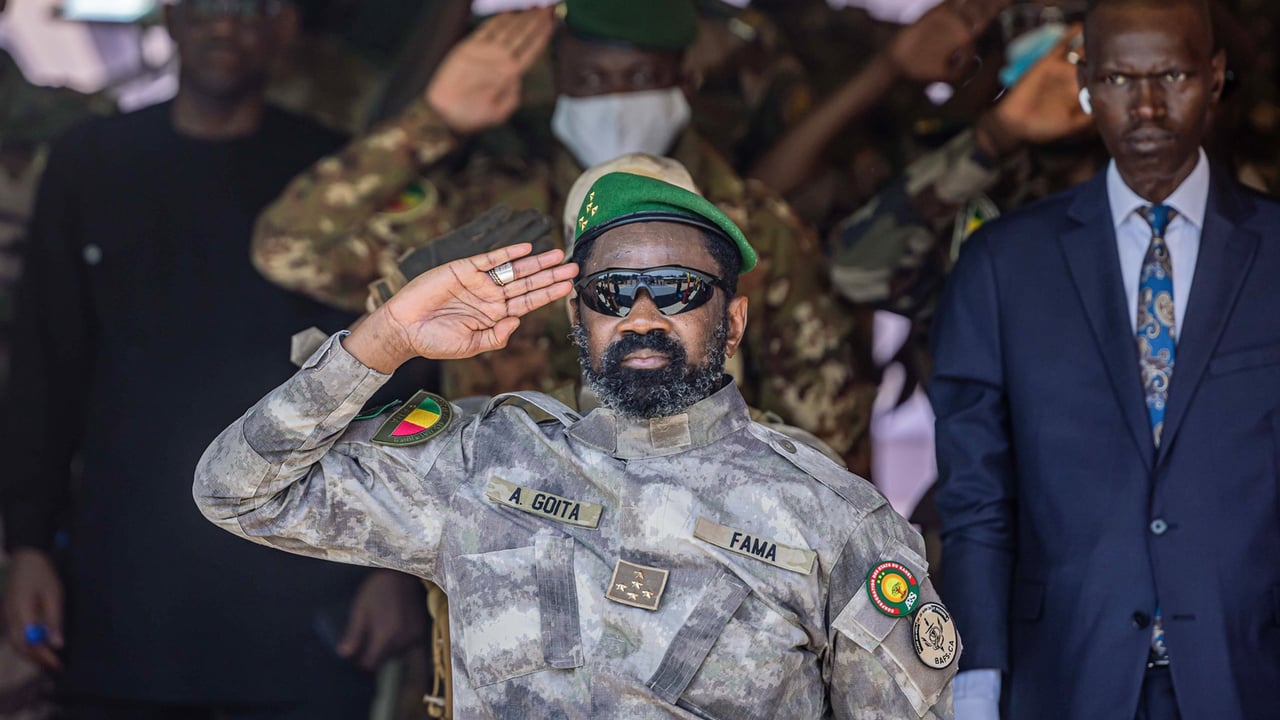

As Mali grapples with deepening political and security crises, Colonel Assimi Goïta stands at the helm, reinforcing his grip on power amid mounting challenges. His leadership, once seen as a stabilizing force, now faces scrutiny as the nation’s fragility becomes increasingly evident.
The recent loss of Sadio Camara, Mali’s Defense Minister and a key ally, during a tragic incident has underscored the volatility gripping the country. Goïta, who seized power in a 2020 coup and later consolidated authority in a subsequent takeover, remains a polarizing figure—admired by some for his decisive actions, yet criticized by others for prolonging political uncertainty.
From coup leader to head of state
Assimi Goïta’s ascent to power began in August 2020, when he led a military coup that ousted then-President Ibrahim Boubacar Keïta. Initially, his takeover was met with widespread public approval, as Malians expressed frustration with widespread corruption and weak governance. However, his second coup in May 2021, which removed transitional leader Bah N’Daw, raised concerns about the military’s long-term intentions.
The transitional government that followed was supposed to pave the way for elections, but delays and shifting timelines have eroded trust in the process. Goïta, who holds the titles of Vice President and President of the transitional council, has positioned himself as the de facto leader, navigating a delicate balance between domestic pressures and international expectations.
Security threats and political tensions
Mali’s security situation remains dire, with armed groups exploiting instability to expand their influence. The Group for the Support of Islam and Muslims (JNIM), one of the most formidable jihadist factions in the Sahel, continues to pose a severe threat, targeting both military and civilian populations. The recent funeral of Sadio Camara highlighted the personal cost of this conflict, as mourners gathered in Bamako to honor a fallen leader.
Domestically, Goïta’s government has struggled to reconcile competing factions, including former allies and political opponents. Protests have erupted over economic hardship and perceived failures in governance, further complicating efforts to restore stability. Meanwhile, international partners, including regional blocs like the Economic Community of West African States (ECOWAS), have imposed sanctions and demanded a clear path toward civilian rule, adding pressure on Goïta’s administration.
What lies ahead for Mali?
The roadmap for Mali’s transition remains unclear. While Goïta has committed to holding elections, skepticism persists about whether the military will cede control in the near future. The presence of Russian-backed Wagner Group forces, deployed to bolster Mali’s security, has also drawn criticism from Western allies, raising questions about the country’s alignment in an increasingly fragmented geopolitical landscape.
For now, Assimi Goïta remains the central figure in Mali’s turbulent journey. Whether he can steer the nation toward stability—or further entrench its fragility—will define his legacy in a country still searching for peace and prosperity.