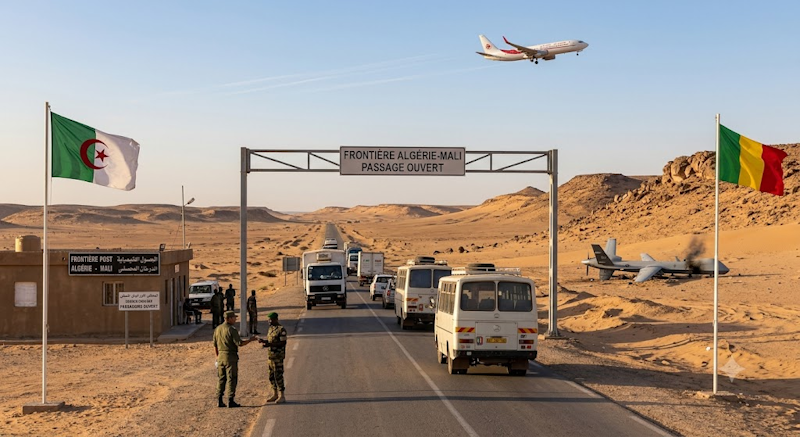

After 15 months of frozen diplomatic ties, Algeria and Mali have ended their standoff by reopening mutual airspaces and preparing for the return of ambassadors. The breakthrough was announced Friday following a year-long dispute triggered by a military incident.
Both nations confirmed the lifting of reciprocal sanctions in separate statements, marking the end of a crisis that threatened regional security cooperation. Civil and military flights can now resume between the two countries, while diplomats will soon return to their posts.
Relations had been severed since April 2025, when a major military clash occurred along their shared border.
Tinzaouaten incident: the spark that ignited the feud
On March 31, 2025, Algerian forces shot down a Turkish-made Malian military drone near Tinzaouaten, a border town in the Kidal region. The area, historically linked to Tuareg separatist movements opposing Bamako’s authority, sits on a strategic frontier.
Algiers claimed radar data proved the drone violated its airspace—a version Bamako vehemently denied, calling the incident an unprovoked attack.
The dispute escalated quickly, drawing regional allies:
- Sahel solidarity: Supported by the Sahel States Confederation (including Niger and Burkina Faso), Mali recalled its ambassador in protest, framing the attack as a violation of the confederation’s territorial integrity.
- Algeria’s response: Rejecting Bamako’s allegations as baseless and inflammatory, Algeria shut its airspace to Malian flights and withdrew its diplomats.
Collapse of security collaboration
Over the months, tensions deepened on the international stage. In September 2025, Mali filed a case with the International Court of Justice (ICJ), accusing Algeria of deliberately targeting the drone to disrupt its counter-rebel operations. Bamako also suspended participation in the Joint Operational Chiefs Committee (CEMOC), a key counterterrorism body initiated by Algeria.
A decade-long mediator: For over ten years, Algeria played a pivotal role in mediating Mali’s conflict with Tuareg rebels, culminating in the 2015 Algiers Accords.
Shifting Sahel dynamics fuel thaw
This diplomatic thaw arrives amid sweeping geopolitical shifts in the Sahel. Since 2020–2021 coups in Mali, Niger, and Burkina Faso, the new military regimes have distanced themselves from traditional partners like France and Algeria, instead forging closer military ties with Russia.
Mali continues to grapple with a relentless jihadist insurgency linked to Al-Qaeda and the Islamic State since 2012. Recent months have seen intensified attacks by both terrorist groups and Tuareg separatists. Restoring dialogue with Algeria could prove vital for regional stability.