At Luanda summit, Félix Tshisekedi declares DRC crisis a test for Africa and the world — urges verifiable peace
Women’s rights and empowerment
- Security
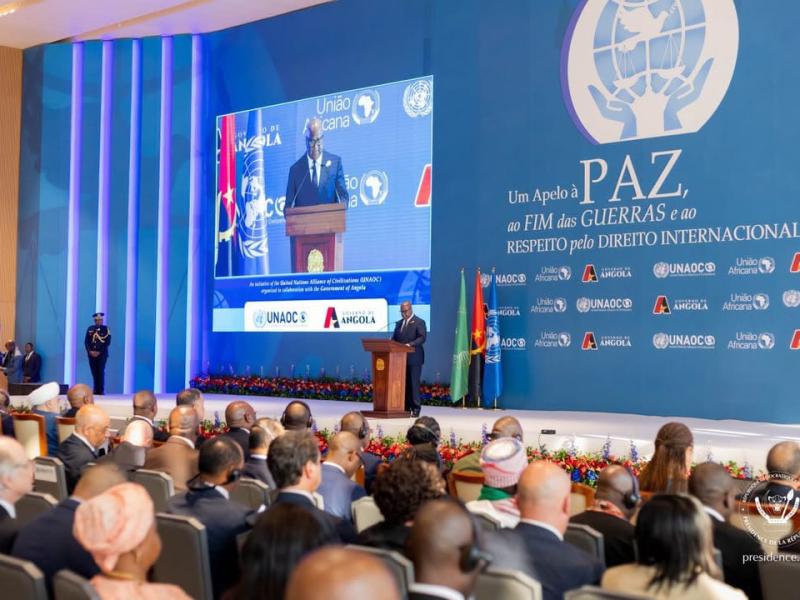
The global peace agenda took center stage in Luanda, Angola, as the United Nations Alliance of Civilizations (UNAOC), in partnership with the Angolan government, convened the third chapter of the landmark international initiative ‘A Call for Peace, an End to Wars, and Respect for International Law’ on 16-17 July 2026. Following previous editions in Gernika, Spain, and Sarajevo, Bosnia and Herzegovina, the gathering aimed to reinforce multilateral cooperation and promote peaceful solutions to conflicts plaguing multiple regions worldwide.
Among the high-level delegates, President Félix Tshisekedi of the Democratic Republic of the Congo delivered a powerful address, drawing from his country’s enduring struggle with armed violence in its eastern provinces. He highlighted the devastating human cost of conflict and the systemic exploitation of natural resources fueling instability in war zones.
« My country knows the price of war firsthand. It knows the pain of displaced families, the anguish of communities trapped in violence, the suffering of women subjected to grave violations of dignity, the grief of communities devastated by massacres, and the trauma of children denied education, security, and hope. It also knows the consequences of the illicit exploitation of natural resources, where a nation’s wealth, instead of funding development, becomes the lifeblood of war economies, » declared President Tshisekedi.
The Congolese leader emphasized that the crisis in eastern DRC represents a critical test not only for Africa but for the entire international community. He underscored the persistent challenges posed by armed groups, mass civilian displacement, human rights abuses, territorial integrity violations, and external interference.
Tshisekedi reaffirmed the DRC’s commitment to diplomatic solutions, acknowledging ongoing peace efforts such as the Washington and Doha processes, both backed by the African Union. He stressed that Kinshasa remains dedicated to dialogue and regional, continental, and international diplomatic initiatives aimed at de-escalation, peaceful dispute resolution, and sustainable stabilization in the Great Lakes region.« For years, the eastern part of our country has faced a severe security and humanitarian crisis driven by the activities of armed groups, massive civilian displacements, human rights violations, threats to territorial integrity, and external interference. This is not merely a national ordeal. It is a test for our region, for Africa, and for the international community, » he stated.
« The Democratic Republic of the Congo remains steadfast in its commitment to dialogue. We are engaged in regional, continental, and international diplomatic efforts. We commend the peace initiatives led by the African Union, regional organizations, the United Nations, facilitating countries, and international partners. These efforts to foster de-escalation, halt hostilities, resolve disputes peacefully, and achieve lasting stability in the Great Lakes region are recognized and valued, » said President Tshisekedi.
Despite these diplomatic endeavors, the security situation on the ground continues to deteriorate, with hostilities persisting. The President warned that sustainable peace cannot be reduced to empty promises but must translate into tangible, verifiable actions.
« Peace cannot remain a suspended promise. It must be backed by concrete action, verifiable on the ground. It must restore state authority, protect civilians, enable the dignified, voluntary, and secure return of displaced persons and refugees, and pave the way for justice, reparations, and reconciliation. The Luanda Call must not be another declaration. It must represent a high-level commitment: to defend international law wherever it is under threat; to prevent conflicts before they escalate into tragedies; to protect civilians without ever diminishing their suffering; to support credible mediation and sincere political processes; to combat impunity; to uphold the rights of societies, even when crimes occur beyond the public eye; to dismantle the economic circuits of war; and to condemn interference, support for armed groups, mercenary activities, and all forms of state destabilization, » he asserted.
In closing, Tshisekedi called for renewed global commitment to place humanity at the heart of peacebuilding efforts. He urged leaders to prioritize responsibility over indifference, law over force, truth over propaganda, justice over impunity, and peace over resignation.
« As we mark the 80th anniversary of the entry into force of the United Nations Charter, our responsibility is not merely to celebrate its legacy but to bring its promise to life. This promise is simple yet profound: to shield future generations from the scourge of war. It remains as relevant today as ever. It obliges us. If we genuinely seek to end wars, we must begin by restoring the strength of international law. If we seek to uphold international law, we must apply it consistently, without selectivity or complacency. If we aim to protect future generations, we must act now, with courage. Only then will we weaken the law of the strongest. Only then will we bequeath to future generations a more just, secure, and peaceful international order, » concluded President Tshisekedi.
The President’s appeal comes at a time when, despite the Washington peace accords and the Doha process, the security and humanitarian situation in eastern DRC continues to worsen. Negotiations between Kinshasa and the AFL/M23 have failed to bridge divides, and commitments remain largely unimplemented, hampering progress toward lasting peace.
Related Posts