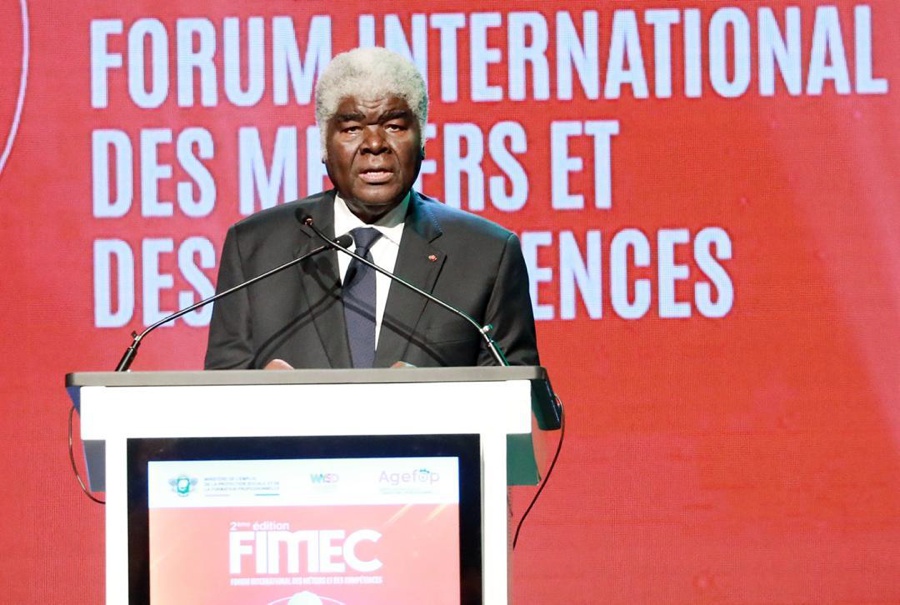
The International Forum for Trades and Skills (FIMEC) stands as a crucial catalyst for realizing the ambitious goals outlined in Côte d’Ivoire’s National Development Plan (PND) 2026-2030. Prime Minister Robert Beugré Mambé highlighted this synergy on Wednesday, July 15, 2026, at the Sofitel Hôtel Ivoire in Abidjan, emphasizing FIMEC’s role in aligning the economy’s demands with the competencies fostered by the nation’s training sector.
Presiding over the opening ceremony of FIMEC’s second edition, the Prime Minister underscored the event’s central theme: “Skills, Employment, and Economic Transformation in Africa: The Strategic Role of Vocational Training”.
Prime Minister Robert Beugré Mambé articulated the core objectives of the National Development Plan 2026-2030, which seeks to accelerate industrial growth, bolster economic competitiveness, nurture national industry leaders, attract greater private investment, and generate over 3 million jobs by 2030. He stressed that within this framework, skills development transcends mere training; it is now a fundamental policy for economic competitiveness. “Every investment in skills,” he affirmed, “is an investment in our businesses’ productivity, our economy’s appeal, and the sovereignty of our national progress.”
The Prime Minister further assured that the government is resolutely committed to continuing essential investments to elevate vocational training into a genuine engine for competitiveness, social inclusion, and sustainable wealth creation. He stated, “Our vision is to cultivate an ecosystem where vocational training fully supports national development priorities, enhances enterprise competitiveness, stimulates innovation, and significantly contributes to the industrialization of our economy.”
He emphasized FIMEC’s critical role as a vital platform for dialogue, bringing together public authorities, the private sector, training institutions, and development partners. This collaborative environment aims to forge unified solutions to pressing challenges in employment, professional qualification, and economic transformation.
The Prime Minister articulated a profound responsibility: “Our duty is to cultivate an environment where every young person can acquire the essential skills needed to succeed, to innovate, to embark on entrepreneurial ventures, and to fully contribute to their nation’s advancement. This very ambition guides the government’s actions, inspires the reforms we are implementing, and unites us all here today at FIMEC.”
He further highlighted that this second FIMEC edition vividly demonstrates Côte d’Ivoire’s unwavering commitment to making human capital development a cornerstone of its comprehensive economic and social transformation strategy. “The world is rapidly evolving,” he observed. “Economies are shifting, and professions are continuously reinventing themselves. In the face of these profound changes, our only viable path is to anticipate, innovate, and invest in our most invaluable asset: the women and men who will shape Africa’s future. Together, let us empower skills to be the primary engine of our competitiveness, our economic sovereignty, and our collective prosperity.”
The two-day forum features a dynamic agenda, including various exhibitions and high-level panel discussions.