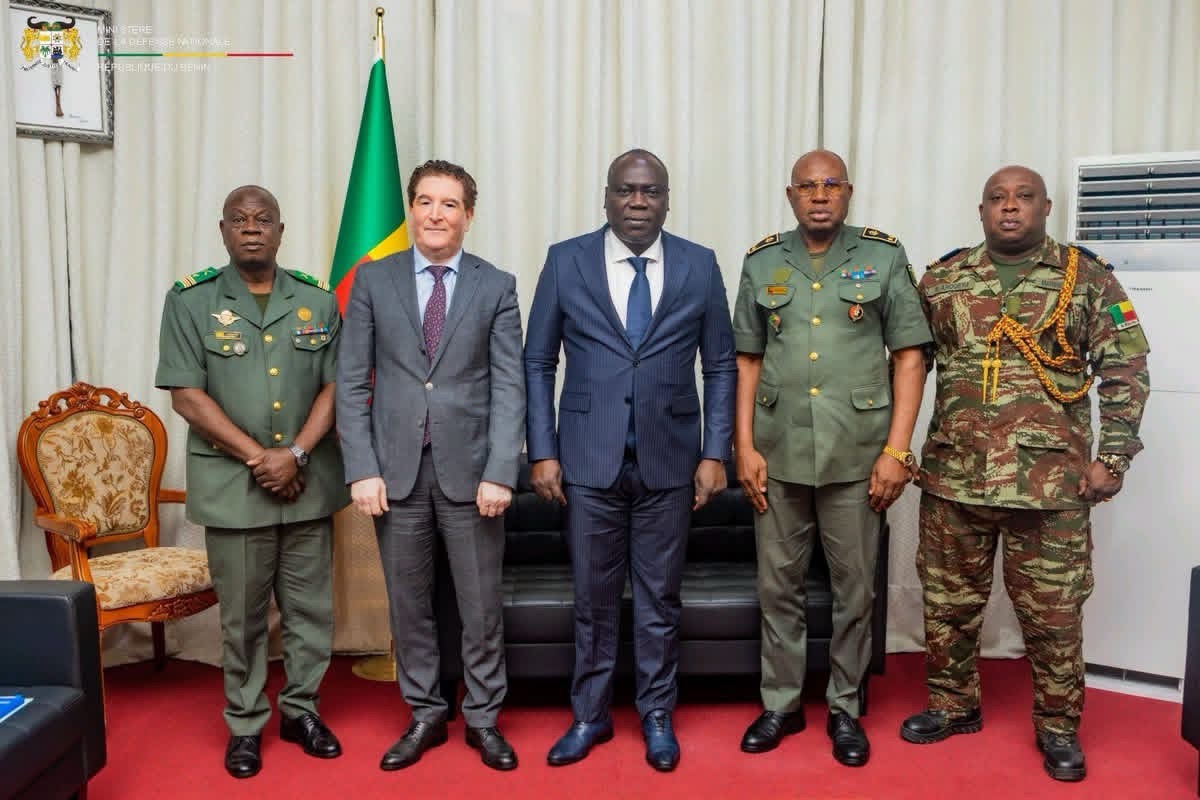
When Benin’s defense leadership sat down with Algeria’s top diplomat in Cotonou on September 24, 2026, the meeting looked like just another bilateral courtesy call. But behind the handshake lies a calculated shift in how this West African nation manages its security. The conversation between Gildas Agonkan, the minister delegate to the President in charge of national defense, and Algerian ambassador Ammar Hadjar was not about a single deal. It was about building options.
The quiet logic behind Benin’s military diversification
Benin’s defense strategy has been evolving for months, and the Algeria talks are the latest expression of a deliberate approach. Rather than anchoring its security architecture to one or two traditional partners, Cotonou is assembling a broader network. The thinking is straightforward: in a region where armed groups constantly change their tactics, no single partner holds all the answers.
Algeria brings something specific to the table. Its military has accumulated decades of operational experience in countering armed groups, and its defense ministry continues to highlight its counterterrorism track record. For Benin, that expertise matters as much as hardware. The minister made clear that the goal is not simply acquiring equipment but strengthening training, operational readiness, and the ability of Benin’s forces to work alongside others.
What Cotonou actually wants from the Algeria opening
Agonkan used the meeting to push for framework agreements that would cover multiple dimensions of national defense. The idea is to create a durable partnership rather than a one-off arrangement. Behind this request is a practical reality: Benin’s military operates in a context where asymmetric threats are spreading across the Sahel and increasingly testing forces in the country’s north.
The Algerian side signaled willingness to share its operational experience, particularly in troop training and capacity development. No date has been set for signing any framework agreement, and discussions are expected to continue. But the political signal is already clear.
A pattern, not a one-off move
The Algeria engagement is part of a wider trend. In recent months, Cotonou has pursued defense exchanges with several countries, including the United States, the United Arab Emirates, Germany, and the Netherlands. Benin’s defense ministry itself describes a policy of military cooperation with multiple states, with agreements that allow Beninese soldiers to attend training and advanced courses abroad.
The logic driving this is to multiply channels of cooperation so that Benin can access a wider range of expertise, training methods, and capabilities. It also allows Cotonou to seek partnerships that fit its own security realities, particularly in the north where armed groups active in the Sahelian space pose a direct threat.
National capacity remains the foundation
Cooperation does not mean outsourcing defense. Benin already runs its own training and development structures. In July 2026, the National Higher School of Armies (ENSA) recorded a 96.15 percent success rate for its 22nd class of the preparatory course for the staff diploma, with participants from seven countries. The ministry presents this institution as a tool for building force resilience.
Opening up to foreign expertise is meant to complement that national effort, not replace it. The engagement with Algiers could allow Beninese military personnel to test their methods against different operational experiences, acquire new skills, and sharpen their ability to respond to threats whose forms are changing quickly.
What happens next
No signing date for a framework agreement has been announced, so discussions will continue before any formal commitments are made. But the strategic direction is already visible: Benin is not closing any doors on security cooperation.
From Washington to Abu Dhabi, from Berlin to Algiers, Cotonou is working to multiply its sources of expertise and training. In a regional environment where asymmetric threats are advancing, this diversification is above all a way for Benin to gradually consolidate its own defense capabilities by combining national experience with that of partners who bring different skills.
The Algerian offer lands in a landscape already in motion. It adds a new piece to a security architecture Benin is building around a simple principle: strengthen its forces, diversify its partners, and keep control of its defense choices.