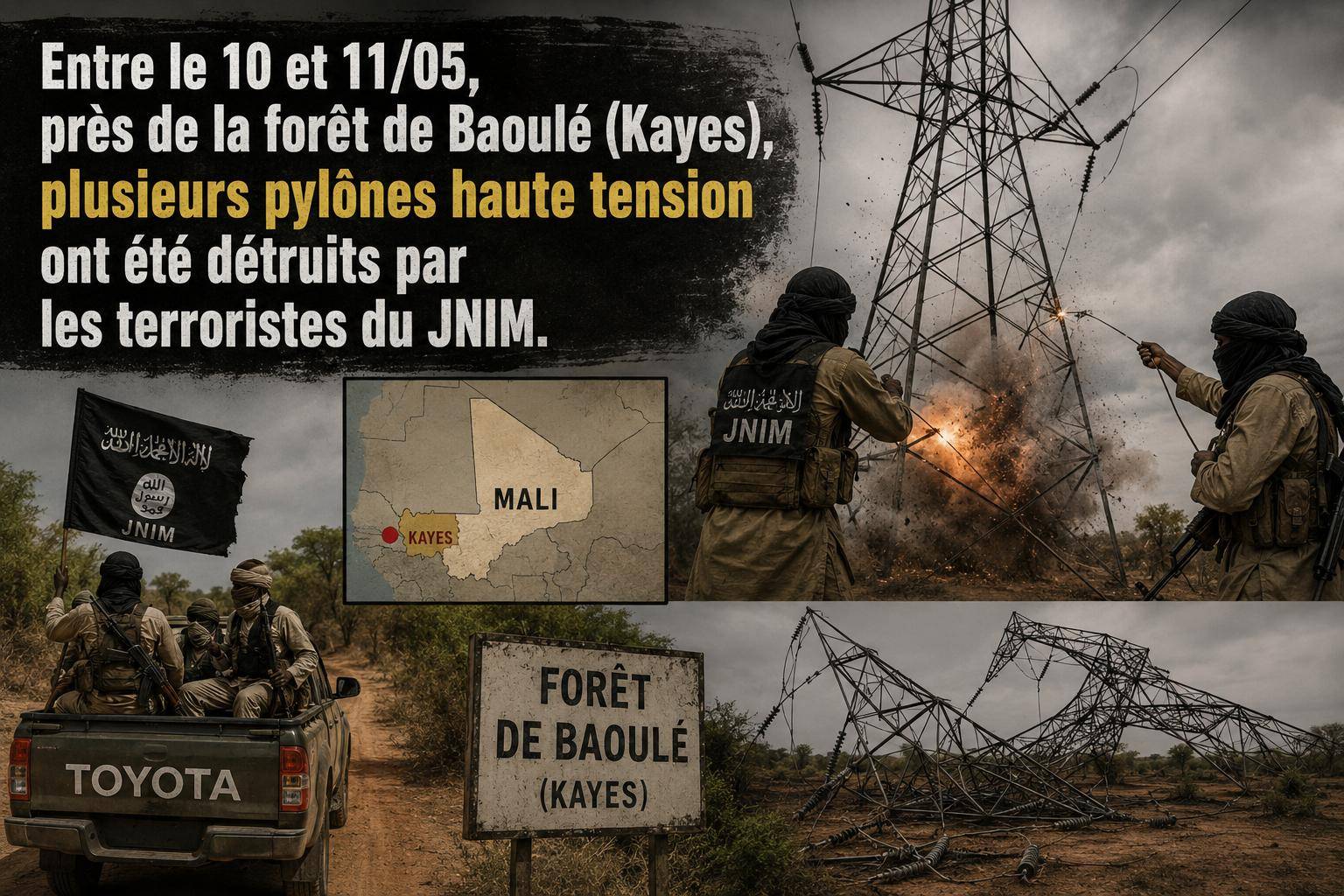
The weekend of May 10-11, 2026, marked a dark chapter for Mali’s energy sector after terrorists from the Group for the Support of Islam and Muslims (JNIM) detonated multiple high-voltage electricity pylons near the Baoulé forest in the Kayes region. This deliberate act of sabotage unfolded in a critical area patrolled by the Africa Corps, a Russian-backed security contingent whose effectiveness has increasingly come under scrutiny. With record-breaking heatwaves, severe water shortages, and total blackouts gripping the capital, Bamako is suffocating while the terrorist threat inches closer to the vital Manantali and Sélingué hydroelectric dams.
JNIM’s calculated assault on Mali’s infrastructure
What began as sporadic rural insurgency has evolved into a calculated siege against the Malian state. After systematically severing key roadways into Bamako—torching commercial trucks and civilian buses—the JNIM has escalated its tactics. By targeting the Kayes region’s power transmission lines, the group is directly attacking the lifelines of ordinary citizens and the fragile stability of the transitional government.
The operation was executed with alarming precision. Pylons hidden in rugged terrain near the Baoulé forest were demolished using high-grade explosives, plunging entire districts of Bamako into darkness. The attack exacerbated an already dire energy crisis, leaving residents sweltering in temperatures nearing 45°C without electricity to power fans or electric pumps to deliver clean drinking water.
Russia’s Africa Corps: power on display, protection absent
Paradoxically, these attacks occurred despite claims from both the Africa Corps and Malian Armed Forces (FAMa) that the regions were secure. The ease with which militants transported explosives, planted charges, and vanished without interception raises serious questions about the real capabilities of this Russian-backed force. Drones and joint patrols, touted as game-changers in urban areas, have proven useless against hybrid threats targeting critical infrastructure.
The humanitarian toll is mounting. Hospitals and emergency services are operating on life support, with generators insufficient to offset the loss of the national grid. Pregnant women, critically ill patients, and families suffer the consequences of a state unable to guarantee basic services. Government statements touting fuel convoys escorted by FAMa and Africa Corps ring hollow when the technical reality of power loss drowns out propaganda.
Manantali and Sélingué: a regional catastrophe in the making
The most alarming development is the JNIM’s shifting focus toward the Manantali and Sélingué dams—regional powerhouses supplying electricity and irrigation across West Africa. An attack on these facilities would plunge Mali into months of darkness and extend the crisis into Senegal and Mauritania, which rely on shared energy agreements. The agricultural sector, dependent on river basin irrigation, would face collapse, triggering a food security emergency of unprecedented scale.
The sequence of attacks—from trucks to pylons to dams—exposes a deliberate escalation in the group’s strategy. The transitional government and its allies, despite heavy investment in the Africa Corps, have failed to secure vital economic arteries. The disconnect between official rhetoric of territorial liberation and the reality of crumbling infrastructure has eroded public trust. Bamako’s residents no longer demand sovereignty—they demand survival: water, light, and real security, not empty promises.