Senegal’s president sacks prime minister Ousmane Sonko amid rising tensions
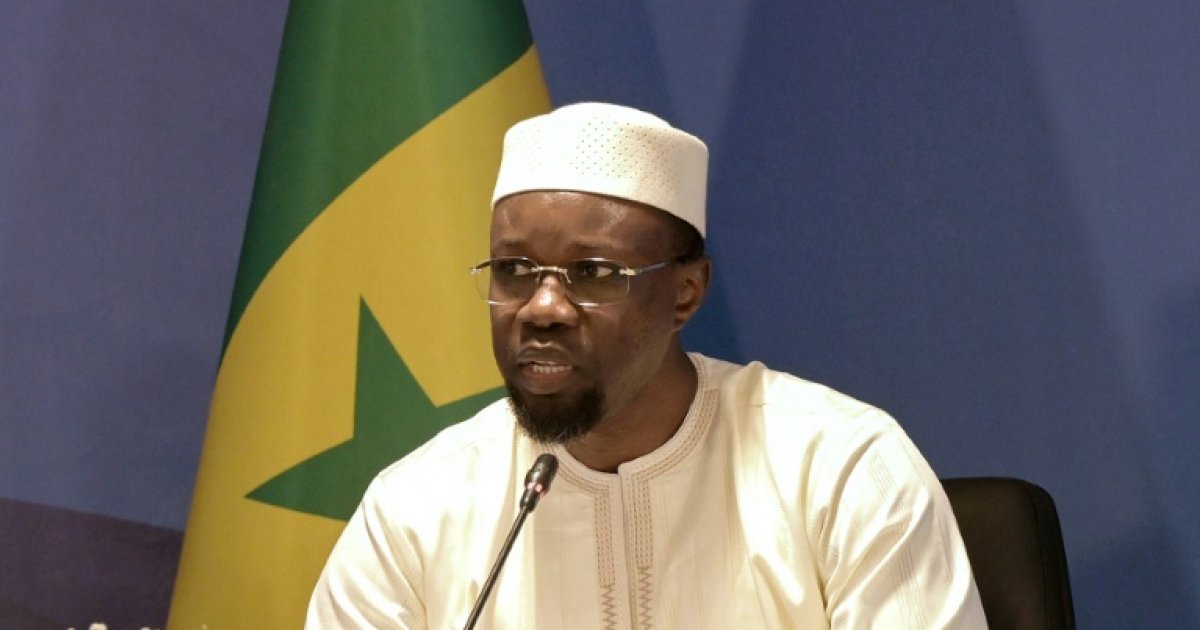
President Bassirou Diomaye Faye of Senegal has dismissed Prime Minister Ousmane Sonko, his former ally and political mentor, following months of escalating tensions between the two leaders who rose to power together in April 2024.
In a televised address delivered by the presidential secretary-general Oumar Samba Ba, the president announced the dismissal, stating that Ousmane Sonko’s tenure as Prime Minister had been terminated, along with that of all ministers and secretaries of state in his government.
The outgoing cabinet has been instructed to handle only routine administrative tasks until further notice, with no timeline provided for the appointment of a successor.
The rift between President Faye and Prime Minister Sonko deepened steadily since the election, despite their shared history as opposition figures against former President Macky Sall (2012-2024).
Sonko, a prominent critic of Sall’s government, was barred from running in the 2024 presidential election due to a defamation conviction that stripped him of his civil rights. He subsequently backed Bassirou Diomaye Faye as the alternative candidate, a move that proved pivotal in their eventual victory.
Sonko’s panafricanist rhetoric resonated strongly with Senegal’s disillusioned youth, particularly during the lead-up to the election, where he faced violent crackdowns from Sall’s administration over his presidential ambitions and opposition to a controversial third-term bid.
Both men were released from prison in April 2024 under an amnesty law aimed at easing political tensions, and campaigned together under the slogan “Diomaye Moy Sonko”, meaning “Diomaye is Sonko” in Wolof.
Spontaneous gatherings follow announcement
Within moments of the announcement, Sonko took to Facebook to express his relief, writing, “Alhamdoulillah. Tonight, I will sleep peacefully in Keur Gorgui,” referring to his residence in Dakar.
Hundreds of Sonko’s supporters gathered outside his home to celebrate the news, according to local reports.
Earlier the same day, Sonko had criticized Western influence in Senegal, accusing it of attempting to impose “homosexuality on the rest of the world” during a parliamentary address, just weeks after the country passed a law imposing stricter penalties for same-sex relations.
The president and prime minister’s differences had become increasingly public in recent months, making any reconciliation increasingly unlikely.
Political dominance and future ambitions
In early August, President Faye publicly criticized Sonko’s “excessive personalization” of the ruling party, warning that his position was contingent on continued trust. “As long as he remains Prime Minister, it is because he has my confidence. When that is no longer the case, there will be a new Prime Minister,” Faye stated in a televised interview.
Sonko’s party holds a commanding majority in Senegal’s National Assembly following a landslide victory in the November 2024 legislative elections. In a controversial move, parliament recently paved the way for Sonko’s potential candidacy in the 2029 presidential election by approving electoral reforms, a move critics argue was designed to benefit him.
The Supreme Court of Senegal had rejected Sonko’s appeal against his 2023 conviction in July 2025, reigniting debates over his eligibility. However, Sonko was elected as a deputy in the November 2024 legislative elections before waiving his mandate to remain as Prime Minister, a decision his party argues preserves his eligibility.
Local elections are scheduled for 2027, with the presidential election set for 2029. Meanwhile, President Faye, who has not enjoyed the same level of popular enthusiasm as Sonko, has been consolidating support through the “Diomaye President” movement, fueling speculation about a potential 2029 candidacy.
Economic challenges loom
The government inherited a severe economic crisis, including a debt burden equivalent to 132% of GDP—the second-highest in sub-Saharan Africa, according to the International Monetary Fund (IMF). In 2024, the new administration accused the previous government of concealing the true state of public finances, leading to the suspension of a $1.8 billion IMF support program.