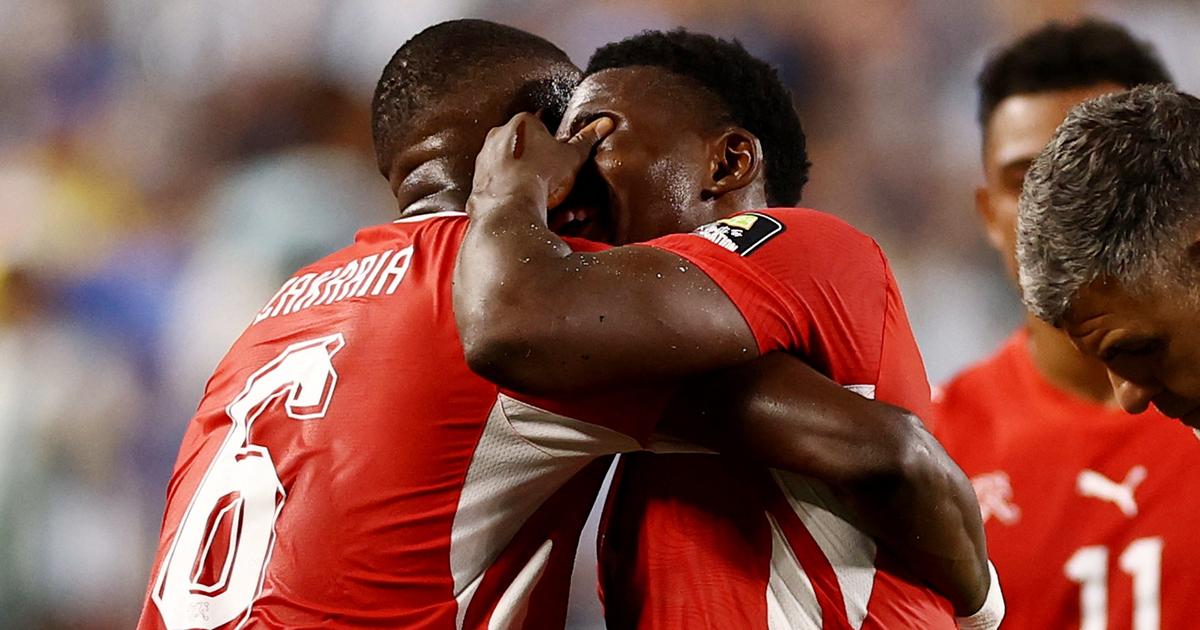
The echoes of disappointment in Kansas City will undoubtedly resonate even deeper than those felt in São Paulo. Much like their Round of 16 clash twelve years ago, Switzerland once again succumbed to Argentina, despite delivering a formidable and spirited performance on the global stage.
Goals from Julian Alvarez in the 112th minute and Lautaro Martinez in the 120th+1 minute proved to be the decisive blows, crushing the Swiss hopes. The outcome might have been different had it not been for an improbable turn of events: Embolo’s red card, which occurred just moments after Dan Ndoye’s equalizer in the 67th minute. At that critical juncture, it truly seemed that Switzerland was poised to overturn Argentina. Yet, the Albiceleste, often finding a way to prevail, continues its quest for a second consecutive World Cup triumph.
Long before this agonizing conclusion, Switzerland had initiated the match with promising intent. However, after only ten minutes, Argentina had already taken the lead. The architect? None other than Lionel Messi, whose perfectly delivered corner kick found the head of Alexis Mac Allister. Djibril Sow, who started for Murat Yakin’s side, was mere centimeters away from preventing the Argentine midfielder from beating Gregor Kobel in the 10th minute.
Switzerland’s early dominance
Still without Johan Manzambi, Yakin’s squad initially appeared as offensively muted as they had been in their Round of 16 encounter against Colombia. By halftime, despite enjoying a clear positional advantage, they registered only a single shot on target: a strike from Sow on the edge of the box, which Emiliano Martinez comfortably gathered in the 20th minute. The sole genuine moment of concern for the Albiceleste in the first half came from a push by Lisandro Martinez on Embolo’s back, which went unpunished by the referee, denying Switzerland a potential penalty in the 31st minute.
The dynamic of the match dramatically shifted after the interval. Switzerland emerged with renewed vigor, displaying increasing enterprise, asserting clear dominance, and finally posing a tangible threat. Capitalizing on the spaces left by the Argentine defense, they began to test Martinez’s reflexes. Embolo had two headers well-saved by the Argentine goalkeeper in the 60th and 65th minutes, followed by a low, long-range shot from Granit Xhaka in the 66th minute.
Ultimately, it was Dan Ndoye who provided the breakthrough. Receiving a pass from Xhaka on the left flank, the Vaudois player executed a flawless one-two with Ricardo Rodriguez. A quick exchange later, he precisely struck the ball with his right foot to beat Martinez in the 67th minute. Switzerland had found their equalizer, and it was thoroughly deserved.
Embolo’s emotional exit
However, just as Switzerland had seized momentum, an unfortunate twist of fate abruptly curtailed their resurgence. The sequence appeared innocuous: at midfield, Embolo fell after a challenge from Leandro Paredes, and the Argentine was initially cautioned. But the Basel striker’s simulation, initiating his dive before contact, did not escape the scrutiny of VAR. The video assistant referee, now empowered to alert the main official when a yellow card has been incorrectly issued, intervened. Referee Pinheiro subsequently reversed his initial decision, penalizing Embolo for simulation. Crucially, the number 7 had already received a yellow card earlier in the first half. The consequence: a red card.
Visibly distraught, Embolo was forced to leave the pitch in tears, consoled by his teammates. The red card was particularly devastating given that Zeki Amdouni was in the process of removing his bib, seemingly preparing to enter the fray as a substitute. However, the planned substitution could not proceed, leaving Switzerland to finish the match with ten players.
Remarkably, even with a numerical disadvantage, Switzerland managed to hold on for another thirty minutes, regrouping into a compact 5-3-1 formation to force extra time. During this period, Argentina created two significant opportunities: a right-footed shot from Messi that narrowly missed Kobel’s post in the 90th+2 minute, and another effort from Lisandro Martinez that the Swiss goalkeeper confidently collected in the 90th+9 minute.
Alvarez ignites the stadium
Displaying heroic resilience, Switzerland maintained their defensive solidity for another twenty-five minutes into extra time before finally capitulating. It took a truly spectacular goal from Julian Alvarez to breach Kobel’s defense, who had brilliantly thwarted numerous attempts until then. Alvarez unleashed a powerful strike into the Swiss top corner, sending tens of thousands of Argentine supporters into a frenzy and shattering the dreams of an entire nation. Lautaro Martinez then sealed Argentina’s victory with a third goal on a final counter-attack.
Despite the painful exit, the overall assessment for this Swiss team remains undeniably positive. They successfully achieved their stated objective: to deliver the best World Cup performance in their history. Reaching the quarter-finals and securing victories in two knockout matches was an unprecedented accomplishment for the squad. The next challenge, no less demanding, will be to consolidate their position within the global top-eight rankings.