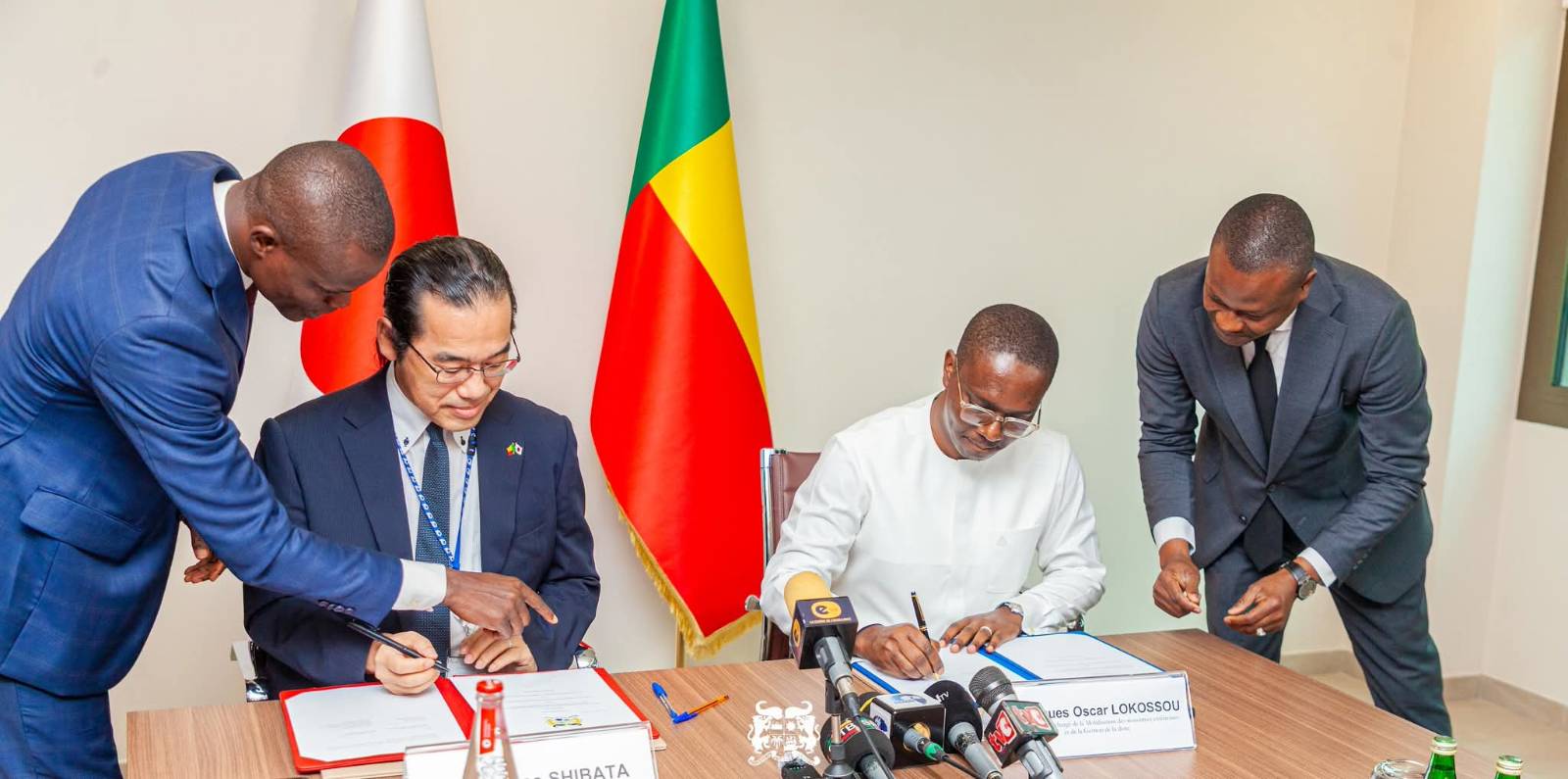
Can a single interchange untangle the daily chaos at one of Cotonou’s busiest crossroads? That is the question hanging over the Vêdoko project after Benin and Japan signed a fresh grant agreement worth 10.8 billion FCFA on Friday, October 9, 2026, to bankroll the second phase of construction. The new injection lifts the total announced financing to 26.228 billion FCFA. The stated ambition is to ease movement through a strategic corridor of Benin’s economic capital, cut down on congestion and improve travel conditions for the thousands of commuters who use this route every day.
Why another funding boost for an already-started project?
The Vêdoko junction interchange has moved into a new chapter with the signing of the 10.8 billion FCFA grant between Benin and Japan. The official ceremony took place on Friday, October 9, 2026 in Cotonou as part of financing for phase two of the works.
This additional envelope brings the total announced funding for the structure to 26.228 billion FCFA. It reinforces the resources mobilised to continue a project whose official launch dates back to October 28, 2025, at a ceremony attended by Japan’s ambassador to Benin.
So this is not the start of the project but a further step in its implementation. The challenge now is to keep the works on track according to the set objectives, so the infrastructure can eventually deliver the expected effects on traffic in Cotonou.
According to information shared around this new agreement, the funding is meant in particular to support the construction of an east-west oriented overpass, along with related development and drainage works needed to complete the structure.
Vêdoko: a strategic crossroads under intense traffic pressure
For road users in Cotonou, Vêdoko is an area where traffic density can make getting around difficult, especially during peak hours. The convergence of vehicle flows, motorcycles, taxis and other means of transport creates slowdowns that affect the reliability of journeys.
In a city where mobility is essential to economic activity, these difficulties have consequences well beyond time spent on the road. Workers have to plan for delays, traders and delivery riders may see their activities disrupted, while public transport drivers must cope with journey times that are sometimes hard to predict.
The interchange is intended to better organise traffic movements at this junction. Through the overpass and the planned upgrades, the aim is to ease the flow of vehicles and reduce conflicts between different streams of traffic.
The project’s reach for urban mobility is therefore significant. However, its effectiveness will depend on how well the structure integrates into the existing road network and on how nearby intersections and roads are managed.
Fewer jams, more time for residents?
The main expectation among the population concerns the concrete impact of the interchange on daily life. Once the works are finished and the infrastructure is in service, users hope to cross the Vêdoko area under better conditions.
For employees, smoother traffic could cut the time spent travelling between home and work. For pupils and students, it could help make journeys more regular. As for traders, transporters and delivery riders, they could benefit from more predictable travel and more efficient organisation of their activities.
Reducing long stops and frequent restarts could also lower fuel consumption linked to congestion, while helping to cut some noise and polluting emissions.
These benefits remain expected effects, not results already achieved. The signing of the new financing agreement does not mean jams will end immediately. The gains will depend on the progress of the works, the quality of the structure and how traffic evolves.
The ambition is to sustainably reduce circulation difficulties at Vêdoko, not to present the interchange as an automatic fix for all of Cotonou’s mobility problems.
A construction site that also demands patience
Since the works have already begun, the construction period is a significant stage for residents and road users. As with any road project of this scale, the works may require traffic adjustments, diversions or temporary restrictions depending on the areas concerned and the phases of execution.
These possible constraints must be weighed against the long-term benefits being sought. They also highlight the importance of keeping users well informed, with visible signage and efficient organisation of temporary routes.
To limit inconvenience, traffic management during the works will need to remain a major concern. Drivers, motorcyclists, pedestrians and residents need to know about changes to traffic and have sufficiently clear directions to adapt their journeys.
The project’s success will therefore be measured as much by the quality of the final structure as by the ability of those managing the site to limit disruption during construction.
Benin-Japan partnership serving urban mobility
Financing the second phase confirms Japan’s role in supporting infrastructure development in Benin. The additional 10.8 billion FCFA grant strengthens a bilateral cooperation intended, in this case, to improve traffic conditions in the economic capital.
The project also foresees collaboration between Japanese and Beninese companies, with a prospect of skills and know-how transfer, according to the Japanese embassy’s statement published at the launch of the works in October 2025.
Beyond building a civil engineering structure, the stakes are economic and social. More efficient mobility facilitates trade, improves access to professional activities and supports the functioning of urban services.
Mobilising substantial funding is only part of the equation, however. The infrastructure’s durability will also depend on the quality of its execution, its maintenance and its integration into a broader policy for managing mobility.
A promise of fluidity still to be confirmed on the ground
With total announced financing of 26.228 billion FCFA, the Vêdoko interchange ranks among projects aimed at improving urban mobility in Cotonou. The new agreement signed with Japan on October 9, 2026 brings additional resources to continue a project already under way.
For local people, the expectation is simple: spend less time in traffic, travel more easily and regain greater regularity in daily journeys. But these hopes can only be considered met once the structure is completed, brought into service and its effects genuinely assessed.
Reducing congestion will notably have to be gauged using data on journey times, queues and traffic conditions before and after the interchange opens.
Ultimately, the Vêdoko challenge is no longer just about financing and building a piece of infrastructure. It is about turning that investment into tangible improvement for users. Only on that condition can the interchange keep its promise: helping to deliver smoother traffic and urban mobility better suited to the daily needs of Cotonou’s residents.