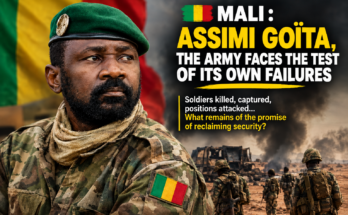
In a matter of days, Mali’s armed forces and their Russian allies came under repeated assault in Dioura and Sévaré, leaving around 150 dead. The scale of the losses has forced the country’s leadership to confront an uncomfortable question: can the state still protect its own soldiers and territory?
Where the attacks unfolded
The strikes targeted two separate locations, Dioura and Sévaré, hitting Malian troops alongside their Russian partners. The coordinated nature of the assaults points to a jihadist group capable of operating across different areas at once.
For communities in these zones, the violence is not abstract. It disrupts travel, trade and daily routines, and it raises fears that security forces may be stretched too thin to respond everywhere at once.
Bamako’s response
Facing the fallout, Assimi Goïta convened a meeting in Bamako on Sunday. The gathering signalled that the authorities view the situation as serious enough to warrant high-level attention.
Yet a meeting alone does not answer the central dilemma: what strategy can actually reverse the momentum of a group that has shown it can strike multiple targets in quick succession?
Key questions hanging over the response
- Can Mali’s military regroup and defend key positions without leaving other areas exposed?
- What role will Russian partners play after coming under attack themselves?
- How will ordinary Malians in affected regions cope if violence continues?
The stakes beyond the battlefield
The death toll of roughly 150 is more than a number. It represents a blow to morale, a test of the government’s credibility, and a signal to armed groups that their operations can still inflict significant damage.
Analyst Wassim Nasr has examined the facts and the broader implications of these events, highlighting how the attacks fit into a wider pattern of jihadist pressure on the Malian state.
For now, the question is not only how Mali responds militarily, but whether it can convince its own population and its partners that it retains control over the trajectory of the conflict.