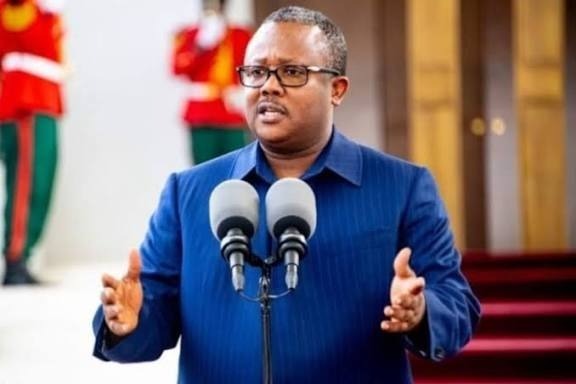
Bissau — Guinea-Bissau is sliding deeper into a bewildering political deadlock. When former president Umaro Sissoco Embaló finally broke his silence from exile and declared he would return to Bissau to run again for the highest office, the military High Command answered without delay. In an unambiguous statement, the transitional military authorities slammed the door shut on his homecoming, condemning what they called a “destabilisation” attempt and dismissing the deposed leader’s electoral ambitions out of hand.
Between political provocations from abroad and the flat refusal of a barricaded military regime, the Bissau-Guinean capital is once again holding its breath.
The audacious gamble of a president in exile
It was a declaration that landed like a shockwave on West Africa’s political chessboard. In exile since his abrupt fall, Umaro Sissoco Embaló has publicly stated his undisputed wish to return home and stand as a candidate in the presidential election envisaged for the end of the year.
Far from accepting the end of his political career, the former strongman of Bissau casts himself as the legitimate alternative. Leaning on the transition texts that formally bar the current junta figures from contesting a vote, Embaló sees an open political highway. To turn that audacious bet into reality, a broad coalition named the “Republican Platform” — bringing together around a dozen organisations and political parties — was even assembled behind the scenes to carry his candidacy.
For the ousted head of state, this is not simply about taking part in an election, but about securing institutional revenge and proving that his popular base remains intact despite last November’s humiliation.
Anatomy of a coup that never felt finished
To grasp the bitterness of this standoff, one must go back to 26 November 2025. That day, Guinea-Bissau — a country historically prone to military upheavals and seizures of power — tipped once more into chaos.
The context was already extremely tense: three days earlier, on 23 November, Bissau-Guineans had gone to the polls for a decisive presidential vote. As counting was nearing its end and both Embaló’s camp and that of his main rival claimed victory, heavy-weapons fire rang out across the capital.
Within hours, armed elements of the Revolutionary Armed Forces of the People surrounded the presidential palace and captured Umaro Sissoco Embaló. The putschists, organised as the “Military High Command for the Restoration of National Security”, immediately suspended the electoral process, claiming they wanted to thwart a plan to “manipulate the results”.
Yet from the first hours of the coup, sharp controversies emerged. International observers, many diplomats and key opposition figures did not hesitate to label the takeover an “arrangement” or a “political comedy”. Embaló’s detractors accused him of having orchestrated a remote-controlled self-coup to neutralise the predicted victory of his opponents and halt the verdict of the ballot box. Flown out the next day to Dakar aboard a special flight, Embaló left behind a country plunged into legal and institutional uncertainty.
The junta’s categorical veto
It is precisely that heavy baggage which the military junta now holds against the former president’s desire to return. In their scathing reply to Sissoco Embaló’s statements, the military authorities made clear that the ex-president would not be allowed to set foot on national soil, naming him the chief culprit behind the crisis that led to November’s seizure of power.
“No actor who has compromised the social peace and stability of the nation will be permitted to instrumentalise the transition process for the purposes of electoral agitation,” the military power insisted.
For the senior officers now at the helm in Bissau, allowing Embaló back would mean reintroducing a major risk factor into an already drained political landscape. The junta intends to keep strict control over the electoral calendar and over who is allowed to compete.
A Bissau-Guinean democracy under extreme pressure
By blocking Umaro Sissoco Embaló’s path, the military power risks inflaming an already poisonous political climate. A large part of the traditional opposition finds itself marginalised, hit by exile or legal proceedings, while Embaló’s supporters denounce an authoritarian drift and arbitrary exclusion.
As Guinea-Bissau struggles to map out a roadmap back to constitutional order, the veto thrown in the former president’s face raises the crucial question of how inclusive the next elections can really be. Between a deposed president determined to force his way back from abroad and a military junta resolved to keep the door locked, the democratic trajectory of Guinea-Bissau remains more of a question mark than ever.