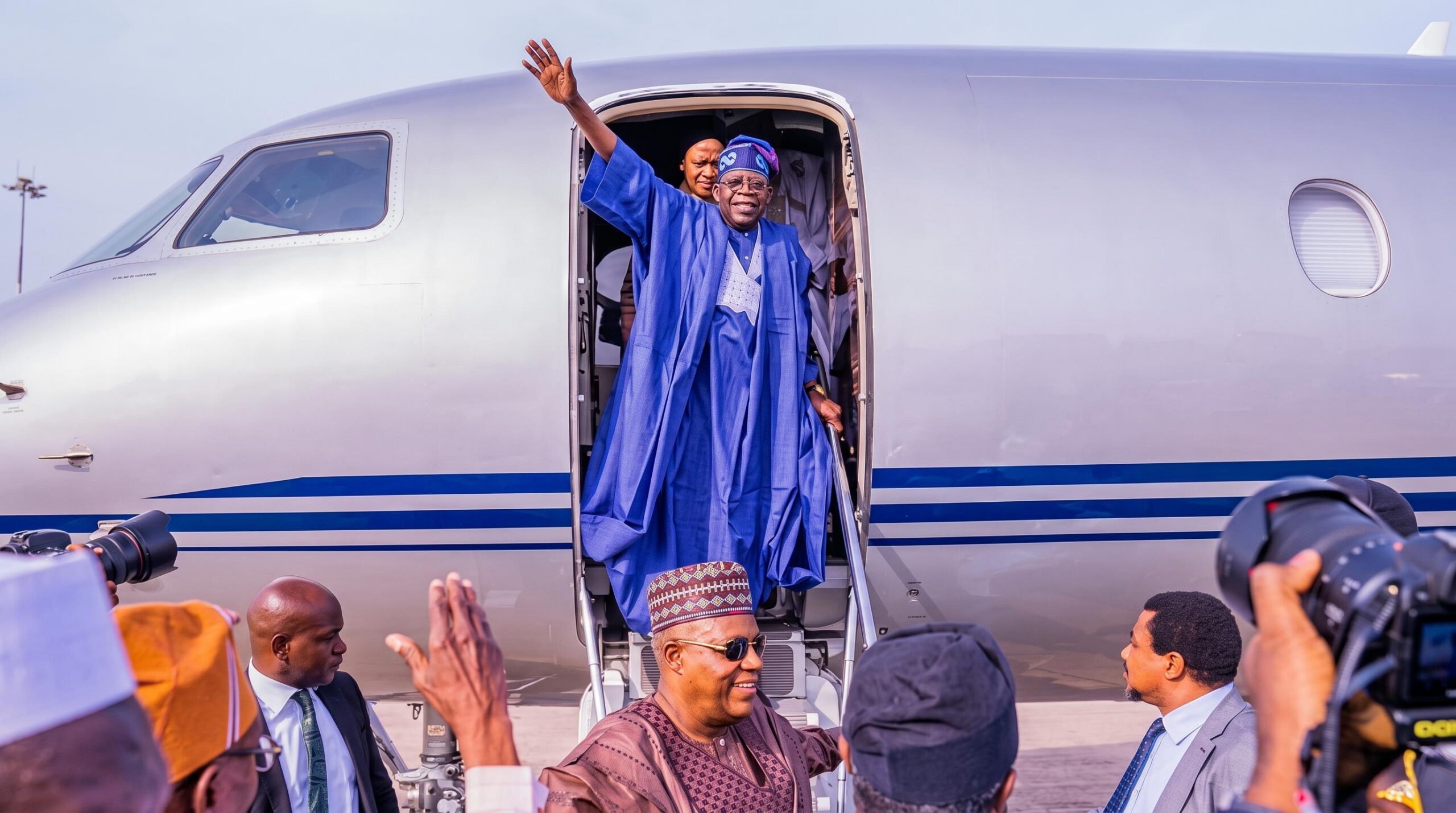
Lagos, 29 september 2026 — The timing tells its own story. When Bola Ahmed Tinubu’s aircraft touched down at Lagos from Paris around 18:22 on Tuesday 29 september, it closed a European absence of almost one month — and opened a carefully choreographed political sequence just 48 hours before Nigeria marks 66 years of independence.
What the presidency first framed as a three-week annual leave, begun with a 30 august departure from Abuja, quietly stretched into a longer stay. The extension, formally confirmed on 21 september, is where the real analysis begins: a sitting president spending four weeks abroad while his government pushed a reform agenda at home, and while the United Nations General Assembly convened in New York without him.
Why the trip lasted longer than announced
Officially, Tinubu kept working from abroad. The presidency described the period as a “working vacation”, insisting the president stayed in constant contact with Nigerian authorities and continued to track state business. The itinerary itself suggests a hybrid between rest and economic diplomacy.
London came first, the opening leg of the European stay. About a week later, the president moved to Paris, where the schedule filled with engagements presented as official business. A private dinner with French president Emmanuel Macron, exchanges with businessman Vincent Bolloré, and a meeting with Femi Otedola of First HoldCo all featured in the programme.
The most tangible outcome was a memorandum of understanding between the Ogun state government and DP World for a deep-sea port and a maritime economic zone, a project announced with a potential investment of 7 billion dollars. Analysts read that signature as the underlying logic of the extended stay: converting a presidential holiday into a platform for investment signalling.
The strategic choice of Lagos over Abuja
Rather than fly straight to the seat of power in Abuja, Tinubu landed in Lagos, the country’s economic engine and former political capital. The presidency links the choice to a tribute: honouring Moshood Kashimawo Olawale Abiola, a towering figure in Nigerian political history.
On 1 october, the president is due at the Wole Soyinka National Theatre in Iganmu for the premiere of a film about MKO Abiola, whose victory in the june 1993 presidential election was annulled, plunging the country into a deep political crisis. Landing in Lagos, in this reading, is not logistics but symbolism — a president anchoring himself in the city where that democratic wound was felt most sharply.
The wider programme blends commemoration with governance. A public debate on the anniversary is set for 30 september, while the presidential address to the nation is scheduled for 1 october. The government has themed this year’s edition: “From Reforms to Stability: Consolidating Nigeria’s Renewed Hope for Shared Prosperity”.
Questions that surfaced during the absence
Four weeks away from Abuja inevitably bred speculation. The length of the stay, and especially its extension, prompted scrutiny in parts of the Nigerian public sphere. The overlap with the UN General Assembly — where vice-president Kashim Shettima represented Nigeria instead — added to the questions.
Tinubu addressed the most sensitive of them himself on arrival. Asked by journalists about his health, he replied that he was “healthy, sound, and ready to go”, pushing back against rumours that had circulated throughout his European stay. It was a direct, unscripted answer — and a signal that the presidency understood the cost of prolonged silence.
What the homecoming sets up for 2027
The deeper context is electoral. Nigeria’s presidential and national elections are scheduled for january 2027, and the presidency indicated from the outset that political activity would resume once the leave ended.
In Lagos, the president is expected to weave independence ceremonies together with political meetings and consultations with party leaders and close allies in the coming days, before eventually returning to Abuja. Each encounter will be read through the lens of 2027 positioning.
For Nigeria, the moment is symbolic as much as political. The country approaches 66 years of independence with a government promoting its economic reforms and trying to shift its official narrative from stabilisation towards growth and shared prosperity. Tinubu’s return — institutional, economic and political at once — places him back at the centre of that story, with the coming days in Lagos likely to set the tone for the months ahead.