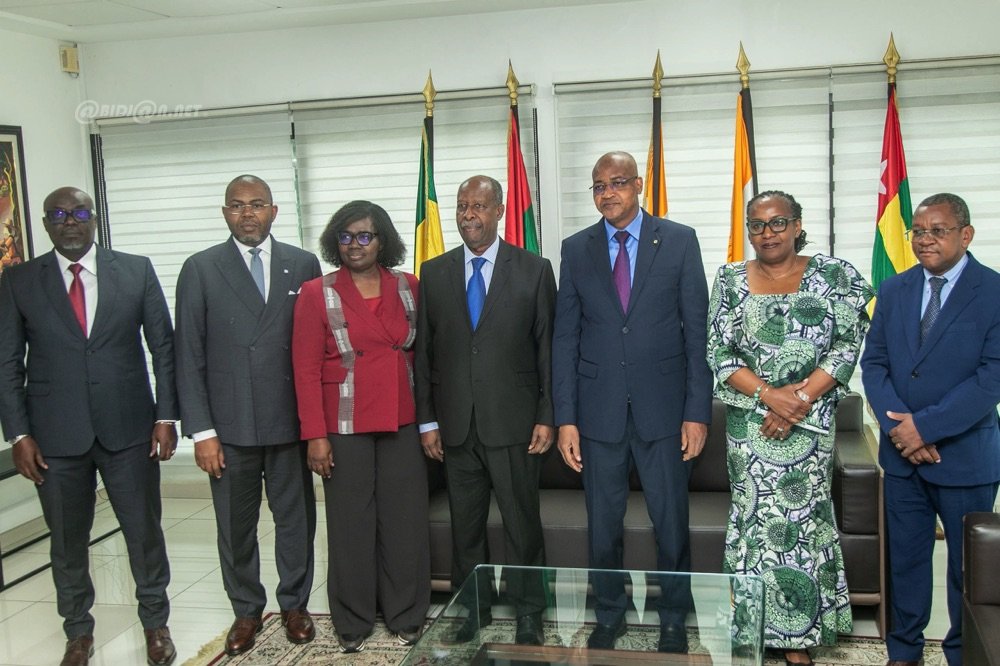
The signing ceremony in Abidjan-Cocody on Tuesday, September 29, 2026, carried more historical weight than the average cooperation agreement. When the Entente Council and the United Nations Office for West Africa and the Sahel (UNOWAS) put pen to paper on a Memorandum of Understanding, they were not merely formalizing a bureaucratic partnership. They were acknowledging a deeper reality: that in a region where security, political, humanitarian, and institutional pressures continue to mount, the mechanisms of the past may hold the keys to the future.
The choice of the Entente Council as UNOWAS’s partner is not accidental. Founded in 1959, the organization predates both the Organization of African Unity and the Economic Community of West African States (ECOWAS). This longevity gives it a unique vantage point — one that Leonardo Simão, the Special Representative of the UN Secretary-General for West Africa and the Sahel, was keen to highlight during the ceremony.
“There are always threats to peace,” Simão remarked. “We cannot treat peace as something definitive. We must always work to maintain peace where it already exists, and also to recover peace where it does not.”
His words underscore the underlying logic of the memorandum: that preventive diplomacy and sustained engagement are not luxuries but necessities in a region where stability remains fragile.
The three pillars of the partnership
At the heart of the agreement lies a tripartite framework designed to address the region’s most pressing challenges through structured collaboration.
Preventive diplomacy, mediation, and political dialogue form the first pillar. The two institutions have committed to conducting strategic consultations, launching good offices initiatives, and facilitating dialogue between states and regional configurations. This is not merely about reacting to crises but about anticipating them — a proactive stance that reflects a hard-earned understanding of how conflicts evolve.
The second pillar focuses on peace and resilience in border areas. Recognizing that frontier zones are often the most vulnerable to conflict spillover, the partnership aims to prevent conflicts, strengthen social cohesion, and ensure that youth and women are not just beneficiaries but active participants in peace initiatives. This inclusive approach signals a departure from traditional top-down security models.
Institutional strengthening and strategic analysis constitute the third pillar. Through information sharing, joint studies, advisory assistance, and capacity building for the Entente Council, the two organizations aim to create a more robust framework for long-term cooperation.
Beyond the text: the council as a diplomatic platform
What makes this memorandum particularly significant is the role it confers on the Entente Council as a platform for dialogue, consultation, and diplomatic facilitation. This is not just recognition of the organization’s historical standing but an operational mandate. When circumstances demand it, the Council could play a role in bringing states closer together — and in bridging different regional configurations that might otherwise operate in silos.
Idi Ali, Deputy Executive Secretary in charge of the interim executive secretariat of the Entente Council, framed the agreement as validation of the organization’s capacity to contribute meaningfully in the current security landscape.
“The Entente Council today constitutes a privileged framework for consolidating peace in the sub-region,” he stated, noting that the organization brings together both Sahelian and coastal countries — a rare combination in a region where geographic divides often mirror political ones.
How the partnership will work in practice
The memorandum is not a static document. To ensure implementation, the two institutions will develop annual joint work plans, designate focal points, and organize regular follow-up consultations. Joint evaluation missions, dialogue missions, and diplomatic facilitation missions may also be conducted as circumstances require.
The agreement is concluded for an initial duration of three years — a timeframe that allows for both short-term responsiveness and medium-term planning. It is a period long enough to build trust and institutional memory but short enough to demand accountability.
The bigger picture: why this moment matters
The context in which this memorandum was signed cannot be ignored. Across West Africa and the Sahel, security challenges persist — from armed insurgencies to political transitions that have tested the resilience of regional bodies. Humanitarian pressures continue to displace populations, and institutional fragility remains a concern in several states.
Against this backdrop, the partnership between UNOWAS and the Entente Council represents more than a bureaucratic arrangement. It reflects a recognition that no single institution — however well-resourced or well-intentioned — can address the region’s challenges alone. The memorandum explicitly aims to preserve and strengthen spaces for consultation between states and regional organizations, a goal that speaks to the fragmentation that has at times hampered collective action.
Simão’s emphasis on the Entente Council’s experience as a foundation for new peace initiatives suggests a deliberate strategy: rather than building new structures from scratch, leverage existing ones that have weathered decades of regional change. This approach is both pragmatic and cost-effective, avoiding the duplication that often plagues international cooperation.
For its part, the Entente Council gains a strengthened partnership with the United Nations system — a relationship that could enhance its visibility and operational reach. Idi Ali welcomed the memorandum as a means of consolidating relations between the two institutions and reinforcing their contribution to peace in the sub-region.
What to watch for next
The success of this partnership will depend on execution. The annual work plans, focal points, and joint missions will be the mechanisms through which commitments translate into action. Observers will be watching for tangible outcomes: whether consultations lead to de-escalation, whether border-area initiatives improve community resilience, and whether the Council’s facilitation role materializes in moments of tension.
What is clear is that the memorandum positions the Entente Council not as a relic of a pre-independence era but as a living instrument of regional diplomacy — one whose historical depth may prove to be its greatest asset in navigating the uncertain terrain ahead.
The ceremony in Abidjan-Cocody was thus more than a signing. It was a statement that in West Africa and the Sahel, peace is not a destination but a continuous process — one that requires both new energy and old wisdom.