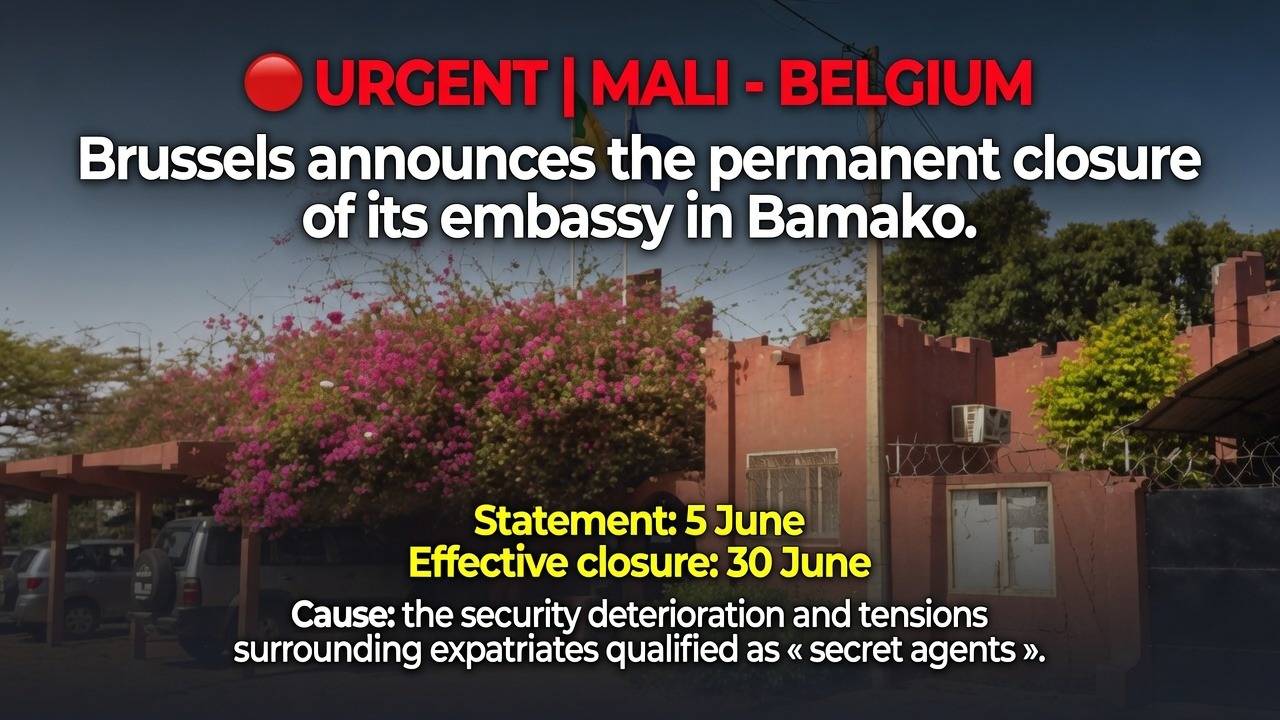
After decades of bilateral cooperation, Brussels officially announced the definitive closure of its diplomatic mission in Bamako this Friday, June 5. This decision, set to take effect on June 30, marks a historic turning point. It stems from the continuous deterioration of the security situation across the Sahel region and follows a series of arrests targeting Western expatriates, frequently labeled as secret agents by the Malian transitional authorities. This move represents another significant blow to Mali’s international standing.
An end to a long-standing relationship
The news sent shockwaves through diplomatic circles in the Malian capital. Through its official communiqué on June 5, the Belgian Ministry of Foreign Affairs confirmed what many observers had anticipated: the permanent departure of the Belgian diplomatic corps from Malian soil. The embassy building’s keys will be formally handed over by June 30, concluding decades of cultural, humanitarian, and economic exchanges.
For Bamako, this withdrawal carries considerable weight. Belgium was among Mali’s historical European partners, notably through its funding of development projects in the Northern and Central regions. This voluntary departure aligns with the gradual disengagement of Western nations, leaving Mali increasingly reliant on its new strategic partners, foremost among them Russia.
Security challenges and partner withdrawals
At the core of Brussels’ decision lies an untenable security equation. Since the departure of French forces from Operation Barkhane and the forced withdrawal of MINUSMA (the UN mission in Mali), the security vacuum has steadily expanded. Armed terrorist groups have intensified pressure on major roadways and around key urban centers.
For Belgium, the safety of its citizens and diplomatic personnel could no longer be guaranteed beyond the June 30 deadline. Belgian authorities assess that the current political and military framework no longer permits the successful execution of development assistance missions. Without reliable security coverage and facing chronic instability, maintaining a fully operational embassy had become, according to Brussels, a disproportionate risk.
The ‘secret agent’ narrative and expatriate targeting
Beyond the jihadist threat, another critical factor accelerated the rupture formalized by the June 5 announcement: the pervasive climate of suspicion in Bamako. For several months, Malian authorities have adopted a tougher stance towards Westerners remaining in the country. Technical experts, humanitarian workers, and qualified consultants have been subjected to arbitrary arrests.
The main point of contention: The official narrative of the transition tends to equate any European expert or researcher with a potential destabilizer or a member of foreign intelligence services.
This systematic labeling of civilians, who were present to support development projects, as ‘secret agents’ has created a genuine climate of fear. The prolonged detention of several European professionals, without clear justification or adherence to standard consular procedures, ultimately convinced Belgium that its personnel were no longer safe. This atmosphere of administrative and judicial hostility rendered fieldwork virtually impossible.
Impact on the Malian population
Locally, the consequences of this closure are expected to be substantial starting in early July. The Belgian embassy managed numerous direct aid programs for populations, particularly in sectors such as access to drinking water, reproductive health, and basic education. The freezing or transfer of these funds to other countries in the sub-region will leave a significant void for vulnerable communities.
Furthermore, for Malian citizens, access to study, medical, or business visas for the Schengen Area becomes even more complicated. Applicants will now need to turn to the already saturated representations of other active European countries, or travel to neighboring nations to complete their procedures.
Towards increased diplomatic isolation
The closure of the Belgian embassy, decided on June 5 for implementation by June 30, is not an isolated event but a symptom of a deeper estrangement between Bamako and the European Union. By opting for a breakdown of trust with its traditional partners and by multiplying arrests of expatriates under pretexts of espionage, the Malian government is entrenching itself in a strategy of confrontation.
While this firm posture is applauded by a segment of the local sovereignist public opinion, it weakens Mali’s position on the international stage. By severing ties with Brussels, Mali loses a moderate interlocutor within Europe, exacerbating its isolation at a moment when economic and security challenges demand global and pragmatic cooperation.