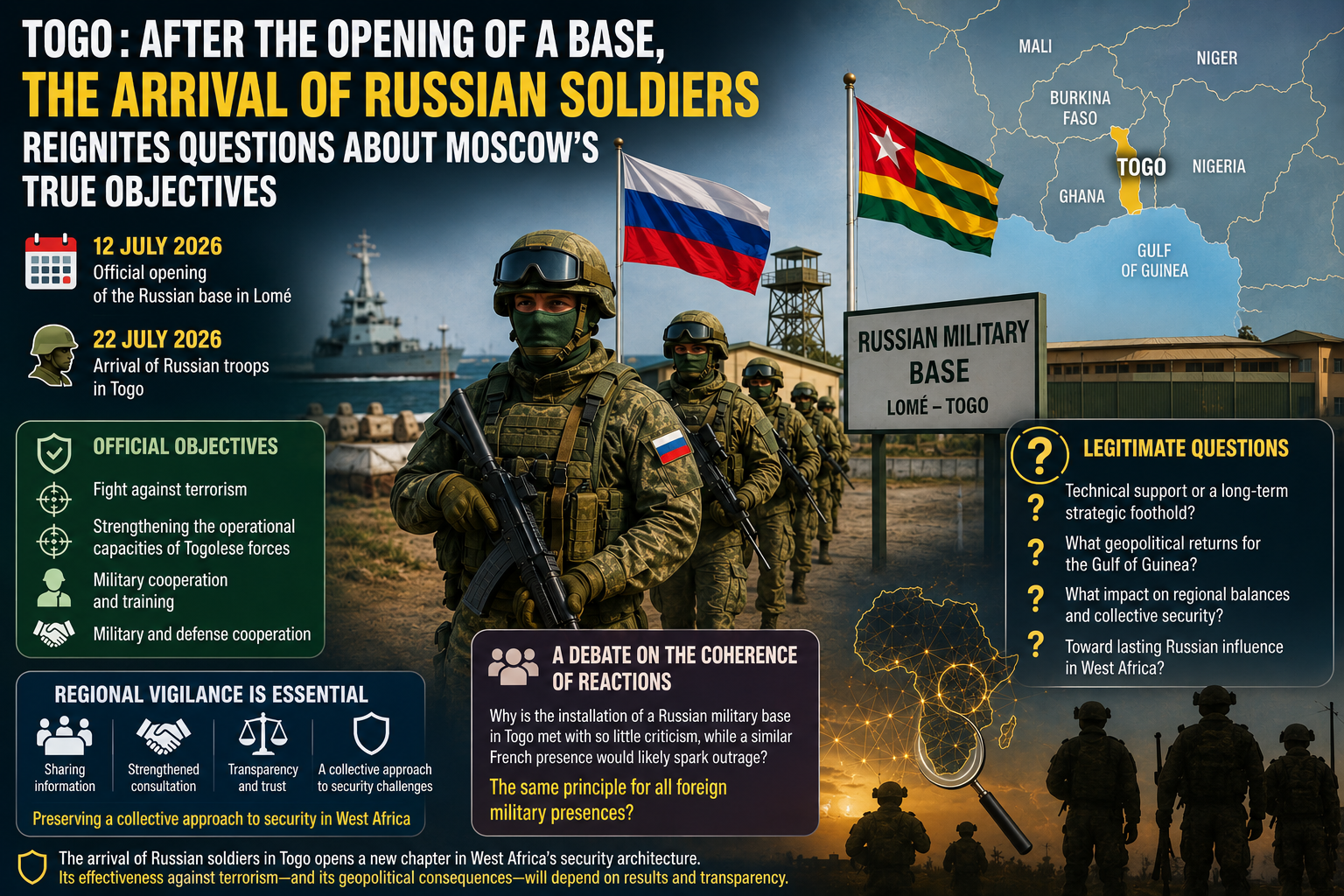
Togo has taken a decisive step in its defense partnerships by welcoming a contingent of Russian soldiers, following the recent inauguration of a military base in Lomé. The deployment, officially announced on July 22, 2026, follows the July 12 opening of the Russian-operated facility, marking a significant expansion of cooperation between Togo and Moscow in the security domain.
The stated purpose of the Russian military presence is to assist Togolese forces in combating terrorism and enhancing their operational capabilities. However, the move has sparked intense debate among regional security analysts about Moscow’s long-term intentions in the Gulf of Guinea.
Expanding Russian influence in West Africa
Russia’s growing military footprint in Africa is not confined to Togo. Over recent years, Moscow has systematically deepened defense ties with multiple African nations through a combination of training programs, arms deliveries, and, in select cases, the deployment of military personnel. The Togolese initiative aligns with this broader strategy of strengthening bilateral defense relationships across the continent.
While the Togolese government has framed the cooperation as a sovereign decision, the introduction of a foreign military presence—especially in a region facing persistent jihadist threats—raises broader questions about regional stability. Observers are now questioning whether this partnership is purely a tactical response to immediate security challenges or part of a larger geopolitical ambition to embed Russian influence in West Africa.
Mixed reactions and questions of consistency
The announcement has also reignited discussions about the varying perceptions of foreign military presence depending on the country of origin. Analysts point out that while a similar move by France would likely have triggered strong reactions in certain regional circles, the Togolese-Russian military cooperation has so far encountered relatively little criticism from the same quarters.
This discrepancy has led some observers to question the consistency of regional attitudes toward external military involvement. If sovereignty and regional stability are the primary concerns, they argue, such principles should apply equally regardless of the foreign partner. Others contend that the lack of criticism toward Russian military engagement may reflect shifting geopolitical alliances rather than a principled stance on foreign troop presence.
Regional implications and the need for transparency
Neighboring countries are closely monitoring developments, recognizing both the sovereign right of Togo to choose its defense partners and the potential regional implications of this military cooperation. Analysts emphasize the importance of transparency to prevent misunderstandings and ensure that the partnership does not inadvertently destabilize collective security mechanisms in West Africa.
In an era marked by transnational terrorist threats and intensifying competition among global powers, the emergence of new defense partnerships demands careful scrutiny. The success of this collaboration—measured not only by its immediate security impact but also by its long-term geopolitical consequences—will depend on clear communication, mutual accountability, and a shared commitment to regional stability.
The deployment of Russian troops in Togo represents a turning point in West Africa’s security landscape. Its ultimate significance will be determined not by rhetoric, but by tangible outcomes: the effectiveness of counterterrorism efforts, the strength of regional coordination, and the preservation of diplomatic equilibrium in the Gulf of Guinea.