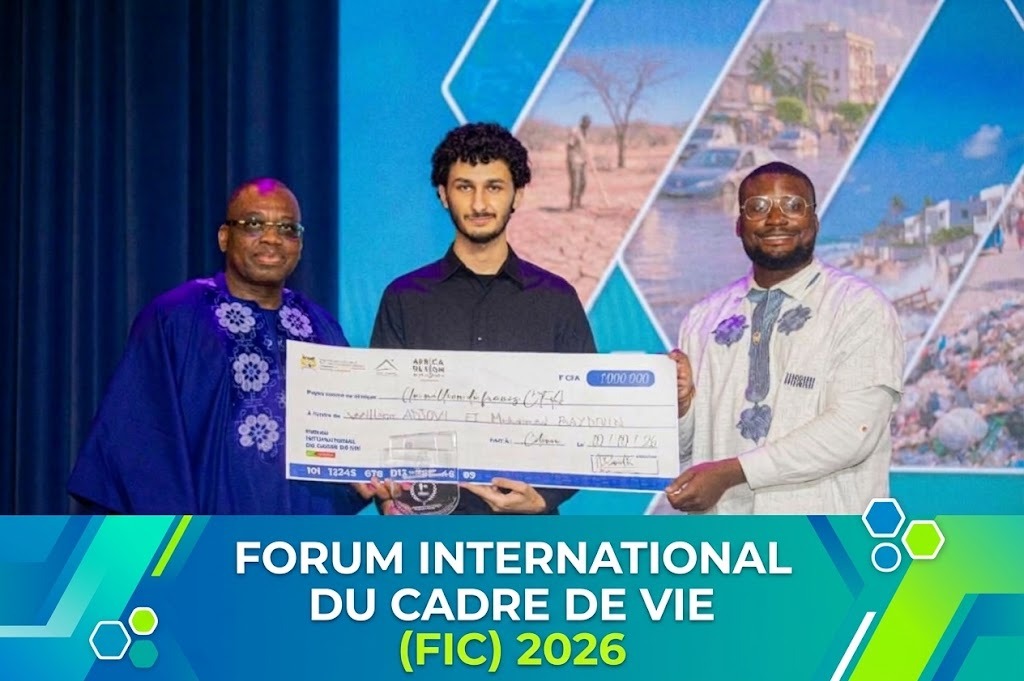
Decent housing, smoother commutes, better waste management, flood prevention and job creation: the shift toward sustainable cities is opening real pathways to improve living conditions. In Cotonou, the fourth edition of the International Forum on Living Environment (FIC), which concluded on 10 October 2026, spotlighted the challenges of urban development that balances environmental protection, economic progress and the essential needs of citizens.
In Benin, as in many African countries, the future of cities also hinges on their ability to address the everyday concerns of residents. Finding decent housing, moving around more easily, living in a healthier environment or being less exposed to flooding are all challenges that place territorial planning at the heart of development policies.
It was against this backdrop that the fourth edition of the International Forum on Living Environment was held in Cotonou from 8 to 10 October 2026. Organised around the theme “Economy of African territories: accelerating the transition to carbon sobriety”, the gathering put into perspective the possibilities offered by a model of urban development that is more respectful of the environment and better suited to African realities.
Beyond discussions on reducing carbon emissions, the challenge is to make the ecological transition a lever for concrete improvements in daily life. A sustainable city is not defined solely by its infrastructure or environmental performance, but also by its ability to offer residents a healthier, more accessible and safer living environment.
Well-planned cities that make everyday life easier
The quality of the living environment depends first and foremost on how urban spaces are organised. When housing, workplaces, schools and essential services are poorly distributed, travel becomes longer and more expensive. Conversely, coherent urban planning can help bring services closer to people and facilitate their daily activities.
Improving mobility is therefore a major issue for Beninese cities. User-friendly facilities, better organisation of travel and consideration of the needs of pedestrians and public transport can help make urban spaces more functional.
The project dedicated to the Fifa bus stop, led by Willson Edwin Mardochet ADJOVI and Mohamed BAYDOUN, was among the initiatives recognised during the hackathon organised on the sidelines of FIC 2026. This proposal illustrates young people’s interest in the concrete challenges of mobility and urban planning.
The challenge now is to foster the emergence of solutions capable of meeting users’ needs while taking into account technical, financial and environmental constraints. Better-designed mobility can, in time, help reduce certain daily difficulties and improve access to essential services.
Sustainable housing: an economic and social priority
Housing represents another pillar of improving the living environment. For households, the quality of a home is measured as much by its solidity as by its comfort, its adaptation to climate conditions and the costs it entails over time.
From this perspective, promoting local materials is a path worth exploring. Their use, when based on quality criteria and appropriate standards, can support national production chains and encourage the development of local skills in the construction sector.
This orientation can also open up economic prospects, particularly for artisans, building companies and material producers. However, its benefits for households will depend on several factors, including production costs, resource availability, the quality of the works and their durability over time.
At the closing of the forum, the Director General of Construction and Housing, Ismaïl YASSO, stressed the need to standardise and certify local materials. This approach is essential to strengthen user confidence and promote the integration of these materials into construction practices.
The goal is to promote housing suited to the country’s realities, without separating sustainability requirements from concerns about cost and affordability.
Preventing flooding and improving neighbourhood sanitation
The effects of inadequate planning also manifest through difficulties in draining rainwater, waste accumulation and sanitation problems. For residents of exposed neighbourhoods, these situations can disrupt travel, weaken homes and degrade living conditions.
Integrated urban planning, taking into account land tenure, infrastructure, flood risks and ecosystem preservation, therefore appears indispensable. It makes it possible to better anticipate constraints and coordinate interventions rather than addressing problems in isolation.
Wastewater management is, in this respect, a major issue. The project presented by Nelly Mahouna GBAGUIDI and Meryl AGNIKPE, who were rewarded during the FIC hackathon, reflects the interest in this problem.
Adapted solutions could help improve neighbourhood sanitation and limit polluting discharges into the environment. Their effectiveness will, however, depend on their implementation, the resources mobilised and the organisation of the services responsible for their operation and maintenance.
Waste management and the preservation of natural spaces serve the same ambition: to build cities where environmental concerns translate into visible benefits for populations.
Carbon sobriety: an opportunity for the local economy
The transition to carbon-sober territories is not limited to reducing the environmental impact of human activities. It can also foster the emergence of new economic activities in sustainable construction, recycling, sanitation and the valorisation of local resources.
These sectors are likely to generate jobs and strengthen national skills. The participation of young people in the FIC hackathon illustrates, in this regard, the potential for innovation that new generations represent in the face of urban challenges.
Yet ideas must be able to go beyond the framework of competitions and professional gatherings. Financing, technical support and project maturation are essential steps to transform proposals into genuinely useful services or infrastructure.
This is precisely one of the points raised by Ismaïl YASSO, who insisted on the need to have sufficiently prepared projects to facilitate access to financing. Carbon sobriety can thus become a lever for economic development, provided its benefits are assessed on the basis of concrete achievements.
From forum to achievements: the post-FIC challenge
The tree planting organised at the Fidjrossè public primary school, ahead of the forum’s closing, reminded us that transforming the living environment can also begin at the scale of neighbourhoods and schools. Such initiatives help raise citizens’ awareness of protecting natural heritage, even if their effects depend on the monitoring and maintenance of the plants.
At the end of this fourth edition, the Minister of Living Environment and Transport, Georges ALE, called on participants to translate the recommendations from the proceedings into precise actions, with clearly defined responsibilities and resources.
This call highlights the main challenge of FIC 2026: ensuring continuity between the discussions initiated and the transformations expected on the ground. For populations, results will have to be measured through tangible improvements, whether in access to housing, mobility, sanitation or the reduction of environmental risks.
In Benin, the ambition of sustainable cities will only fully make sense if it translates into a perceptible improvement in living conditions. The success of this approach will depend on the ability of public authorities, local governments, economic actors and citizens to turn the forum’s orientations into feasible, accessible and sustainable projects. Because, beyond carbon sobriety, the real challenge remains to build more pleasant cities to live in, where development directly benefits populations.