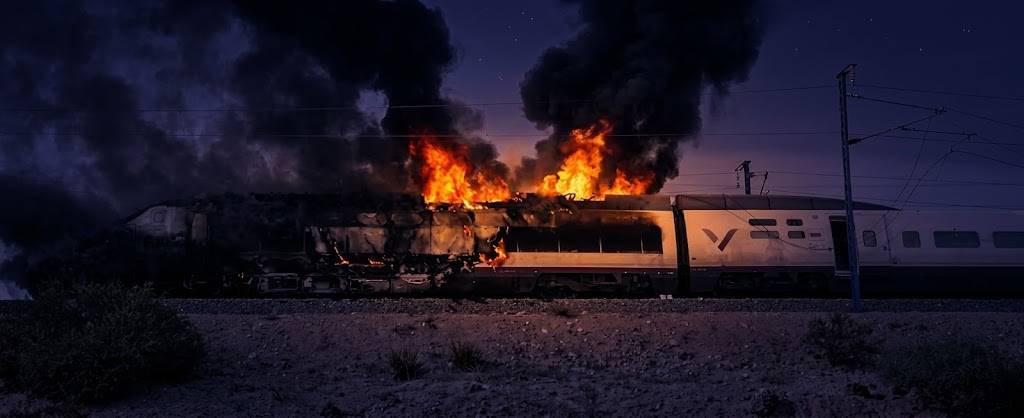
When an AVE high-speed train left Madrid’s Puerta de Atocha station at 2:27 pm on Monday, October 12, nobody on board could have predicted that within two hours they would be standing trackside near Ricla, in the province of Zaragoza, watching their carriage burn. Yet that is exactly what unfolded — and the question now hanging over Spain’s flagship rail corridor is a simple one: how vulnerable is the Madrid-Barcelona line to a single, localized fire?
A mid-afternoon blaze that stopped Spain’s busiest high-speed route
The Renfe service was bound for Figueres in Catalonia, running via Barcelona, when flames were detected at around 4:05 pm in the rear driver’s cab of the train. All 283 passengers were evacuated. In its initial statement, the rail operator confirmed that no injuries had been reported.
Emergency protocols kicked in the moment the fire was spotted, with crew members leading travelers off the train while firefighting teams moved in to bring the flames under control. Smoke inside a confined carriage, combined with the risk of the fire spreading, made getting everyone out quickly the overriding priority. On that measure, the response worked.
What remained unclear in the hours that followed was what actually sparked the blaze. Renfe’s early communications did not identify a cause, and an investigation was opened to establish the origin of the fire and to pinpoint any technical failure that might lie behind it.
Why the disruption spread far beyond the burning train
The fire itself was contained to one train. Its consequences were not. As a precaution and to give emergency crews room to work, high-speed traffic between Madrid and Barcelona was halted for several hours.
The knock-on effects were immediate and widespread on one of the country’s most heavily used rail links. Trains were held at stations along the route, afternoon departures were cancelled, and thousands of travelers found themselves facing delays, rerouted journeys or simply no clear answer about when — or whether — they would reach their destination that day.
Timing made matters worse. October 12 is Spain’s national day, and this year it fell at the end of a long weekend, a period when transport demand traditionally peaks. The line closure therefore hit precisely when the largest number of people were trying to get home or complete their holiday travel.
Renfe’s response: refunds, rebookings and safety checks
Faced with the scale of the disruption, Renfe announced measures aimed at softening the blow for affected passengers. The company offered free ticket changes or full refunds for journeys impacted by the incident.
At the same time, technical teams and the relevant services had to carry out post-fire operations, including safety inspections of the rail infrastructure itself. Resuming service depended on being able to guarantee safe operating conditions on the affected stretch of track.
In a statement issued the day of the fire, Renfe said it could not immediately estimate how long the disruption would last. The company later confirmed a gradual return to normal service once firefighters had finished their work and the first inspections of the line were complete.
The unanswered questions the investigation must address
Even with all 283 passengers safely evacuated and no injuries reported, the incident raises hard questions — about the technical circumstances that allowed a fire to start on a moving high-speed train, and about what happens when one train is immobilized on a route this busy.
At this stage, no definitive cause could be put forward. Investigators will need to establish exactly how the fire began in the rear cab and determine what corrective measures, if any, should follow.
The episode is also a reminder of how much high-speed rail depends on emergency protocols — and on how quickly crew, operator and rescue services can coordinate when something goes wrong at speed.
The human outcome was reassuring: 283 travelers brought to safety, no one hurt. But the fallout on the network told its own story. A single localized incident, in a matter of minutes, can throw a major rail corridor into disarray and upend the travel plans of thousands.