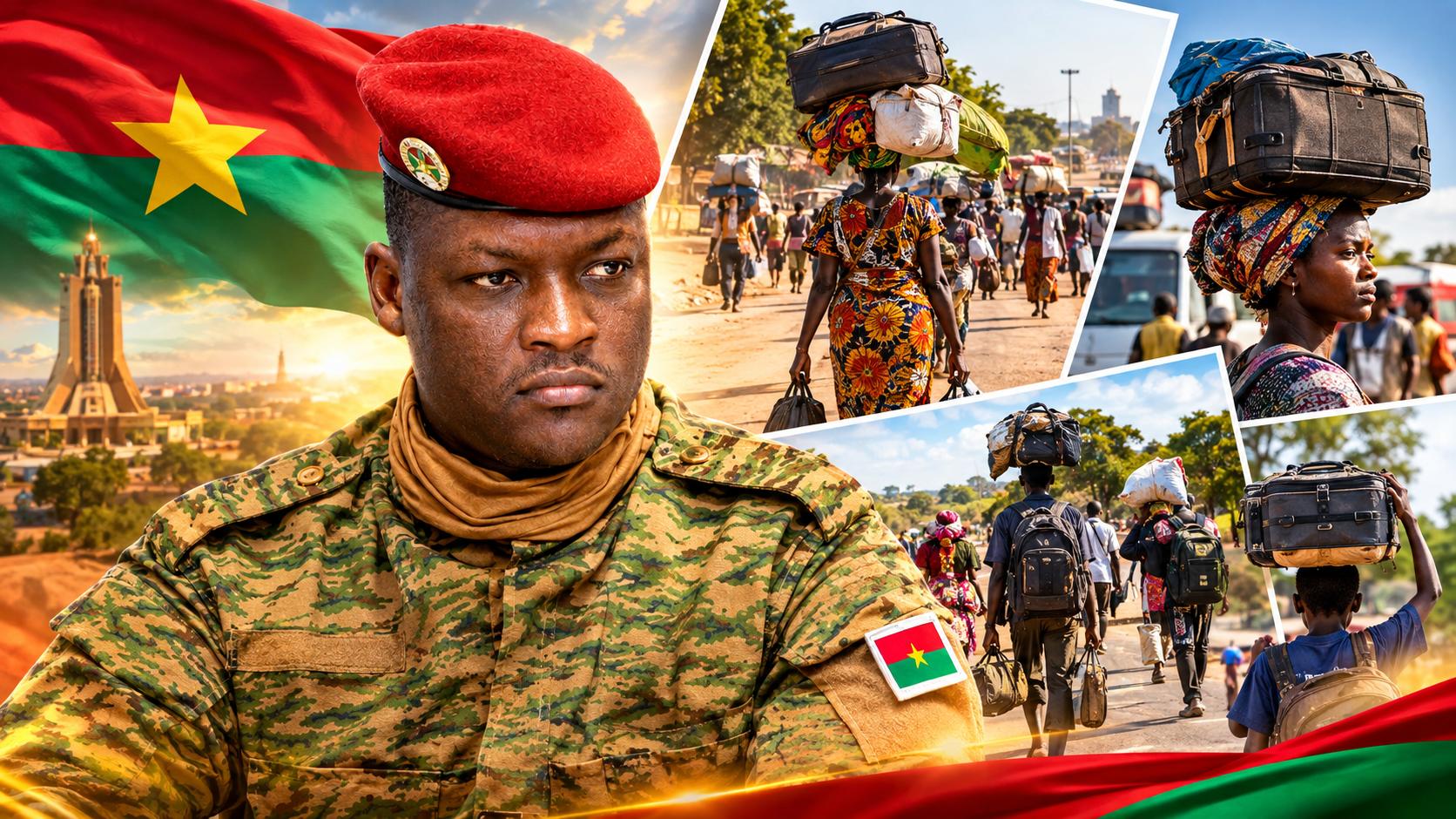
Ouagadougou — On 30 September 2022, Captain Ibrahim Traoré seized power in Burkina Faso, toppling Lieutenant-Colonel Paul-Henri Sandaogo Damiba. Four years on, the young junta leader claims to have transformed the country: recapturing territory, strengthening the army, asserting national sovereignty and breaking with several Western partners. But behind that official narrative, the record remains fiercely contested — especially on the security of ordinary people, the displacement of civilians and public freedoms. Reactions are now pouring in, and the debate over where Burkina Faso goes next is more open than ever.
The war against armed groups: a priority that still consumes the state
When Traoré took power, he made the fight against jihadist groups his absolute priority. His government reinforced the armed forces and expanded the Volunteers for the Defence of the Homeland (VDP), civilian auxiliaries called on to support the military.
The authorities say they have retaken several zones that were previously controlled or threatened by armed groups. Traoré also highlights increased military capacity and the mobilisation of the population as pillars of his security strategy.
Yet four years after he came to power, the violence has not disappeared. Armed groups continue to mount attacks on security forces and civilians. ACLED notes that jihadist groups retain a significant capacity to act across Burkina Faso and that attacks on civilians remain a major feature of the conflict.
The result is a paradox: the state claims to have strengthened its territorial control, but insecurity remains a daily reality in several regions.
More than two million people displaced — a crisis that keeps growing
One of the heaviest indicators of the conflict remains the displacement of populations. According to UNHCR data, more than two million people were internally displaced inside Burkina Faso by the end of 2025, in addition to refugees and asylum seekers. UNHCR’s October-December 2025 figures recorded precisely more than 2.06 million internally displaced people.
These displacements are not solely the result of jihadist attacks. Human Rights Watch has also documented violence committed by government forces and the VDP against civilians accused, among other things, of supporting armed groups. The organisation says it documented attacks that killed at least 1,800 civilians between 2023 and 2025, while stressing that abuses are committed by multiple parties to the conflict.
The plight of the displaced captures a central difficulty in the security record: retaking territory does not necessarily mean guaranteeing lasting safety for the people who live there.
Journalists under pressure as the media space shrinks
The other major rupture of the Traoré years concerns press freedom. The authorities justify certain measures by the context of war and the need to preserve the morale of the troops and the population. Press freedom organisations, however, describe a considerable narrowing of the media space.
Reporters Without Borders (RSF) says several journalists have been arrested, abducted or requisitioned to join the armed forces. In 2025, the organisation recorded several journalists subjected to forced enlistment and eight journalists questioned by the security services in the month of October alone.
The case of Atiana Serge Oulon, publication director of the newspaper L’Événement, has become emblematic. Abducted in June 2024, he was presented by the authorities as having been requisitioned to serve in the army. An investigation published in 2026 by RSF, however, claims he was secretly detained in Ouagadougou rather than sent to the front as the official version indicated.
Forced enlistment: a new tool of repression?
The issue of forced enlistment goes beyond journalists alone. Human Rights Watch reports that dozens of critics of the government were allegedly requisitioned and sent to combat zones. The organisation estimates that this practice has affected journalists, civil society activists, opponents and magistrates.
The phenomenon is particularly sensitive because it blurs the line between national mobilisation and political punishment. In a wartime context, the state has mobilisation mechanisms for national defence. But human rights organisations stress that such procedures must respect legal safeguards and allow those concerned to challenge their assignment.
A government that claims sovereignty as its banner
Traoré, for his part, defends a vision built on sovereignty and a break with old dependencies. Burkina Faso has distanced itself from France, strengthened ties with Russia and moved closer to Mali and Niger within the Alliance of Sahel States. The government also highlights policies for the local processing of resources, particularly in the mining sector.
But this assertion of sovereignty has come with a shrinking political and civic space. Journalists, activists, opponents and human rights defenders have been arrested, detained or forced into exile, according to several organisations.
Four years on, a verdict still being written
Four years after the September 2022 coup, Traoré’s record cannot be reduced to a single reading. His government can point to the militarisation of the fight against armed groups, the mobilisation of the VDP, the pursuit of greater strategic autonomy and some economic advances.
But the displacement figures, the persistence of attacks and the accusations of abuses against civilians show that the security crisis remains deep. At the same time, the arrests of journalists, disappearances and forced enlistments documented by international organisations raise the question of the price paid in the name of war.
In Burkina Faso, after four years of military rule, the challenge is therefore twofold: recapturing territory, but also ensuring that the reconquest does not come at the expense of rights and the protection of the population. What happens next will depend on whether the government can deliver security without sacrificing the freedoms it claims to defend.