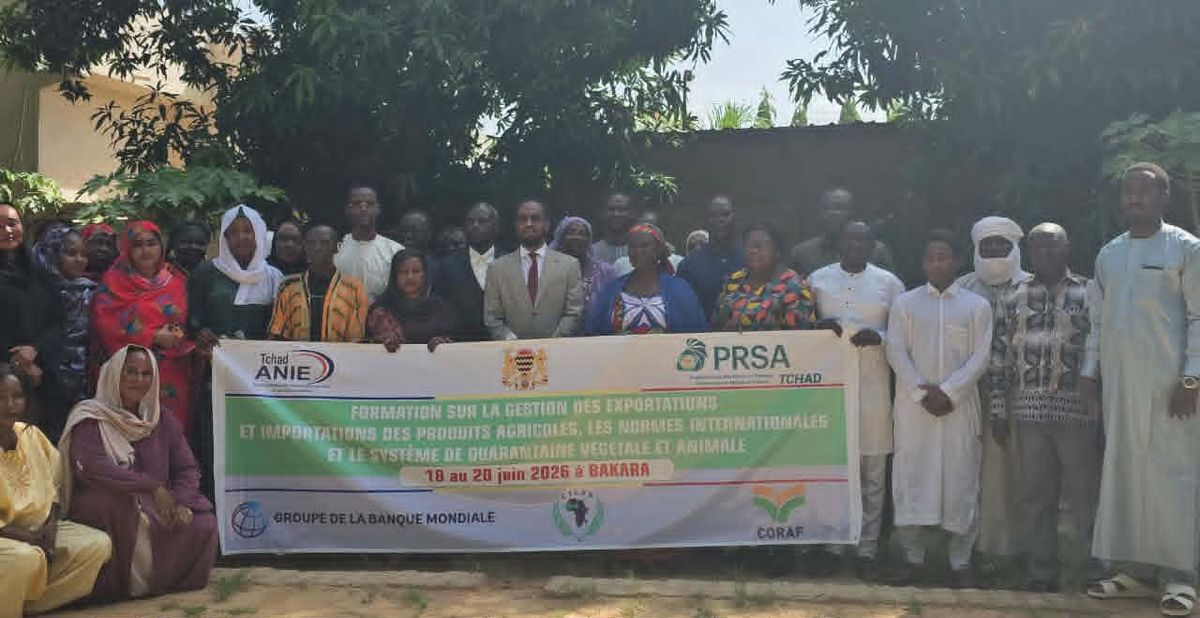
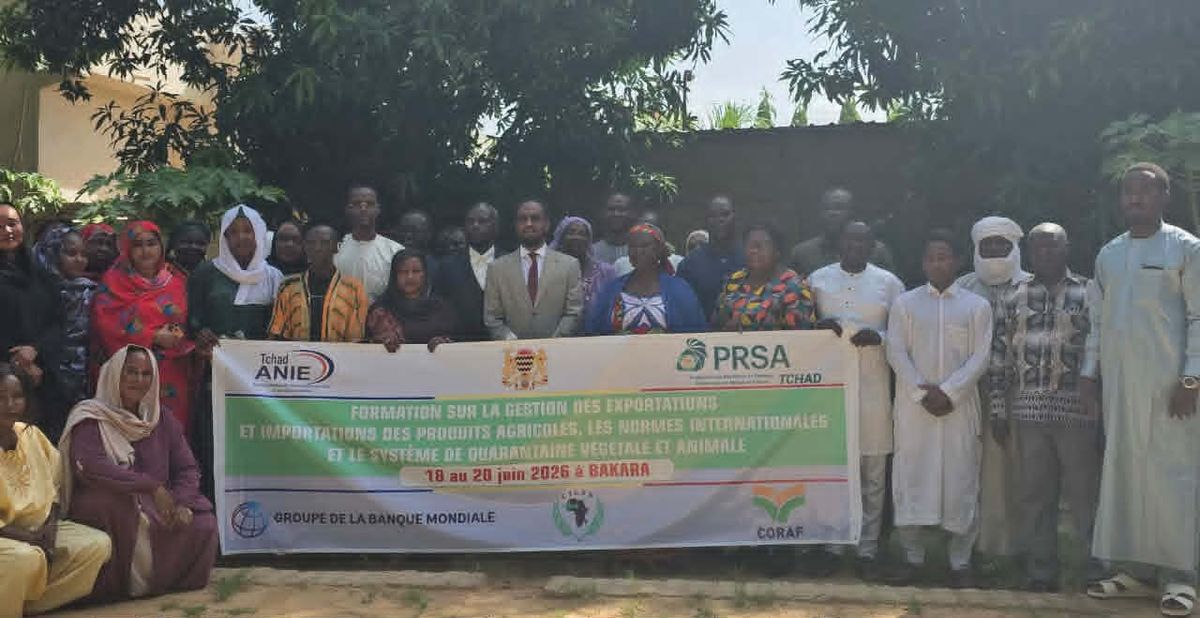
The World Bank and the National Agency for Investments and Exports (ANIE) jointly organized a capacity building workshop in Bakara on June 18, 2026, under the Agricultural Sector Resilience Program (PRSA). The training focused on managing agricultural product exports and imports, international standards, and plant and animal quarantine systems.
During his speech, the coordinator of the Agricultural Trade and Market Dashboard-PRSA-TD, Gotoraye Arnaud, emphasized that access to foreign markets remains a major challenge for Chadian producers. They face numerous constraints, including the complexity of export procedures, compliance with quality and safety standards, and the implementation of sanitary and phytosanitary measures.
The goal of this training is to strengthen participants’ operational skills in international certifications, export logistics chains, and customs risk prevention.
For his part, the Deputy Director General of ANIE, Dadi Adoum Arsin, recalled that this initiative is fully in line with the vision of the government of the Republic of Chad, which places economic diversification, local processing of national production, private sector development, and export promotion at the heart of its priorities. It is also part of the momentum of the National Development Plan “Chad Connexion 2030”, which aims to make the private sector a driver of growth, job creation, and regional economic integration.
To achieve this ambition, it is essential to build an economy capable of producing more, but also selling more beyond borders. In this perspective, export promotion becomes a true lever of economic sovereignty.
The entry into force of the African Continental Free Trade Area (AfCFTA) opens a market of over 1.4 billion consumers. In this new environment, only countries that invest in quality, standardization, certification, and capacity building of their operators will fully benefit from the opportunities offered by African economic integration. Chad cannot remain on the sidelines of this dynamic.
ANIE aims to create an ecosystem where businesses find information, technical support, market opportunities, and partnerships necessary for their development. It wants to be a close partner, a catalyst for growth, a facilitator of trade, and a true ambassador of Chadian know-how on international markets.
This training is one concrete illustration of this ambition. It marks a new step in the collective commitment to a more competitive agriculture, more efficient businesses, and a Chad more integrated into regional and international economic exchanges. It is important to note that this training brought together actors from the public and private sectors involved in agricultural trade, sanitary and phytosanitary controls, production, processing, and export promotion.