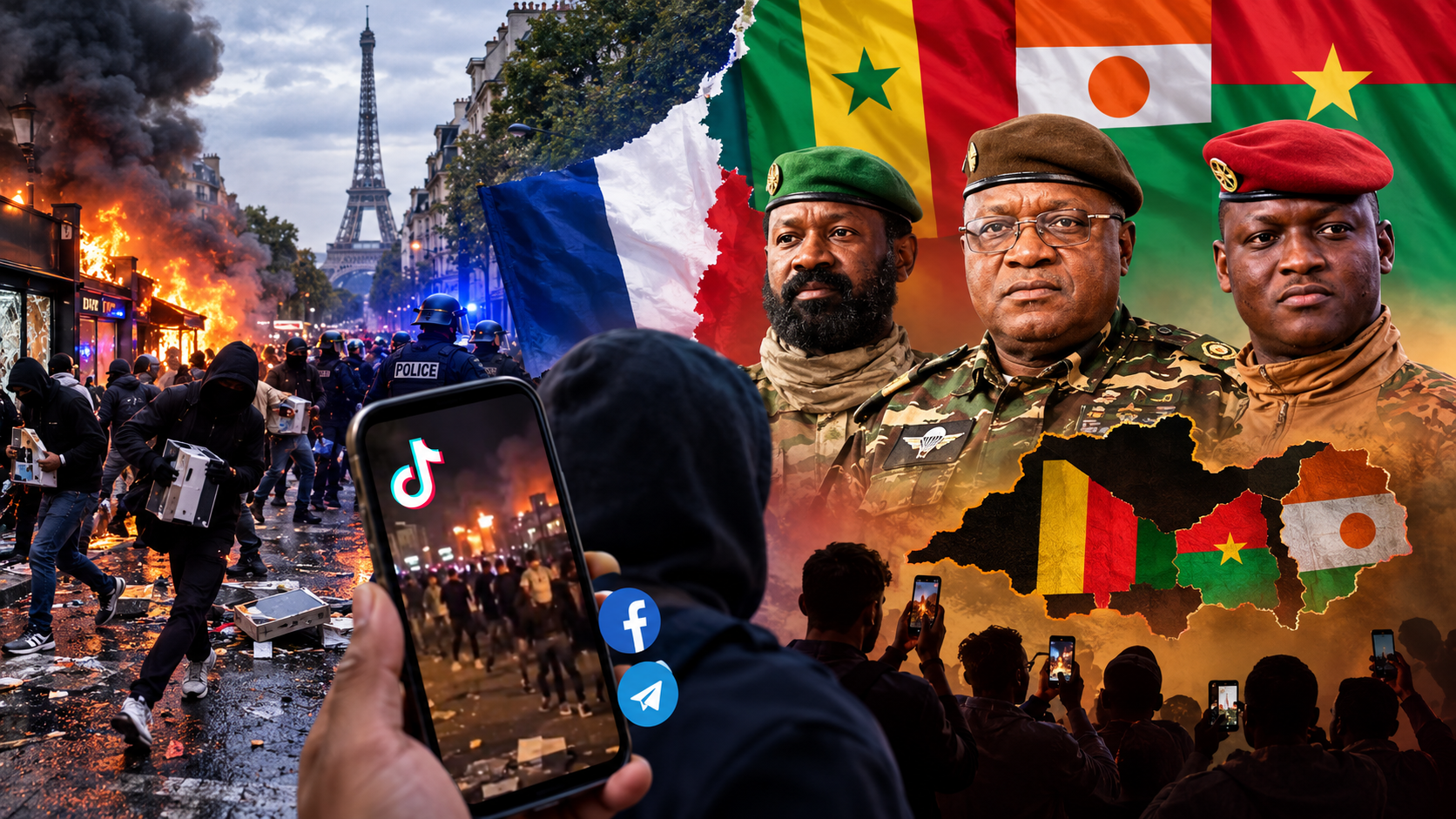
The recent urban unrest in France has transcended its borders, becoming a focal point in political debates across Mali, Burkina Faso, and Niger. Since the rise of military governments in these Sahel nations, relations with Paris have deteriorated significantly. Social media platforms such as TikTok, Facebook, and Telegram have rapidly amplified images of looting, property destruction, and clashes with law enforcement to fuel anti-France narratives.
Propaganda tactics and the erosion of French credibility
For supporters of the Alliance of Sahel States (AES), the footage of chaos in France serves as ammunition to challenge Paris’ credibility on democracy, security, and the rule of law. The argument is straightforward: if France itself struggles with internal instability, how can it critique the governance models of Sahelian regimes? This strategy aims to undermine France’s moral authority while positioning AES governments as more stable alternatives to Western influence.
Legal accountability vs. political exploitation
Amidst the propaganda battle, a critical question emerges: the legal accountability of individuals involved in the unrest. Investigations suggest that foreign nationals, including some from AES member states potentially including those in France illegally participated in looting and destruction. If these allegations are substantiated, they must face legal consequences under French law, regardless of nationality.
Establishing individual responsibility
The judicial process will determine the precise roles of those implicated. Prosecutors must gather evidence, verify participation in specific acts, and apply the law uniformly. For foreign nationals, including those without legal residency, the situation presents dual consequences: potential criminal prosecution for violent acts and possible administrative repercussions, such as deportation proceedings, if laws are violated.
It is essential to emphasize that foreign status does not exempt anyone from compliance with local laws. If evidence confirms the involvement of Malian, Burkinabè, or Nigerien nationals in the unrest, their nationality will not shield them from accountability.
From raw footage to weaponized narratives
While AES-aligned digital spaces leverage the unrest to depict France as a failing state, it is vital to scrutinize the accuracy of these claims. A single video of looting or clashes does not equate to systemic collapse, nor does it validate the governance achievements of Sahelian military regimes.
Propaganda often relies on misrepresentation: authentic footage paired with misleading captions, recycled old videos presented as new, or isolated incidents framed as nationwide crises. To substantiate allegations of a coordinated campaign, concrete evidence such as cross-platform collusion among accounts must be established. Previous analyses of misleading content in AES-affiliated digital ecosystems underscore the need for rigorous fact-checking to avoid conflating isolated events with systematic disinformation.
Individual justice over collective blame
The debate extends beyond propaganda to fundamental principles of justice. Authorities in France must investigate all allegations impartially, while legal systems must adjudicate guilt or innocence based on evidence not social media narratives. Responsibility must remain individual; guilt cannot be assigned to entire nationalities based on actions taken by a few.
This principle also applies to those who weaponize the unrest for political ends. Selective use of footage highlighting disorder while ignoring lawful governance undermines credibility on all sides. Criticism of Sahelian regimes must be met with reciprocity: acknowledgment of individual accountability when French law is broken abroad mirrors the standard AES governments demand for their own internal stability.
Diplomatic tensions and the role of judicial outcomes
The confrontation between Paris and Sahelian military governments now spans both diplomatic channels and digital arenas. France’s internal challenges are seized upon to advance a broader narrative of Western decline, while Sahelian governments emphasize their own security achievements both claims requiring empirical validation.
The unrest alone does not prove France’s collapse, nor does it validate the governance models of AES governments. If investigations confirm foreign nationals’ involvement in criminal acts, these cases must be treated as what they are: instances of individual responsibility subject to the rule of law. France’s judicial institutions will determine the outcomes, not the algorithms of social media or the agendas of propagandists.
By Jeanne Ntouba — Journalist