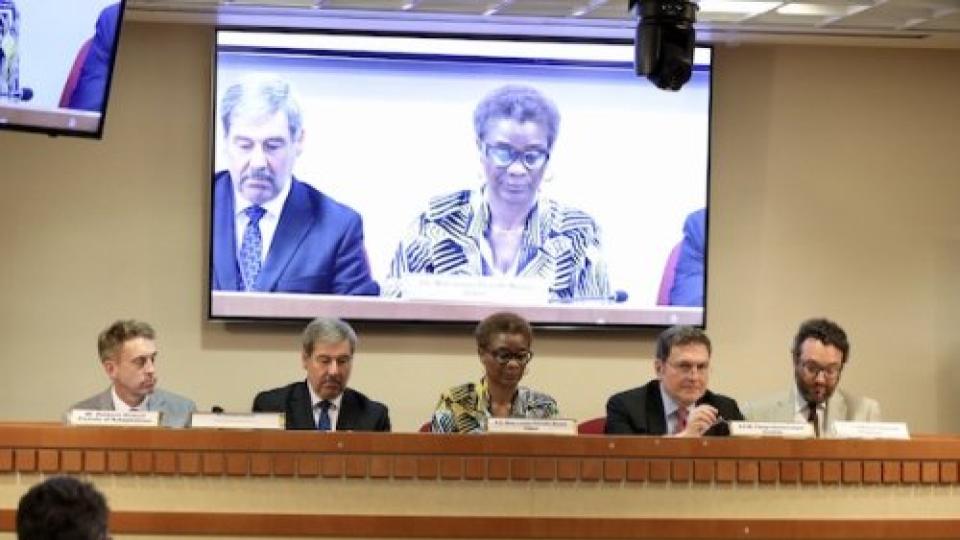
In New York, on the sidelines of the High-Level Political Forum (HLPF), the African Union’s permanent mission hosted the presentation of a joint OECD-OIF/IFDD report focusing on access to ecological financing. During this international gathering, Louise Pierrette Mvono, Gabon’s Minister of Planning and Foresight, stepped forward to articulate her nation’s stance, calling for a profound transformation of international aid distribution channels.
With its vast territory blanketed by 88% forest cover and its established role as a significant net carbon sink, Gabon stands as a crucial contributor to global climate regulation. Yet, this remarkable dedication to conservation is frequently undermined by complex procedural and linguistic hurdles that impede crucial access to vital environmental funds.
Minister Mvono, while commending the scientific rigor of the presented report, highlighted this stark paradox. She asserted that Gabon’s monumental preservation efforts necessitate a reciprocal, predictable, equitable, and proportionate international financial solidarity, free from the current slow-moving bureaucratic processes.
A national strategy already in motion
Far from passively awaiting a shift in global paradigms, Libreville is actively forging its own path. Ahead of submitting the country’s second Voluntary National Review to the United Nations, the Minister underscored the meticulously structured framework guiding Gabon’s ecological transition.
The National Growth and Development Plan 2026-2030 already incorporates advanced financial instruments, including green bonds and carbon credits. The accreditation of Gabon’s Caisse des Dépôts et Consignations (CDC) by the Green Climate Fund exemplifies this drive towards greater financial autonomy. Furthermore, the innovative $60 million “Country Package” partnership, forged during COP16 in Cali, demonstrates an integrated approach, linking climate action, biodiversity protection, and local community development.
Three key levers for future progress
To ensure that global commitments translate into tangible local impacts, the Minister presented three pivotal recommendations to donor nations. These included advocating for stronger local empowerment by valuing direct accreditation of national institutions, thereby reducing reliance on international intermediaries. She also stressed the importance of fostering sustained expertise through funding continuous training programs, enabling the local design of bankable ecological projects. Finally, Minister Mvono called for the monetization of natural capital by establishing robust payment mechanisms for ecosystem services and transparent carbon markets, which are essential for recognizing the systemic value of tropical forests.
Through this practical and forceful advocacy, Gabon reiterates that the future of our planet hinges on the capacity of wealthier nations to simplify and accelerate financial support for countries on the front lines of conservation efforts.