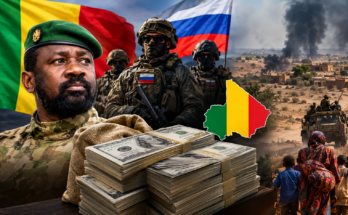
The jihadist alliance Jama’at Nusrat al-Islam wal Muslimin (JNIM), affiliated with al-Qaeda, has escalated its blockade strategy in Mali, crippling the nation’s economy and infrastructure. Over the weekend, militants torched at least ten buses on the critical Ségou-Bamako corridor, the primary supply route connecting the capital to eastern regions. Simultaneously, the group targeted and destroyed electrical facilities linked to the Manantali hydroelectric dam in Kayes, plunging parts of the country into deeper uncertainty.
Manantali dam: a strategic target in a war of attrition
The assault on Manantali is far from accidental. Operated under a tripartite agreement involving Mauritania and Senegal through the Senegal River Development Organization (OMVS), the dam is a cornerstone of Mali’s urban electricity supply. By damaging its transmission lines, JNIM is no longer just confronting military forces—it is striking at the heart of the economy, where power outages paralyze public services, businesses, and industries almost instantly.
This campaign follows weeks of systematic attacks on fuel convoys entering Mali from Senegal and Côte d’Ivoire. The jihadists aim to weaponize fuel shortages, betting on eroding public patience with the transitional government led by General Assimi Goïta. Bamako, long spared from direct conflict, has now become the epicenter of a slow-burning siege.
Army responds, but supply chains remain fragile
The Malian Armed Forces (FAMa) report ongoing ground and air operations across multiple regions. Military escorts have successfully escorted hundreds of fuel tankers into Bamako in recent days, offering temporary relief to gas stations under strain. However, this logistical lifeline is precarious—each convoy demands significant resources, and securing national highways over the long term appears increasingly out of reach.
FAMa faces a dual challenge. In western and central Mali, JNIM continues ambushing civilians and destroying infrastructure. Meanwhile, in the north, near Kidal, tensions remain locked in a tense stalemate, with rebel factions from the Permanent Strategic Framework signaling fresh clashes on the horizon. Bamako’s leadership is thus navigating two parallel crises, with dwindling human and material resources.
A regional crisis with ripple effects
The blockade’s impact extends beyond Mali’s borders. Neighboring economies—particularly those of Senegal, Mauritania, and Côte d’Ivoire—are feeling the pinch as trade corridors across West Africa weaken. Ports in Dakar and Abidjan, which handle significant transit traffic to the Sahel hinterland, are experiencing slowdowns. The Alliance of Sahel States, comprising Mali, Burkina Faso, and Niger, has yet to forge a unified response to the jihadist-driven economic warfare.
The attack on Manantali also raises alarms over shared OMVS infrastructure. Further damage could directly disrupt electricity supplies to Senegal and Mauritania, turning a Malian crisis into a regional emergency. External partners, including development funders and military suppliers, face a delicate balancing act: supporting Bamako’s sovereignty while protecting cross-border critical infrastructure.
On the ground, the disconnect between the army’s operational claims and the reality of a capital under siege underscores the unprecedented nature of this conflict phase. JNIM is no longer just contesting territory—it is attempting to suffocate a state.