
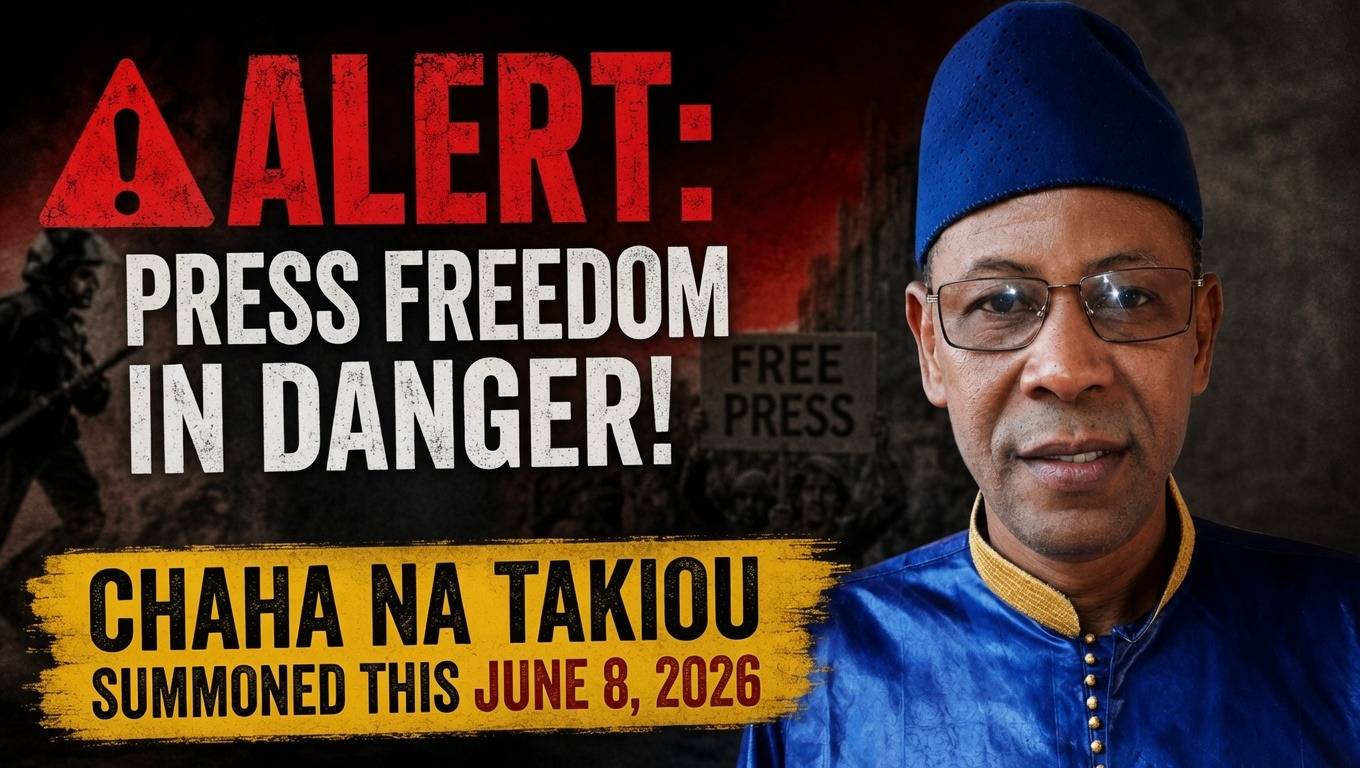
Chahana Takiou, editor-in-chief of the weekly newspaper Le 22 Septembre, has been summoned to appear before the cybercrime unit prosecutor in Bamako on June 8, 2026, at 1 PM. The summons follows his recent public statements criticizing the military junta’s handling of governance, security, and economic matters. This case underscores the growing pattern of judicial harassment and systemic repression targeting dissenting voices, journalists, and citizens who refuse to align with the transitional authorities’ official narrative.
Cybercrime unit becomes tool of political repression
The announcement sent shockwaves through Mali’s media landscape. Chahana Takiou, a respected journalist and leader of Le 22 Septembre, now faces an investigation by a judicial body notorious for its use as a political weapon. While officially tasked with combating online criminality, the cybercrime unit has increasingly been deployed to silence critics, particularly those whose reporting challenges the junta’s legitimacy or policies. For Takiou, the act of practicing journalism has morphed into a high-stakes legal gamble.
Press freedom suffocates under authoritarian grip
The space for free expression in Mali has narrowed dramatically since the military takeover. Once hailed as a beacon of press freedom in the region, the country now operates under a suffocating climate of fear and self-censorship. Independent journalism is no longer just discouraged—it is criminalized. Journalists who dare to report objectively or question official narratives face immediate consequences: suspensions, legal threats, or administrative intimidation. The High Authority for Communication (HAC) has become an enforcer of state propaganda rather than a regulator protecting media pluralism.
The junta demands absolute loyalty to its version of events. Any outlet that resists or questions its decisions risks swift retaliation, pushing Mali’s once-vibrant media sector into financial and moral collapse. Credible reporting is now treated as a subversive act.
Disappearances and fear: the junta’s shadow war
The targeting of Chahana Takiou is not an isolated incident. It is part of a broader, coordinated strategy of repression. Dissent is not tolerated—whether from politicians, civil society leaders, human rights defenders, or ordinary citizens expressing opinions online. The consequences extend beyond courtrooms: enforced disappearances are on the rise. Civilians are being abducted by unidentified armed men, widely believed to be state security agents, and held incommunicado for weeks. This climate of terror is designed to silence all forms of opposition and quash public debate across the nation.
Media solidarity clashes with state repression
In response to Takiou’s summons, press unions and professional associations have rallied to condemn the judicial intimidation. Calls for solidarity and protection have been issued, but these efforts are increasingly futile against a militarized state that routinely disregards constitutional rights and due process. Journalists’ unions continue to insist that constructive criticism is vital for national resilience, especially in times of crisis. Yet, under the current regime, even measured dissent is branded as treason or an attempt to destabilize the country—closing the door to any meaningful democratic discourse.
This escalation signals a dangerous new phase in Mali’s authoritarian drift. By summoning a journalist of Takiou’s stature, the transitional authorities have made their intentions clear: no critical voice will be spared. The junta’s obsession with enforced conformity—through force, imprisonment, and intimidation—further isolates Mali and deepens internal divisions. As the nation grapples with severe security and humanitarian challenges, silencing truth-seekers does not resolve its crises. The future of independent journalism and civic freedoms in Mali is now being decided in the corridors of Bamako’s courts—where justice itself is under siege.
