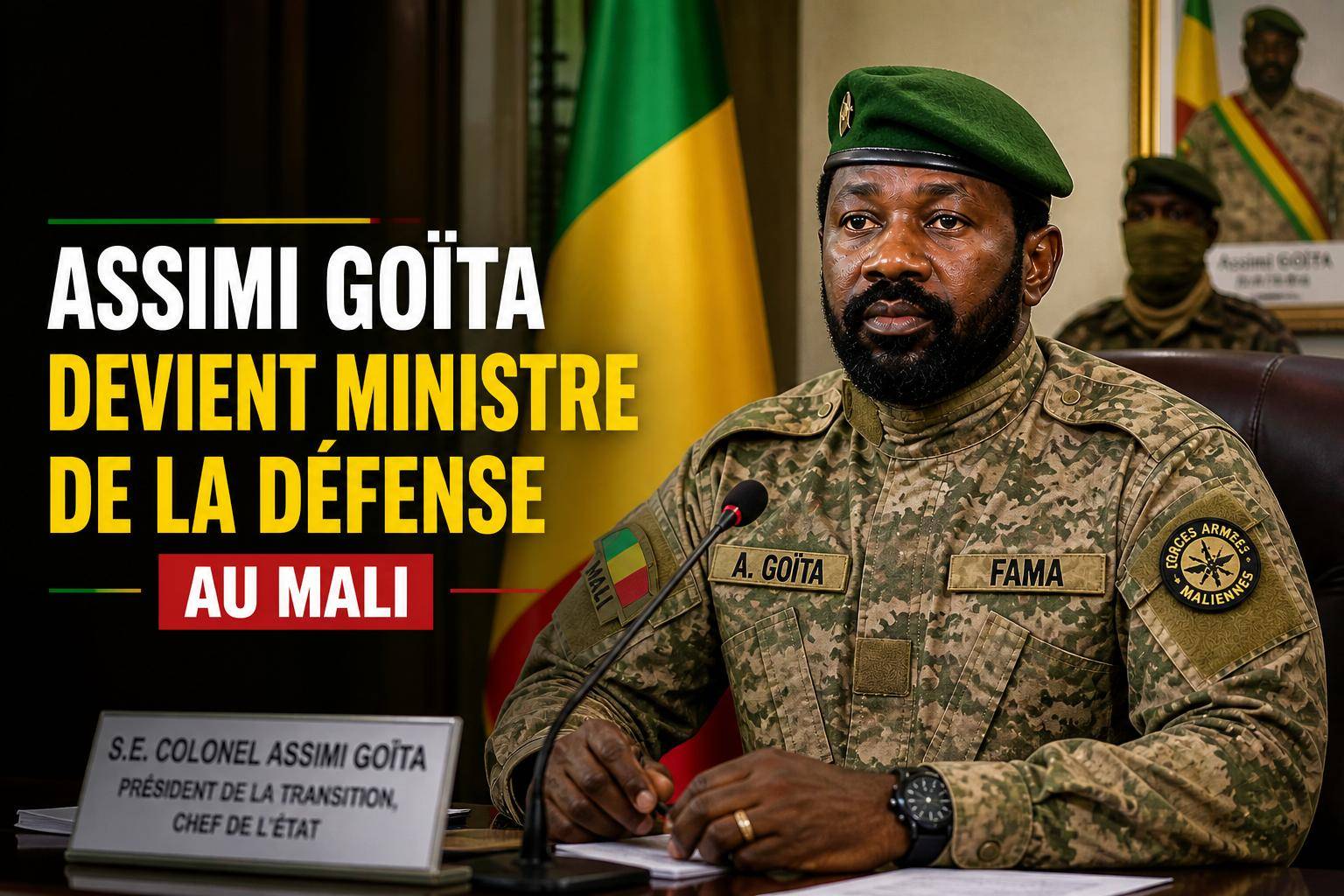
The recent appointment of Colonel Assimi Goïta as both President and Minister of Defense marks a significant shift in Mali’s political and military landscape. This consolidation of power in Bamako signals more than a routine administrative change—it reflects deepening instability and a faltering military strategy.
By merging the roles of Head of State and Defense Minister, Goïta has assumed direct operational control over Mali’s armed forces. This move has drawn scrutiny from regional observers, who view it as a sign of growing distrust within the leadership. In the midst of a prolonged transition, the concentration of authority raises a critical question: can a single leader effectively oversee state governance, regional diplomacy, and the tactical demands of an asymmetric war?
the illusion of control in Kidal: a strategic setback
Just months ago, official communications celebrated the «liberation» of Kidal as a triumph of Mali’s sovereignty. Yet, the loss of the city to armed groups like the Jama’at Nusrat al-Islam wal Muslimin (JNIM) and the Coordination of Azawad Movements (CMA/FLA) has exposed the fragility of Bamako’s military gains. The insurgents’ swift reoccupation of Kidal reveals systemic weaknesses in Mali’s army, despite claims of improved capabilities.
The withdrawal of public administration and the collapse of security infrastructure allowed jihadist and rebel factions to regain control almost effortlessly. The JNIM, in particular, has demonstrated a refined strategy, isolating military outposts and severing supply lines—turning Mali’s hard-won victories into fleeting successes.
Wagner’s fading influence in Mali’s security crisis
The Russian paramilitary group Africa Corps (formerly Wagner) has been a cornerstone of Mali’s security partnership with Moscow. While marketed as a sovereign alternative to French military support, the results have been underwhelming.
Reports of human rights abuses by Russian forces have fueled local resentment, inadvertently strengthening terrorist recruitment. Worse still, the army’s vulnerability in ambushes and tactical failures suggests that Moscow’s military contributions may be overstated. With Russia embroiled in its own conflict in Europe, its ability to provide critical air support or advanced technology to Mali remains uncertain.
regional isolation and diplomatic strain
Mali’s decision to exit the Economic Community of West African States (ECOWAS) and form the Alliance of Sahel States (AES) has deepened its diplomatic isolation. While the move aimed to assert sovereignty, the reality is stark: terrorism knows no borders, and porous frontiers demand regional cooperation.
The concentration of power under Goïta has further strained relations with neighboring countries, complicating dialogue and mutual defense efforts. Mali now faces a paradox: it seeks to impose sovereignty through force, yet remains dangerously dependent on opaque external actors and a centralized command structure.
the looming specter of prolonged conflict
For civilians in central and northern Mali, insecurity is worsening. Daily attacks on military and civilian convoys have become the norm, testing the resilience of both the population and the state.
Goïta’s gamble as both President and Defense Minister hinges on rapid security improvements. Failure to stabilize the situation risks social unrest, which has so far been suppressed by heavy-handed security measures. History in Africa warns that excessive centralization of power often precedes major instability.
To break the cycle, Mali must rethink its approach. Relying solely on brute force and mercenary alliances has proven ineffective. A sustainable solution requires inclusive governance and a renewed focus on social reintegration in conflict zones. Without these, the Colonel’s strategy risks faltering against the resilience of armed groups.
The time for wartime rhetoric is over. What Mali needs now is urgent political realism—because the survival of the Malian state is at stake in the shifting sands of the North.