Two years after its formation, the Alliance of Sahel States struggles to assert itself against a more formidable adversary
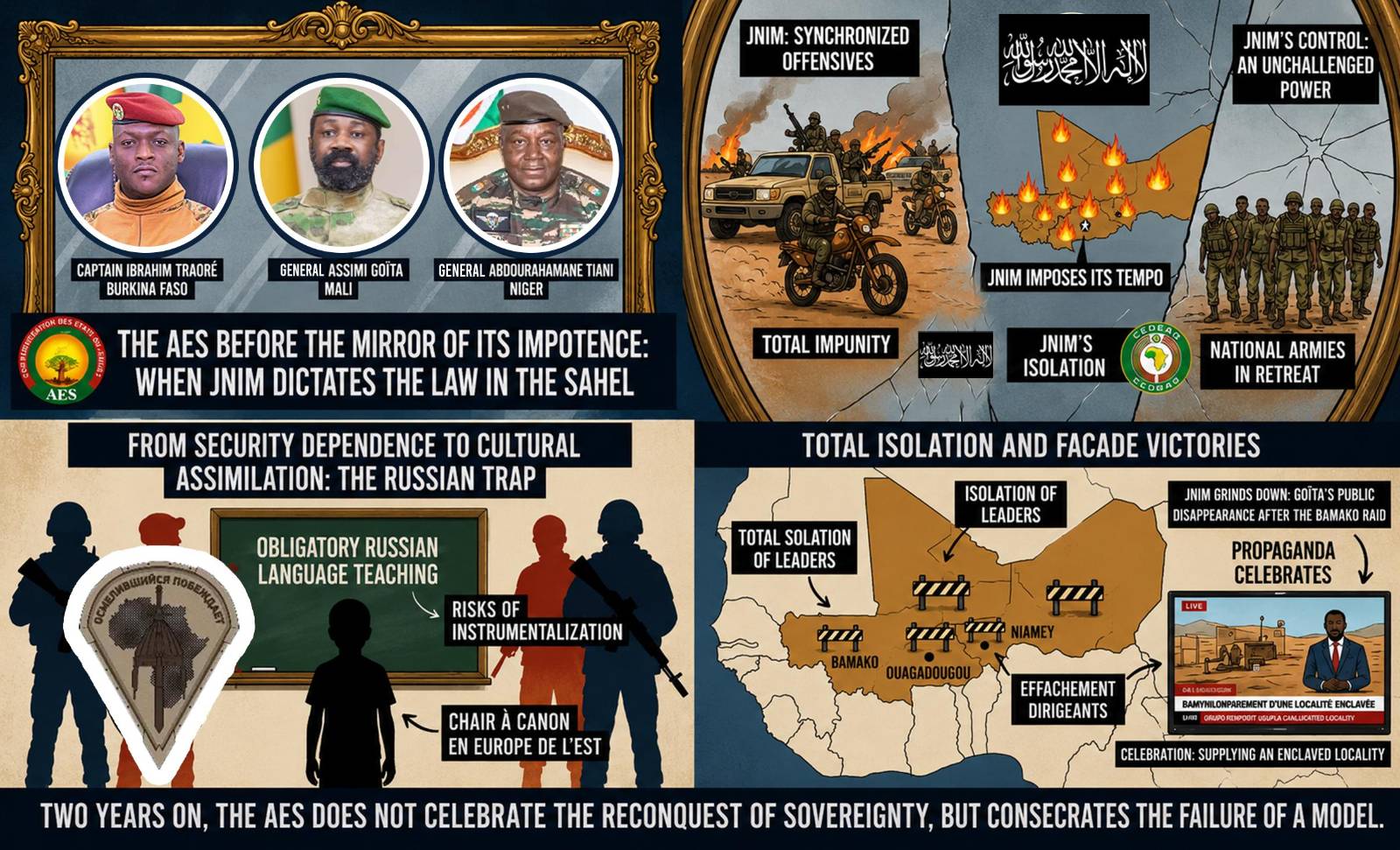
The bold declarations of sovereignty and fiery rhetoric from the military juntas of Bamako, Ouagadougou, and Niamey have failed to mask a harsh truth: the only coordinated armed force capable of dictating terms and striking at will across the region remains the Group for the Support of Islam and Muslims (JNIM). Two years after the Alliance of Sahel States (AES) was formed with great fanfare, its veneer of unity is cracking under relentless pressure.
The limits of political grandstanding
The self-proclaimed champions of Sahelian independence now face an uncomfortable reality. Despite theoretical intelligence-sharing agreements and a full alignment with Moscow, their combined military efforts have proven woefully inadequate. The JNIM, meanwhile, continues to execute large-scale, synchronized offensives, overwhelming national armies—often better equipped—and seizing control of key territories at will.
Russia’s cultural and military grip tightens
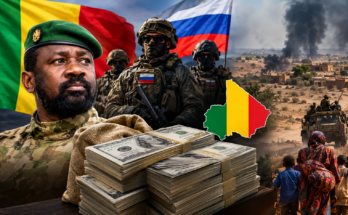
Faced with this impasse, the leaders of Burkina Faso, Mali, and Niger have increasingly turned to Russia for support. Yet the partnership has expanded beyond military cooperation and the presence of Kremlin-linked mercenaries, now known as Africa Corps. A recent decision to introduce Russian as a mandatory language in Burkinabè schools starting next year signals a deeper ideological shift. While framed as a move toward cultural decolonization, the policy raises serious concerns about the long-term implications for the country’s youth.
The integration of Russian into the national curriculum is not merely an educational reform—it is a strategic maneuver. By exposing Burkinabè students to Russian language and culture from an early age, the regime is laying the groundwork for deeper ideological alignment. The potential consequences are alarming: young graduates could be sent to Russia under the guise of academic or vocational training, only to be exploited as expendable forces in distant conflicts that have nothing to do with the Sahel. The scenario evokes fears of Sahelian youth being used as human shields or cannon fodder in a geopolitical struggle far removed from their homeland.
Terrorists dictate the agenda while juntas lose ground
The JNIM’s relentless campaign has pushed the AES leadership into a state of isolation. Public appearances by Malian leader Assimi Goïta, for instance, have become increasingly rare following a deadly raid in Bamako that reportedly claimed the life of the Defense Minister. Meanwhile, the group steadily expands its territorial control, leaving the juntas to celebrate minor logistical victories or defensive maneuvers—hardly the hallmarks of a winning strategy.
The contrast between the JNIM’s operational prowess and the AES’s political farce could not be starker. What began as a bold assertion of sovereignty has devolved into a cycle of propaganda and retreat. By trading one form of dependence for another—shifting from Western alliances to Moscow’s cultural and military embrace—the juntas have not liberated the Sahel. They have merely exchanged one set of masters for another, with the future of the region’s youth hanging in the balance.