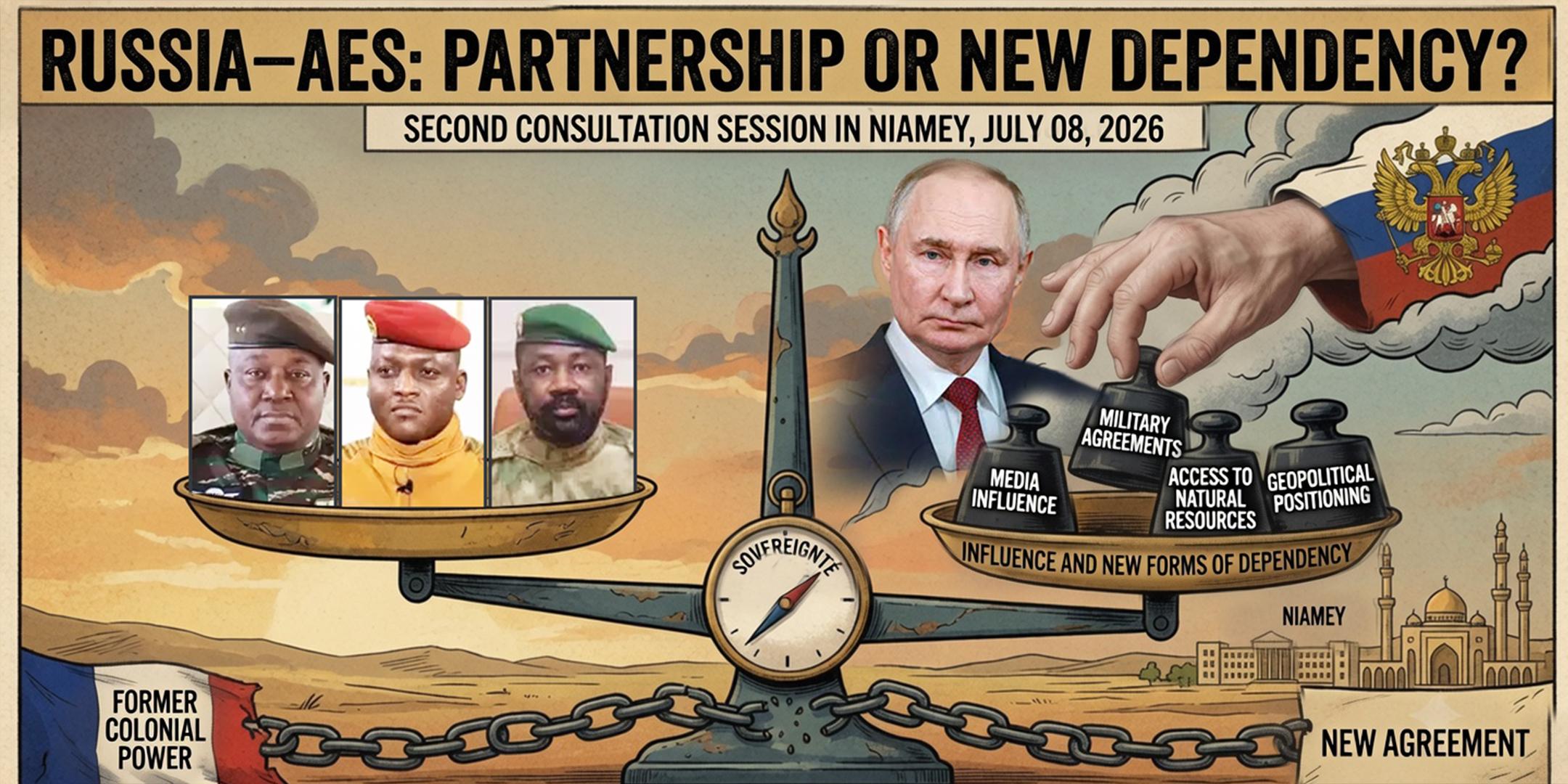
On July 8, 2026, Niamey hosted the second round of high-level consultations between foreign ministers of the Alliance of Sahel States (AES) and Russian counterpart Sergey Lavrov. While governments frame this engagement as a landmark step toward sovereignty and mutual respect, the emerging dynamic raises a critical question: could this alliance inadvertently lay the groundwork for a new dependency on Moscow?
From colonial critique to new alliances
The AES bloc has long criticized the historical influence of former colonial powers—particularly France—under the banner of national sovereignty. Yet substituting one external power for another does not inherently guarantee greater autonomy. Geopolitical, economic, and strategic interests have historically shaped state-to-state relations, often at the expense of true independence.
Expanding Russian influence across the Sahel
Moscow’s footprint in the region has grown substantially through military cooperation, diplomatic agreements, trade initiatives, cultural exchanges, and media presence. For AES leaders, diversifying partnerships signals a sovereign choice. Critics, however, question the long-term implications: at what point does such influence transition from collaboration to control?
Great powers rarely invest in distant regions without expecting tangible returns. Whether securing access to natural resources, expanding diplomatic leverage, or strengthening strategic positioning in Africa, every alliance serves broader national objectives. Russia’s engagement in the Sahel follows this well-established pattern.
Diplomatic risks of over-reliance
A heavy tilt toward a single external actor can constrict a nation’s diplomatic flexibility, narrow its alliance options, and expose it to shifting global power struggles. In today’s multipolar world, the Sahel risks becoming a battleground for competing interests rather than an autonomous actor defining its own future.
True sovereignty extends beyond choosing new partners. It demands the capacity to make independent decisions, maintain balanced relationships, and advance national interests without defaulting to rigid alignment.
Assessing the promise of mutual benefit
AES authorities describe the partnership with Russia as “mutually beneficial.” Yet the true test lies in measurable outcomes: sustainable security improvements, economic development, job creation, skills transfer, and institutional strengthening. Without concrete progress in these areas, appeals to sovereignty may ring hollow to the very citizens they aim to empower.
The coming years will reveal whether cooperation with Moscow empowers Sahel nations or merely shifts them from one sphere of influence to another. For many analysts, genuine independence is not achieved by replacing one dominant partner with another, but by cultivating a diplomacy that engages globally without falling under any single power’s sway.