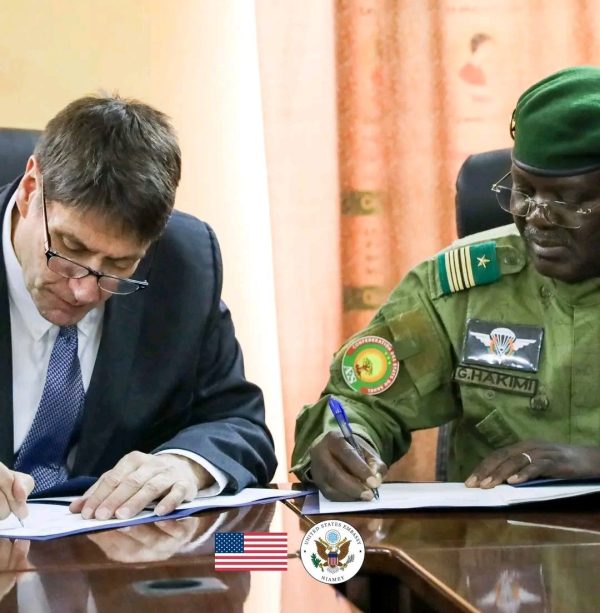
Is the Niger government striking a landmark health partnership or risking its digital sovereignty? The question has dominated diplomatic circles since the signing of a health cooperation protocol between Niger and the United States in Niamey on February 26, 2026.
The $178 million (approximately 99.6 billion FCFA) agreement aligns with the Trump administration’s America First global health strategy. On paper, the priorities seem clear: combating malaria, monitoring infectious diseases, preventing polio, and improving maternal and child health. Yet beneath these widely supported goals, concerns are growing.
Massive funding amid tight budget constraints
The U.S. commitment could reach $107 million over five years. At the same time, Niger pledges to increase its domestic health spending by over $71 million. This means the Nigerien government is not only relying on external support but also committing to significantly boost its own investment in health—despite persistent budgetary pressures and heavy security spending.
This raises key questions: can Niger maintain this level of domestic investment in the long run? And more critically, which sectors will have to be scaled back to keep this promise?
Is this a health partnership or a tool of diplomatic influence?
Officially, the agreement is framed as a technical collaboration to strengthen Niger’s health systems. But the deal goes beyond medical support. Niger has been included in a U.S.-led initiative for paid health data exchange—an aspect barely mentioned in official statements.
In today’s data-driven world, health information has become a strategic asset. Does this protocol enable the transfer of Nigerien medical data to U.S. databases? And if so, under what legal protections? These are sensitive issues that strike at the heart of national sovereignty and digital autonomy.
African precedents: caution or mistrust?
Several African nations have recently pushed back against similar arrangements.
The Zimbabwe government declined participation outright. In Kenya, a comparable program was suspended by the courts last year. Zambia, meanwhile, rejected a billion-dollar deal, citing concerns that data-sharing clauses violated its national interests.
These examples fuel further doubt: did Niger secure stronger safeguards, or did it prioritize urgent health needs over legal caution?
A chance to build health self-reliance?
Yet it would be shortsighted to focus only on data governance. Niger faces deep-rooted health challenges: endemic malaria, epidemic vulnerability, underdeveloped rural infrastructure, and persistently high maternal mortality.
If funds are deployed effectively, the impact could be transformative: upgraded disease surveillance, expanded vaccination coverage, and stronger community health centers.
Still, recent experience with international partnerships shows that large external funds alone rarely drive lasting change without internal reforms.
Balancing sovereignty and necessity
At its core, the Niamey agreement reflects a familiar dilemma for African states: how to attract strategic investment while protecting decision-making autonomy.
In a shifting geopolitical landscape, Niger appears to be taking a pragmatic stance. The real test will be whether this investment strengthens its health system—or sparks wider debate over data governance and digital sovereignty.
Because when all is said and done, the true cost of this partnership may not be measured solely in FCFA or dollars.