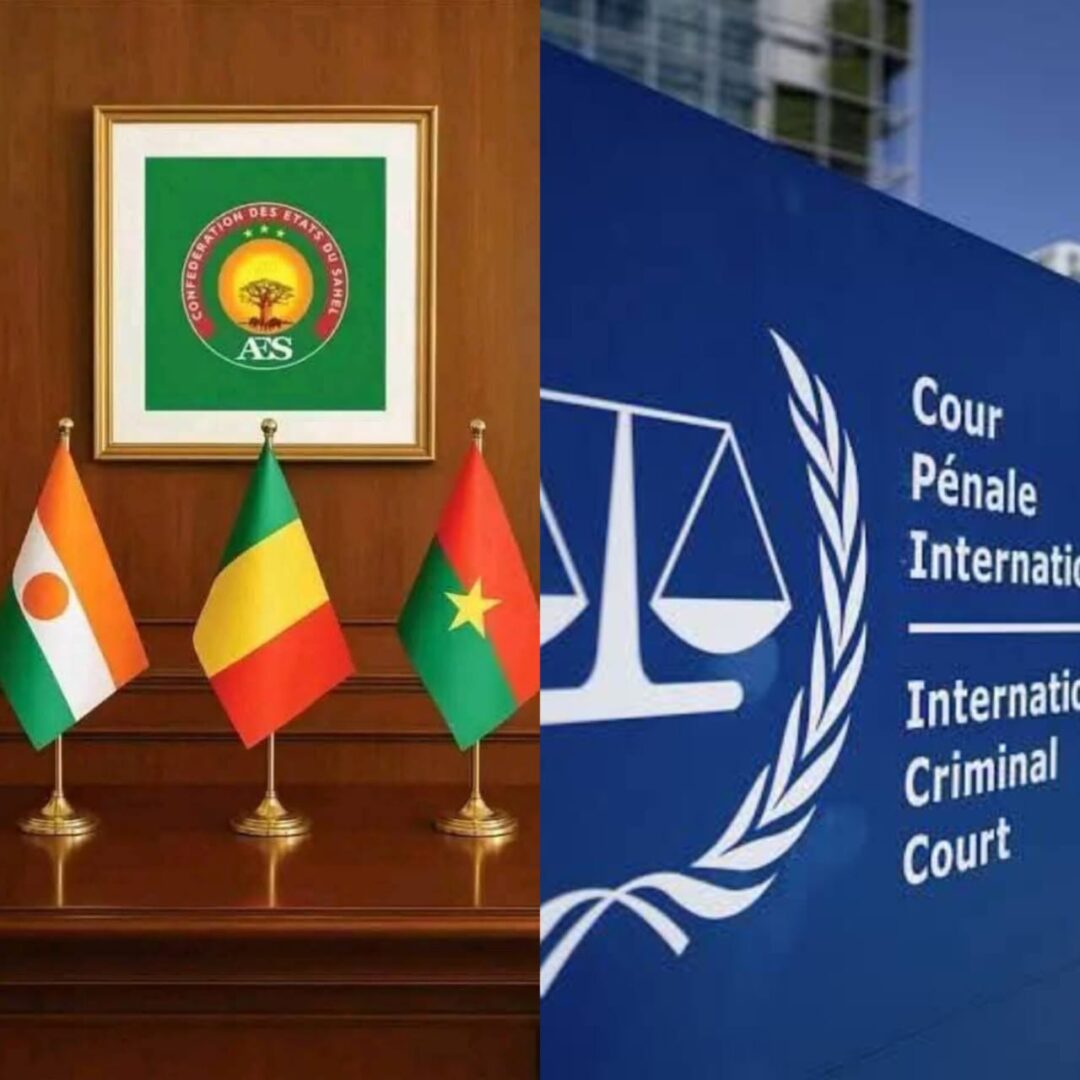
The withdrawal of Burkina Faso, Mali, and Niger from the International Criminal Court (ICC) is more than a diplomatic rupture—it is a profound challenge to the very foundations of global justice in the 21st century.
On September 22nd, the Alliance of Sahel States (AES) made a decisive move by announcing its joint departure from the ICC. This decision is not merely a reconfiguration of regional alliances; it represents the most symbolic blow to international criminal justice since the Rome Statute was signed in 1998. While critics argue that this exit paves the way for unchecked impunity for military regimes under pressure, the move resonates deeply within the Global South. It forces the ICC to confront its own contradictions, failures, and inability to uphold a truly universal judicial authority.
The quest for sovereignty and strategic calculations
For the transitional authorities in Bamako, Ouagadougou, and Niamey, leaving the ICC is the logical culmination of an uncompromising drive for sovereignty. Following the denunciation of military agreements with France and the United States, the rupture with ECOWAS and the withdrawal from the Francophonie, exiting the Rome Statute seals this process of institutional disconnection. The message is clear: Sahel affairs must be resolved by Sahelians themselves.
Yet beneath this posture of national dignity lie cold strategic calculations. As the AES governments and their security forces wage an asymmetric war of unprecedented violence against terrorist groups, they face recurring accusations of civilian abuses. By withdrawing from the ICC, they erect a legal shield for their command chains and reassure non-Western security partners—most notably Russia, which has also openly defied the Hague-based court.
The ICC’s credibility deficit and global inequality
The widespread support for the AES’s withdrawal stems from a damning indictment of the ICC: its flagrant global inequality and the political weaponization of its procedures. How can the court claim neutrality when architects of the most destructive wars of the 21st century remain untouched? The 2003 invasion of Iraq, launched without a UN mandate and based on false pretenses, devastated an entire region. Yet neither George W. Bush nor Tony Blair have ever faced justice in The Hague. When the ICC dared to investigate alleged war crimes by US forces in Afghanistan, Washington responded with direct financial sanctions against the court’s prosecutors.
This impunity of the powerful is compounded by the illusion of fair justice, undermined by partisan procedures. The nearly decade-long detention of former Ivorian President Laurent Gbagbo stands as a stark example. Delivered to The Hague following a deadly post-election crisis, Gbagbo endured seven years of pre-trial detention before being fully acquitted on all charges, with judges condemning the prosecution’s « exceptional weakness » in evidence. Worse still, the ICC has often seemed to practice a « victor’s justice, » pursuing one side almost exclusively while ignoring abuses committed by allied forces in power.
The swift issuance of an international arrest warrant against Vladimir Putin for the invasion of Ukraine, while legally sound, starkly contrasts with decades of inaction over Western powers’ or their allies’ atrocities—further fueling perceptions of a « white man’s justice » or a geopolitical tool of the North.
Can Africa build a credible alternative?
Africa already possesses strong instruments to uphold fundamental rights: the African Court on Human and Peoples’ Rights (ACHPR) at the continental level and the ECOWAS Court of Justice at the regional level. However, a glaring contradiction persists. How can states condemn ICC interference while ignoring rulings from their own regional courts? Too often, West African nations proudly claim membership in ECOWAS but refuse to enforce its judicial decisions when they condemn arbitrary arrests, political freedoms violations, or authoritarian excesses.
If Sahel states are serious about challenging the ICC’s biases, they must start by strengthening the ECOWAS Court of Justice and rigorously complying with its rulings. Without systematic enforcement of regional judges’ decisions, complaints about ICC partiality ring hollow. Sovereignty cannot justify replacing international arbitrariness with national impunity. There can be no real rule of law in the Sahel—or anywhere in Africa—without independent judges whose decisions bind everyone, including heads of state.
The AES withdrawal must not be seen as mere defiance but as a wake-up call for international law. It marks the definitive end of the illusion that global justice is dictated from the West. The Sahel’s message is unambiguous: the ICC has lost its monopoly on international morality. It is now up to African nations and sub-regional institutions to prove that the alternative to The Hague is not the law of the strongest, but the affirmation of a strong, independent, equitable, and universally respected continental justice system.