The Sino-Congolese Programme, a flagship initiative aimed at transforming the Democratic Republic of Congo’s (DRC) infrastructure landscape, is facing severe setbacks due to persistent customs clearance delays. Despite strong financial, technical, and institutional backing, these bureaucratic hurdles are directly impeding the progress of multiple construction sites across the country.
Critical materials held hostage at Matadi port
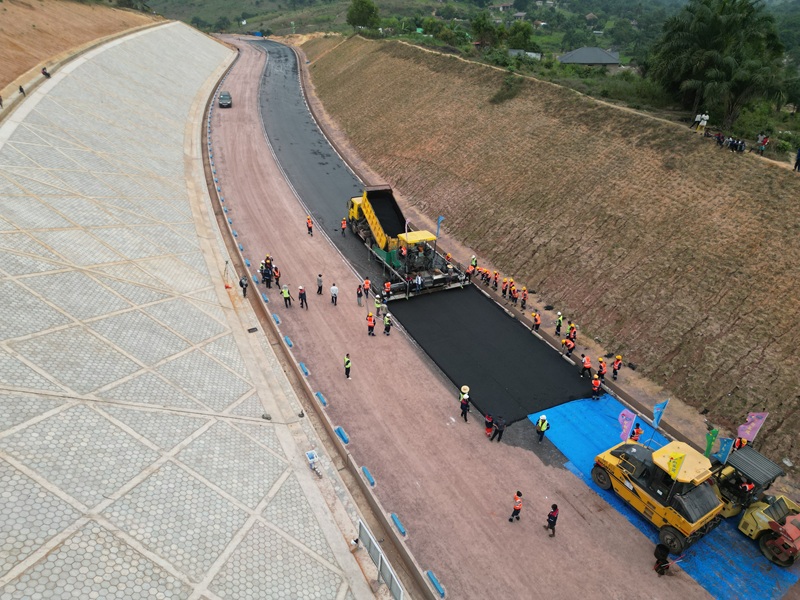
Nico Nzau Nzau, Director-General of the Congolese Agency for Major Works (ACGT), recently briefed Minister of Infrastructure John Banza on the crisis. The minister was informed that road surfacing projects, including key stretches of the Kinshasa bypass routes, could have advanced significantly had it not been for a six-month customs standoff at the Port of Matadi. Over 1,477 tons of bitumen, imported by SISC SA for these projects, remain trapped at the port, even though the programme is legally exempt from applicable duties under Law No. 14/005 of February 11, 2014, and the 2024 Collaboration Agreement Addendum No. 5.
Additionally, approximately 1,650 tons of bitumen destined for the rehabilitation of the Mbujimayi–Nguba segment of National Road 1 are also stranded in the Grand Katanga region. The toll is not limited to bitumen alone—construction equipment, including the concrete plant for the Idiofa Stadium, spare parts, and other essential materials, are likewise held up at customs checkpoints, preventing their deployment to active worksites.
Unfinished infrastructure projects threaten national development
Since June 19, Minister John Banza and his delegation have been on a province-wide inspection tour of infrastructure projects funded by SICOMINES. While progress on several sites, including the General Reference Hospital in Kikwit, has been commendable—the expansion of which will increase bed capacity from 150 to 650 and morgue capacity from 9 to 90—these achievements are now at risk due to the customs impasse.
Minister Banza acknowledged the satisfactory progress on multiple fronts, yet stressed that the delay poses a significant threat to the country’s development trajectory. The dry season, traditionally ideal for construction, is being squandered due to the logjam, further jeopardizing delivery timelines set by the government.
Major projects at risk
The following key projects, all critical to public welfare and economic connectivity, are directly affected:
- The Southeast and Southwest Bypasses of Kinshasa
- The Manterne–Tshela–Singini road
- The Kananga–Kalamba Mbuji route
- The RN1 segment between Mbujimayi and Nguba
- The Idiofa Stadium
- The General Reference Hospital of Kikwit
Without urgent resolution, the entire nation stands to lose not only time but also access to modern infrastructure that would benefit millions of citizens.
The role of APCSC: a call for decisive action
At the heart of this crisis is the Agency for Pilotage, Coordination, and Monitoring of Conventions (APCSC), which serves as the central interface between stakeholders and is specifically tasked with overseeing customs clearance for infrastructure projects under the Sino-Congolese Programme. The agency’s proactive involvement is now more crucial than ever to prevent a slowdown—or worse, a complete halt—to ongoing work.
With millions of tons of essential materials and equipment currently immobilized, the APCSC must accelerate the processing of outstanding requests, including voice message approvals and coverage of indirect fiscal obligations. Failure to act will not only stall the programme but also undermine public confidence in large-scale infrastructure initiatives.
The stakes are high: the future of DR Congo’s infrastructure development hangs in the balance, and timely customs clearance is the key to unlocking progress.