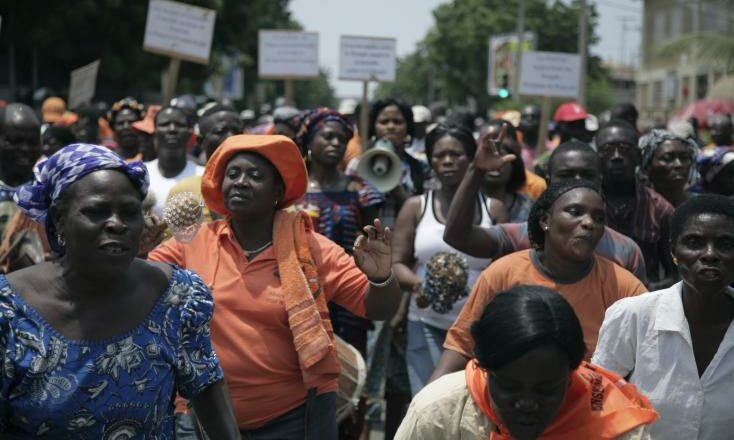
Hundreds of protesters gathered in Vogan, southern Togo, on Sunday to voice their opposition to the country’s new constitution, adopted in 2024 and accused by opposition parties of allowing President Faure Gnassingbé to perpetuate his rule.
The rally, organized by the National Coordination for Concertation for Change in Togo (CNCC), a coalition of opposition parties and civil society organizations, took place about 60 kilometers from Lomé. It was the second meeting of this coalition in three months, following an initial mobilization in May.
Protesters held banners bearing slogans such as ‘No to unconstitutional government change’ or ‘Constitutional coup’, denouncing what they see as a illegitimate reform.
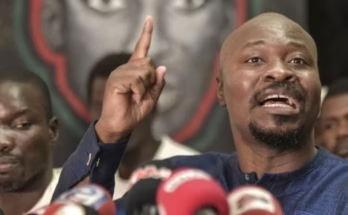
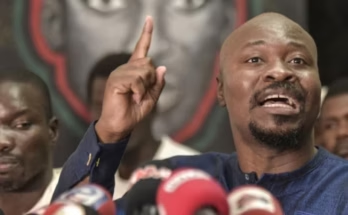
‘The 2024 constitution is completely illegal. It’s a constitutional coup that the Togolese will never accept,’ said David Dosseh, spokesperson for the Front Citoyen Togo Debout (FCTD), one of the organizations behind the protest.
The new Basic Law, which came into effect in 2024, has significantly altered Togo’s institutions. It abolished direct presidential elections and introduced a parliamentary system. The president of the Council, currently held by Faure Gnassingbé since 2005, is the highest executive position in the country.
Opposition parties and civil society actors believe that this reform aims to indefinitely prolong their leader’s rule. In contrast, the government defends a text that they claim strengthens institutional representation.
Tensions surrounding this reform have already led to protests in 2025, resulting in seven deaths according to civil society, while the prosecution cites five deaths due to drowning.
In a January 29 ruling, the Economic Community of West African States Court of Justice (CEDEAO) deemed the reform ‘a change in unconstitutional government’. The Togolese government rejected this decision, claiming that the court overstepped its authority, limited to monitoring human rights and community law without being able to pronounce on internal law.