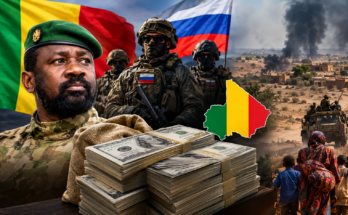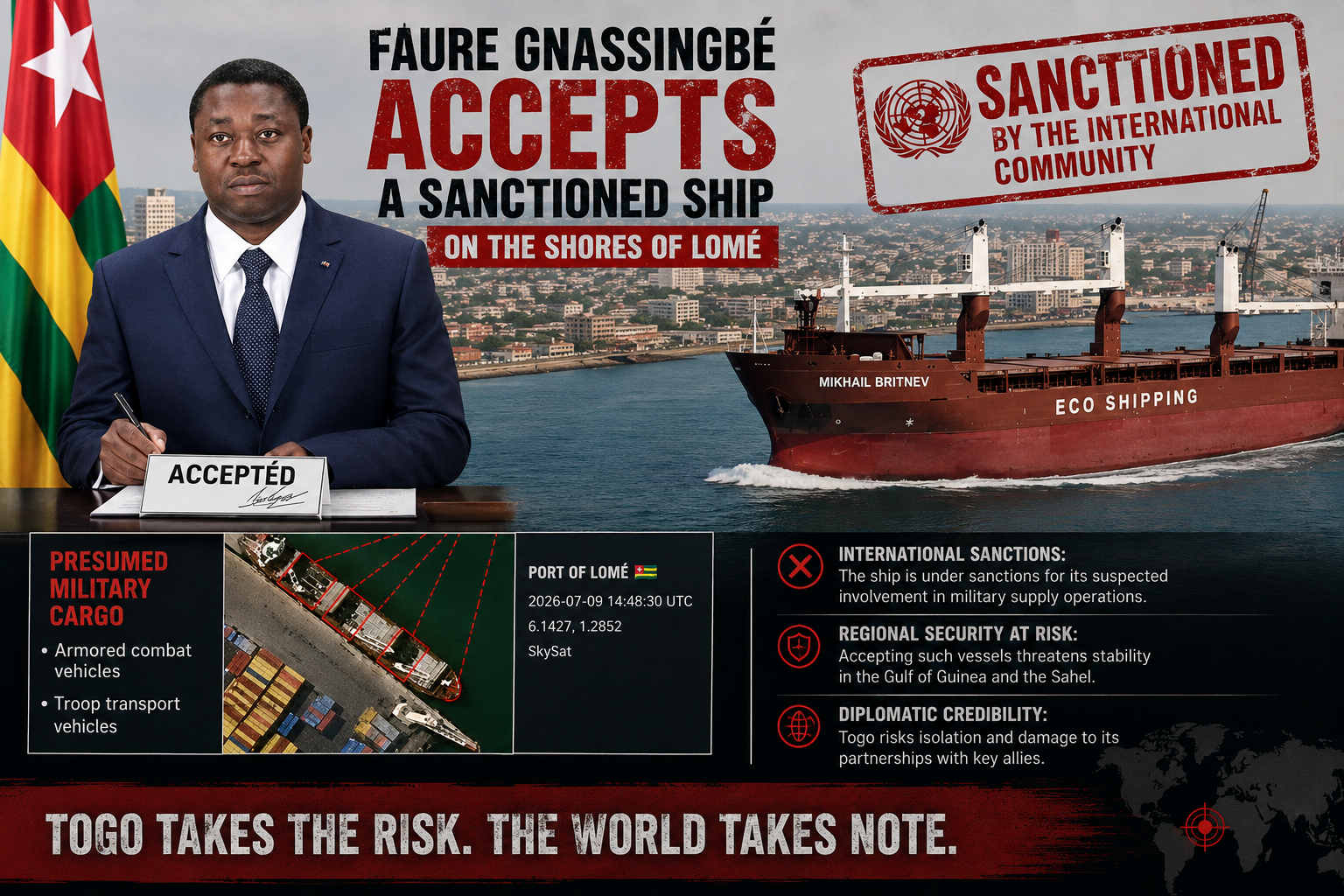
The arrival of the Russian cargo vessel « Mikhail-Britnev », a ship subject to international sanctions, at the port of Lomé, coupled with reports detailing the deployment of several hundred Africa Corps personnel within Togolese territory, has ignited an intense national discourse regarding Togo’s diplomatic and security orientation. For many observers, these developments signify an accelerated alignment with Moscow, a strategic trajectory that could irrevocably commit the nation to a path with potentially unmanageable consequences.
While official statements frame this collaboration as a necessary response to the escalating security challenge posed by armed groups in the northern regions, detractors of President Faure Gnassingbé contend that this partnership extends far beyond the scope of counter-terrorism efforts. They express apprehension that the head of state may gradually transform Togo into a logistical and strategic hub for Russian interests across West Africa, with implications that transcend national boundaries.
Faure Gnassingbé’s actions draw regional scrutiny
For numerous analysts and leaders within the sub-region, this strategic shift is not an isolated incident. President Faure Gnassingbé faces direct criticism for his tendency to employ Togolese diplomacy as a tool for influence, even if it risks destabilizing neighboring states. Critics recall that such maneuvers are not unprecedented for the Lomé administration, which has historically been accused of serving as a rear base, logistical facilitator, or financial conduit in various regional conflicts to leverage its influence.
Presently, President Gnassingbé’s unilateral decision to welcome Russian paramilitary forces into the country and provide port facilities to sanctioned vessels has generated considerable apprehension among contiguous nations. His counterparts suspect the Togolese President of seeking to disrupt the cohesion of ECOWAS, positioning himself as an independent actor capable of forging alliances with Sahelian military regimes (AES) at the expense of collective West African stability.
This evolving situation is particularly concerning given the sensitive political context. For critics of the current administration, the intensification of military cooperation with Moscow, spearheaded by Faure Gnassingbé, primarily serves to consolidate his own regime rather than contributing to a comprehensive strategy for national stabilization. According to this interpretation, the head of state is utilizing the jihadist threat to justify an external military presence, which not only bolsters the regime’s security capabilities but also reinforces a power structure that has been in place for several decades.
The limitations of a purely military approach
Experiences observed in other Sahelian nations further fuel these anxieties. Despite the involvement of Russian military partners, countries such as Mali, Burkina Faso, and Niger continue to grapple with pervasive insecurity and ongoing deadly assaults. Many analysts assert that a predominantly military strategy proves inadequate against terrorism when deep-seated issues like economic hardship, institutional fragilities, communal discord, and governance deficits persist without sustainable resolution.
Beyond the immediate security implications, this strategic reorientation orchestrated by the presidency may incur significant diplomatic repercussions. By forging closer ties with a power currently facing international sanctions and widespread global opposition, President Gnassingbé risks alienating Togo from its established European, American, and African partners. Such a trajectory could adversely affect foreign investment, economic collaboration, and the nation’s global standing.
Fundamentally, this strategic shift brings forth critical questions of governance. A commitment of such profound national consequence necessitates transparent public discourse and comprehensive national deliberation. The President’s unilateral decisions regarding defense policy, military alliances, and national sovereignty will shape the destiny of future generations. These choices ought to emerge from broad democratic discussion, rather than being perceived as the exclusive prerogative of a select presidential inner circle.
While counter-terrorism remains an undeniable imperative, it cannot singularly validate all diplomatic or military alignments. Enduring security fundamentally rests upon a foundation of economic advancement, robust institutional frameworks, mutual trust between the state and its citizenry, and adherence to democratic tenets. President Gnassingbé’s administration will ultimately be assessed on its ability to maintain this crucial equilibrium in the years ahead.