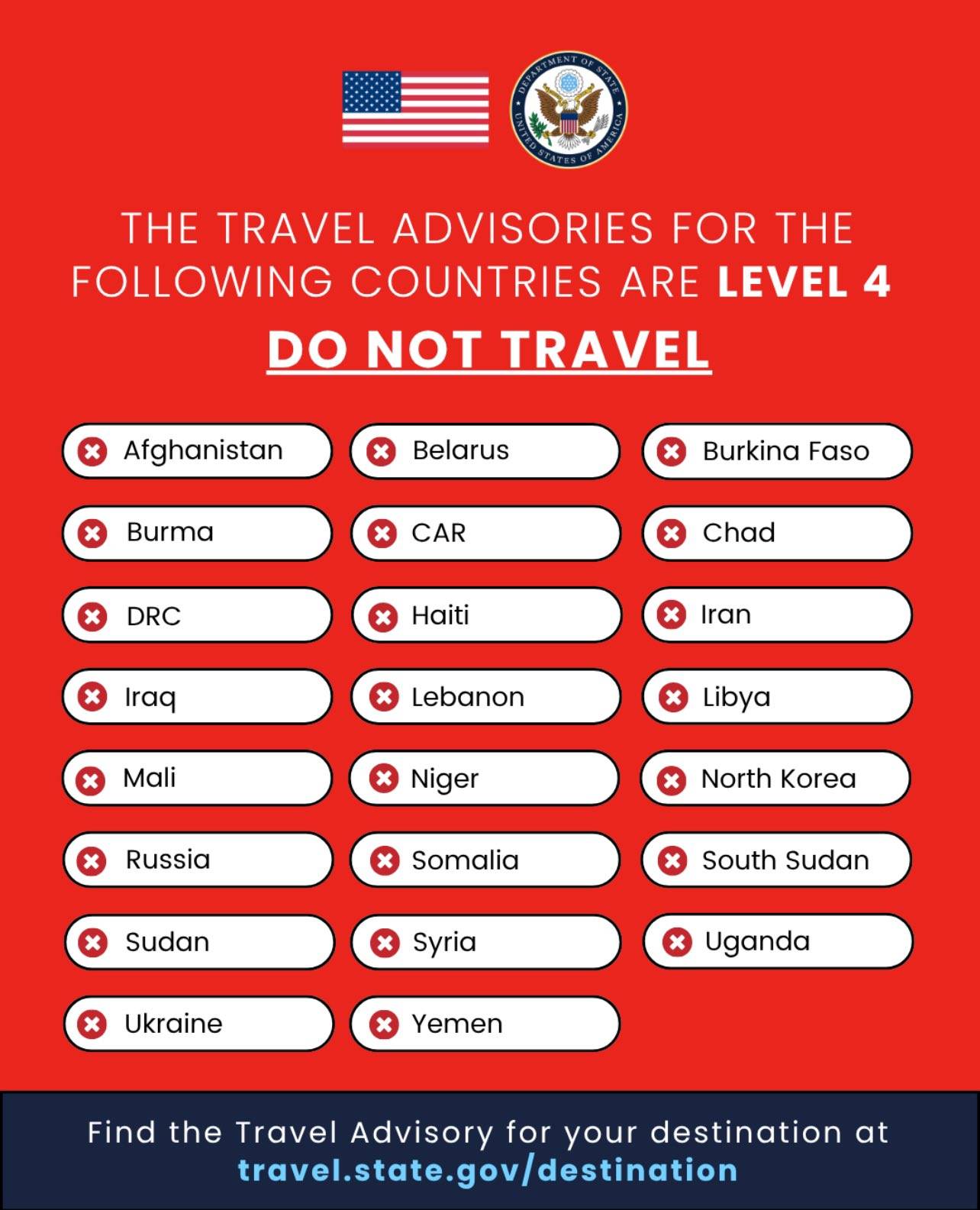
Washington has once again updated its global travel advisory, placing 23 countries at the highest risk level—”Do not travel.” Among these, the three Sahel nations forming the Alliance of Sahel States (AES)—Burkina Faso, Mali, and Niger—stand out, facing unprecedented security deterioration and the relentless spread of terrorism across the region.
Washington’s strictest warning: what level 4 means for travelers
The U.S. State Department’s tiered travel advisory system assigns four levels of risk, with level 4 representing the most severe warning. A designation at this level is not merely a recommendation—it serves as a definitive prohibition for American citizens. The U.S. government explicitly warns its nationals against any travel to these countries, citing an inability to provide emergency consular or medical assistance due to the withdrawal of non-essential diplomatic staff. Travelers risk exposure to grave dangers, including kidnappings, terrorist attacks, and hostage situations.
The AES under siege: Burkina Faso, Mali, and Niger in the crosshairs
The joint inclusion of Burkina Faso, Mali, and Niger in the highest-risk category reflects the deepening crisis within the Alliance of Sahel States (AES). These nations are grappling with a multi-faceted emergency marked by political transitions, strained relations with Western partners, and a rapidly deteriorating security landscape.
The roots of this crisis run deep. State authority has eroded in peripheral and border regions, while systemic poverty fuels recruitment by armed factions offering financial incentives or ideological indoctrination. The shift in military alliances—marked by the departure of Western forces and the embrace of new partnerships, particularly with Russia—has introduced a period of uncertainty, with questions lingering over the effectiveness of these new security arrangements on the ground.
The unchecked rise of terrorist networks
Central to Washington’s decision is the alarming geographic expansion of terrorist organizations. Affiliates of Al-Qaeda, through the Group for the Support of Islam and Muslims (JNIM), and the Islamic State in the Greater Sahara (EIGS) no longer confine their operations to isolated desert strongholds. Instead, they launch coordinated offensives, seizing control of new territories and extending their influence across borders.
Burkina Faso: a nation under siege
Burkina Faso bears the brunt of this asymmetrical warfare. Armed groups now control or encircle vast portions of the country, with entire towns cut off by strict blockades. Daily attacks on military outposts and supply convoys have triggered massive internal displacement, leaving countless civilians stranded without access to essential services.
Mali: instability from north to south
In Mali, the security vacuum left by the withdrawal of the UN peacekeeping mission has fueled renewed conflict between government forces and northern rebel factions. Terrorist groups have exploited this instability, escalating violence that now threatens the southern regions, including the outskirts of Bamako, once considered relatively safe.
Niger: the triple frontier under pressure
Niger faces a dual security challenge. In the west, the volatile “triple frontier” region—shared with Burkina Faso and Mali—remains a hotspot of militant activity. To the southeast, the Lake Chad basin is plagued by the persistent threat of Boko Haram and the Islamic State’s West Africa Province (ISWAP). Despite efforts to reorganize its armed forces, Niger’s security situation remains precarious, further complicated by regional diplomatic tensions that hinder cross-border cooperation.
A global portrait of instability
The U.S. advisory extends far beyond the Sahel. Other countries on the level 4 list highlight a world increasingly fragmented by high-intensity conflicts and political volatility. Russia, for instance, remains at the highest risk level due to the ongoing war in Ukraine and the arbitrary detention risks faced by foreign nationals. The eastern Democratic Republic of the Congo continues to endure active warfare, with clashes involving multiple armed groups, including the M23, resulting in civilian massacres and abductions. Chad, sandwiched between the Sahel and war-torn Sudan, faces cascading regional crises, including terrorist incursions and the looming threat of internal unrest.
Economic and humanitarian fallout of a “red zone” designation
The repercussions of a level 4 classification extend beyond tourism. For Burkina Faso, Mali, and Niger—already economically fragile—the warning acts as a deterrent to foreign investment. Multinational corporations, wary of exorbitant insurance costs for their personnel, are freezing or abandoning critical infrastructure and resource development projects. Humanitarian organizations also face severe constraints, as stringent security protocols drastically limit their ability to reach civilians in dire need of food, medical care, and education.
The Sahel’s security impasse
The U.S. State Department’s decision underscores the failure of past stabilization strategies in the Sahel. Despite political upheavals and shifting alliances in Bamako, Ouagadougou, and Niamey, insecurity continues to escalate, with civilians bearing the heaviest burden. Military-focused solutions have proven insufficient. Without addressing governance failures, social justice, economic development, and access to essential services, the Sahel’s map may remain mired in red for years to come.