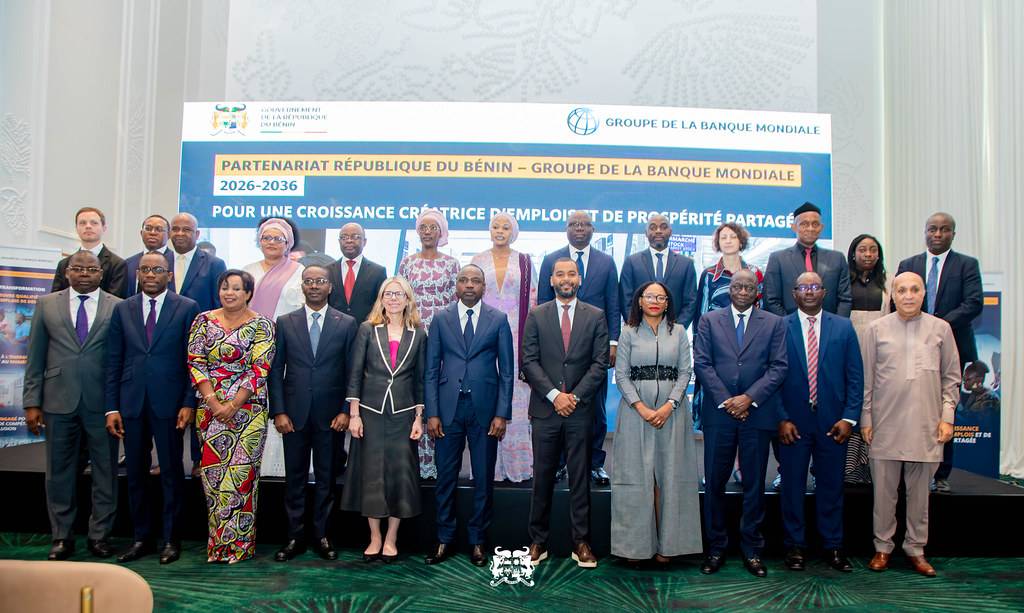
The Sofitel Cotonou Marina Hotel & Spa buzzed with anticipation on Friday, July 17, 2026, as the official launch of the Country Partnership Framework (CPP) 2026-2036 unfolded. This landmark agreement between the government of Bénin and the World Bank Group signals a bold commitment to reshaping the nation’s economic future. Rooted in the forward-looking Alafia Bénin 2060 vision, the CPP sets a new standard for long-term collaboration, focusing on three transformative pillars: human capital, productive infrastructure, and youth employment.
a strategic alliance for a new economic era
The event’s atmosphere was a blend of solemnity and optimism, drawing together government officials, international diplomats, development partners, and private sector leaders. The CPP 2026-2036 isn’t just an incremental update—it’s a comprehensive overhaul of how the World Bank will support Bénin’s growth over the next decade. This timing is no coincidence; it aligns with a pivotal moment in the country’s political and economic trajectory, as the administration pursues macroeconomic stability while accelerating inclusive growth.
The presence of Anna Bjerde, World Bank Group Managing Director of Operations, underscored the international community’s confidence in Bénin’s structural reforms. Her attendance highlighted the institution’s renewed faith in the government’s ability to deliver sustainable progress, reinforcing Bénin’s reputation as a reform-driven nation on the global stage.
economic transformation at the heart of the partnership
The CPP’s core mission goes beyond GDP growth—it’s about redefining Bénin’s economic identity. By securing a decade of stable financing, the World Bank enables the government to implement large-scale infrastructure projects without compromising fiscal balance. This influx of capital and expertise is designed to unlock private investment, both domestic and foreign, fostering a self-sustaining cycle of economic expansion.
three pillars to drive structural change
The partnership’s strategy rests on three interconnected pillars, each tailored to address critical bottlenecks in Bénin’s development:
- Human capital development: A robust economy cannot thrive without a skilled and healthy workforce. The CPP prioritizes nutrition, public health, and vocational training reforms to bridge the gap between education and market demands. The goal is clear—equip Bénin’s youth with the tools to compete in a rapidly evolving job market.
- Critical infrastructure expansion: Infrastructure deficits remain a major hurdle for local businesses. The framework earmarks significant investments in energy, digital connectivity, and transport networks. By improving links between agricultural zones, urban centers, and the Port of Cotonou, Bénin aims to slash logistics costs and boost export competitiveness.
- Private sector-driven growth: The private sector is the engine of job creation in this plan. The CPP will support reforms to streamline business regulations, expand credit access for SMEs, and empower young and female entrepreneurs, ensuring that economic gains translate into lasting opportunities.
youth employment: the ultimate test of success
For Bénin, the litmus test of this decade-long plan will be its ability to integrate young professionals into the workforce. With a predominantly young population, the country faces both a social imperative and an economic opportunity. Aristide Medenou, Minister of Economy, Finance, and Cooperation, emphasized this urgency during the launch, stressing that the CPP must act as a catalyst for opportunity.
The strategy revolves around high-value agricultural sectors and agro-industrialization—industries capable of absorbing young labor and curbing rural exodus. By aligning World Bank technical assistance with national industrialization goals (as seen in initiatives like the Glo-Djigbé Industrial Zone), the framework ensures that new jobs are not just temporary but embedded in the country’s economic fabric.
resilience and inclusivity: the bedrock of sustainable growth
Long-term prosperity cannot be built on fragile foundations. The CPP integrates resilience and social cohesion as cross-cutting priorities, particularly in the face of regional security and climate challenges. Investments will extend beyond southern urban hubs to peripheral and northern regions, where basic infrastructure (clean water, electricity, rural roads) and employment opportunities are scarce.
By addressing these disparities, the program aims to reduce vulnerability, strengthen national cohesion, and safeguard territorial stability—a critical step in shielding Bénin from external shocks.
global recognition and long-term commitment
Anna Bjerde praised Bénin’s leadership for its strategic vision, singling out the President and his administration for their commitment to financial discipline and reform. In her view, the CPP’s launch is perfectly timed to translate macroeconomic ambitions into tangible benefits for farmers, entrepreneurs, and families across the country.
This endorsement not only reassures international markets but also cements Bénin’s status as a preferred partner for multilateral institutions. It signals the World Bank’s willingness to stand by the country through challenges, adapting financing mechanisms to align with ground realities.
a roadmap to an emerging Bénin by 2036?
The CPP 2026-2036 is more than a financial agreement—it’s a blueprint for a decade of structural transformation. By simultaneously targeting human capital, infrastructure, and private sector growth, Bénin and the World Bank are deploying a holistic economic recovery plan.
The success of this ambitious initiative hinges on rigorous execution, robust project governance, and the ability of local institutions to absorb investments effectively. If the promises made in Cotonou materialize across the nation’s villages and cities, Bénin could emerge as a beacon of inclusive economic growth in West Africa—a model for others to emulate. The countdown to 2036 has begun.