The joint expert committee tasked with evaluating the reopening of the Benin-Niger border has delivered its findings, sparking cautious optimism. A preliminary agreement has been reached on security protocols, transit regulations, and key legal and economic frameworks. However, Niamey has set three non-negotiable conditions that must be met before political ratification can proceed.
This long-standing dispute, now in its third year, has inflicted severe economic and humanitarian consequences on both nations. What lies ahead for this lingering crisis?
Three uncompromising demands from Niamey
The Nigerien delegation in Cotonou has outlined three uncompromising prerequisites for a lasting border reopening, sealed since 2023.
- First, Niamey insists on a formal defense and security pact with Benin. This accord must enshrine mutual non-aggression and prohibit either nation from allowing its territory to be used as a launchpad for destabilizing the other.
Analyst Régis Hounkpè, executive director of InterGlobe Conseils, views this commitment as fundamental yet contextually significant: « While mutual non-aggression is standard practice, its formalization in this post-crisis climate is remarkable. The real test will be implementation—both Benin and Niger must ensure this clause, though non-binding, is effectively enforced. »
- The second condition centers on intelligence-sharing through a joint task force, enabling real-time exchange of critical data—particularly on terrorism and cross-border trafficking.
Hounkpè praises this initiative as a pragmatic step toward mutual reassurance: « A shared intelligence hub ensures neither side harbors ambitions of destabilization. »
- The third demand addresses Benin’s military partnerships, demanding full transparency on foreign forces or deployments near the border.
« This touches on sovereignty, Hounkpè notes. The Beninese president has repeatedly affirmed his nation’s autonomy in foreign alliances—whether with France, Western partners, or beyond. The core issue is sovereignty: Benin must guarantee its agreements won’t undermine Niger’s security. Pragmatically, destabilizing a neighbor serves no purpose for either side. »
The Nigerien government seeks to safeguard its territorial integrity amid deep political mistrust—stemming from the 2023 military transitions in both countries.
How the closed border is crippling Niger
Until Benin meets these demands, the border remains sealed—a blockade that throttles a vital trade artery for both nations. Landlocked Niger relies on Benin as its primary maritime gateway, with nearly 70% of its imports transiting through this corridor.
The port of Cotonou is equally critical for other Alliance of Sahel States members—Burkina Faso and Mali—which depend on Benin for fuel, construction materials, and staple foods like rice. Alternative routes via Togo or Nigeria are longer, riskier, and up to 50% more expensive.
The crisis has also paralyzed Niger’s oil sector. The 2,000 km Agadem-Sèmè-Kpodji pipeline, inaugurated to export 90,000 barrels daily, has seen flows suspended—costing Niger millions in lost revenue. Each delayed shipment represents a financial hemorrhage no Sahelian budget can absorb.
Benin’s economic strain
Benin, too, faces severe repercussions. Transit fees and port congestion are plummeting, with some sectors—including customs, logistics, and wholesale trade—reporting up to 60% revenue losses. Blocked containers have redirected maritime traffic to Togo and Nigeria, threatening Benin’s status as a regional hub.
Households on both sides of the border are feeling the pinch. Markets in Malanville (Benin) and Gaya (Niger) report half as many customers, with small businesses shuttering and unemployment rising. Essential goods have become scarce, and prices for basic staples have surged.
The border closure has also disrupted mobility. Pirogue crossings—more perilous than land routes—have become the norm, inflating transport costs and isolating communities. Families have been torn apart, while vulnerable groups face worsening hardship. These conditions have fueled smuggling and extortion networks.
Why economic survival outweighs political divides
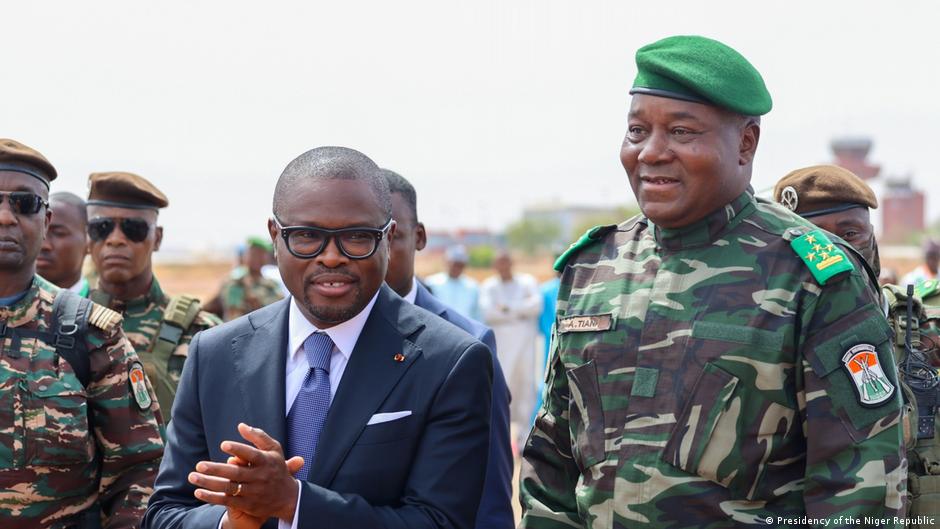
Economic imperatives have reignited dialogue since Romuald Wadagni’s election as Benin’s president. Days after his inauguration, he visited Niamey, launching the joint expert committee’s efforts.
Hounkpè stresses the necessity of putting ideology aside: « Leaders today must prioritize geography over politics. They share a destiny—bound by economics, logistics, security, and terrorism threats. The focus must be survival. »
Progressive border reopening is likely, with priorities given to essential goods under heightened controls. If successful, Hounkpè suggests this thaw could « inspire positive spillovers for the Alliance of Sahel States and ECOWAS »—mirroring the recent détente between Mali and Côte d’Ivoire, driven by economic pragmatism over ideology.