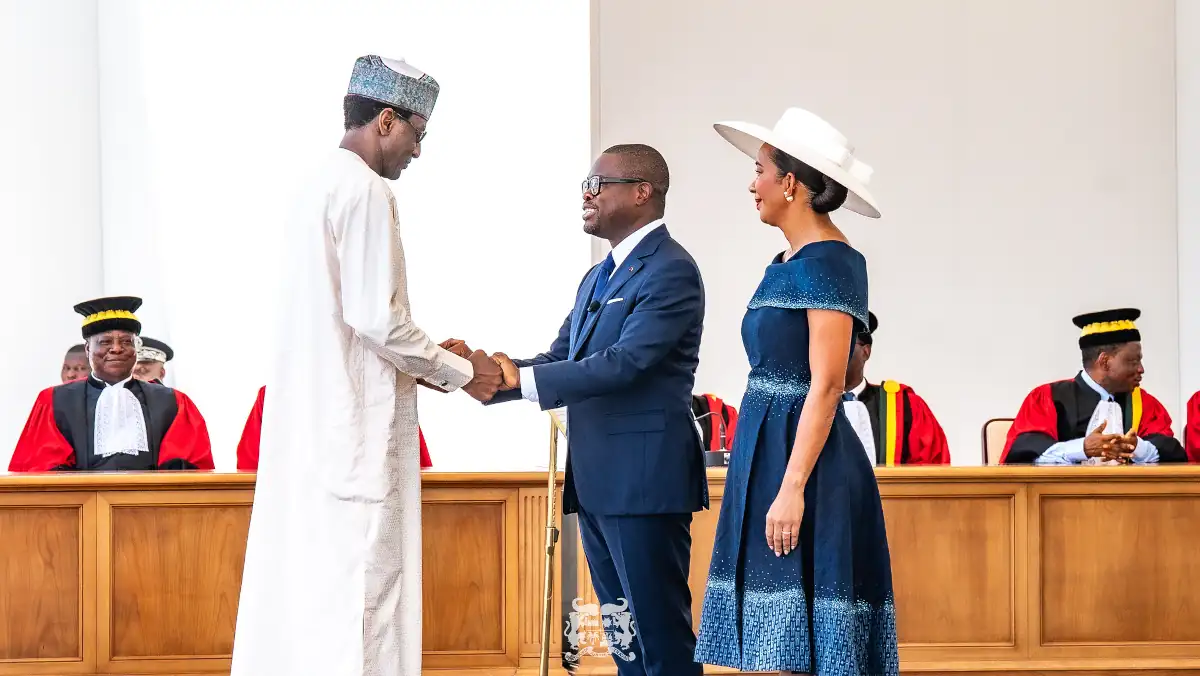
Cotonou witnessed a profoundly symbolic day on May 24, 2026, as Romuald Wadagni officially assumed the presidency of Bénin. Beyond the formal investiture, it was the remarkable assembly of political and diplomatic figures that truly captured observers’ attention. Opposition leaders, former heads of state, delegates from various neighboring West African nations, and influential personalities previously estranged from the corridors of power all gathered, potentially signaling the dawn of a new political chapter for Bénin.
Following the decade under Patrice Talon, this substantial show of unity around the incoming president suggests a clear aspiration for peace and national cohesion. A highlight of the inauguration was the notable attendance of former presidents Nicéphore Soglo and Boni Yayi. These two iconic figures in Bénin’s democratic history, who had often voiced criticism of the previous administration, chose to be present. Their participation sends an unmistakable message of institutional recognition and republican stability, despite the fact that President Soglo had openly campaigned in support of the new head of state.
Within the official stands, images depicting cordial exchanges among political figures from diverse ideological backgrounds quickly circulated, sparking widespread commentary. It became evident that beyond mere protocol, the profound political implications of these presences were what truly resonated.
For several years, Bénin’s political landscape had gradually become fraught with tension, primarily stemming from institutional reforms, and electoral conditions that a segment of the opposition vehemently challenged. The 2019 legislative elections, controversies surrounding the return of exiled opposition members and those incarcerated, along with debates over partisan system reform, had severely hampered national political dialogue. Against this backdrop, witnessing long-standing government opponents gather in support of the new president carries profound significance for Bénin’s political reconciliation efforts.
The attendance of opposition leaders and prominent figures at this investiture ceremony stands out as a key indicator of this deliberate move towards de-escalation. Their participation unequivocally signals an acceptance of the transition process and a conscious decision to prioritize republican dialogue. The sight of Boni Yayi observing Romuald Wadagni’s oath of office starkly contrasts with the periods of intense friction witnessed in recent years, fostering a sense of gradual return to normalized political engagement in Bénin.
According to numerous political analysts, Romuald Wadagni enters office under a markedly different atmosphere than that which surrounded Patrice Talon‘s ascent to power in 2016. A renowned technocrat and former Minister of Economy and Finance, the new president projects an image heavily focused on technical governance. His emphasis on economic management and administrative reforms appears to cultivate a more consensual perception, even among some circles that were critical of the outgoing administration.
Regional appeasement and enhanced cooperation for Bénin
The investiture ceremony also featured a robust sub-regional diplomatic presence, notably including representatives from the AES countries. Delegations from Niger, Burkina Faso, and Mali attended, alongside those from Nigeria, Togo, and other neighboring states, underscoring a broader call for regional unity.
This diplomatic turnout holds significant weight, occurring within a regional context characterized by heightened security tensions, military political transitions in several Sahelian nations, and a re-evaluation of power dynamics within ECOWAS. Bénin, as is widely known, has experienced particularly strained relations in recent years with its neighbors unified under the Alliance of Sahel States (AES).
By welcoming multiple representatives from these neighboring countries, Bénin’s new leadership appears keen to reassert its commitment to diplomatic openness and enhanced regional cooperation. Bénin, having faced a persistent terrorist threat in its northern regions for several years, critically requires reinforced security collaboration with its direct neighbors, including those like Burkina Faso, to ensure stability in West Africa.
The presence of these diverse country delegations also reflects a degree of confidence in Bénin’s institutional stability. Despite internal political criticisms over recent years, Bénin continues to be viewed as a stable state within a region often disrupted by political and security crises. However, it is predominantly on the domestic front that this investiture holds the potential to ignite a fresh dynamic for the nation.
The path forward: actions beyond symbols for Bénin
Nevertheless, numerous observers counsel caution. True political de-escalation cannot be confined to mere symbolic gestures or formal coexistence at an official ceremony. Romuald Wadagni inherits an economically transformed nation, yet one still marked by significant political divisions. His paramount challenge will involve safeguarding governance achievements while simultaneously rebuilding trust among institutions, the opposition, and the various segments of society.
At the very least, the new president’s investiture has achieved one crucial outcome: it brought together, at a single table, key political actors who had for years operated within an almost constant framework of confrontation.
In a West African region often destabilized by institutional crises and democratic setbacks, this portrayal of unity surrounding Bénin’s presidential transition already serves as a powerful political signal. The critical question now remains whether this ceremonial phase will genuinely pave the way for a new era of profound dialogue and lasting political reconciliation within Bénin.