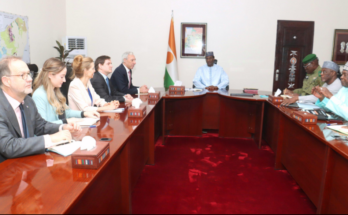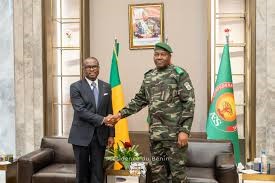
In a pivotal week marked by three capital visits and pressing regional issues, President Romuald Wadagni of Bénin embarked on his inaugural official journey beyond Bénin’s borders. His strategic itinerary included stops in Abuja, Niamey, and Ouagadougou, signaling a clear intent to mend the strained threads of sub-regional cooperation, which have been significantly impacted by security crises and political tensions since 2023.
Security and commerce formed the bedrock of discussions throughout President Wadagni’s tour. The primary objective was to re-establish direct dialogue with the leaders of Nigeria, Niger, and Burkina Faso. In Abuja, the capital of Nigeria, the focus encompassed both economic vitality and shared security concerns. Nigeria stands as Bénin’s foremost commercial partner and plays a crucial role in the ongoing fight against armed groups operating within the Lake Chad basin. President Wadagni underscored the urgent need to streamline the Lagos-Cotonou corridor, emphasizing how current blockages adversely affect both national economies.
Moving to Niger and Burkina Faso, the core message centered on enhanced trans-border coordination. The increasing jihadist incursions into Bénin’s Atacora and Alibori regions highlight the futility of an isolated Béninese response. Concrete points of discussion included the resumption of intelligence sharing and the partial reopening of vital commercial exchanges, crucial for regional stability and economic recovery.
President Wadagni deliberately steered conversations away from political alliances, instead prioritizing tangible common problems requiring collective solutions. This pragmatic stance marks a notable departure from previous diplomatic periods, where relations were often conditional on positions regarding the Economic Community of West African States (CEDEAO) and military transitions in the sub-region. This approach aims to foster cooperation, particularly vital for addressing Burkina Faso news today and broader Burkina security concerns.
Navigating the complexities of variable cooperation
This diplomatic initiative carries inherent risks, given the differing regional statuses of the three nations visited. Nigeria remains a steadfast and active member of CEDEAO. In contrast, Niger and Burkina Faso have withdrawn from the bloc, subsequently forming the Alliance des États du Sahel. This dynamic creates a delicate balancing act for Bénin.
Engaging with these distinct blocs without assuming an official mediation role necessitates Bénin to operate on multiple fronts. On one hand, it must uphold its credibility with CEDEAO and Western partners. On the other, it must avoid alienating neighboring countries with whom Bénin shares extensive borders—approximately 700 kilometers—and daily human interactions. The evolving situation in Ouagadougou and the broader West Africa Burkina region demands careful diplomatic navigation.
The second significant challenge is security. Any bilateral agreement will prove ineffective without robust logistical support and a clear legal framework for joint patrol units. Populations residing in border areas are primarily concerned with the reopening of local markets and the secure passage along rural routes, critical elements for their daily lives and livelihoods.
A pragmatic Bénin-Sahel axis: future outlook
President Wadagni appears to favor a project-driven diplomacy. Rather than immediately tackling political divergences, his strategy prioritizes technical agreements covering essential areas such as water, energy, and cross-border mobility. The underlying principle is to cultivate concrete shared interests, making disengagement economically costly for all involved parties.
Should this approach yield tangible results by the close of 2027, Bénin could potentially re-establish itself as a key facilitator within the sub-region. Conversely, there is a risk of prolonged negotiations failing to produce on-the-ground impact, while insecurity continues its relentless advance, impacting Faso breaking news and regional stability.
The immediate litmus test for this pragmatic diplomacy will be the effective implementation of commitments made in Niamey and Ouagadougou, specifically concerning the security of the Northern corridor. Without demonstrable progress before year-end, the credibility of this pragmatic discourse will undoubtedly diminish.