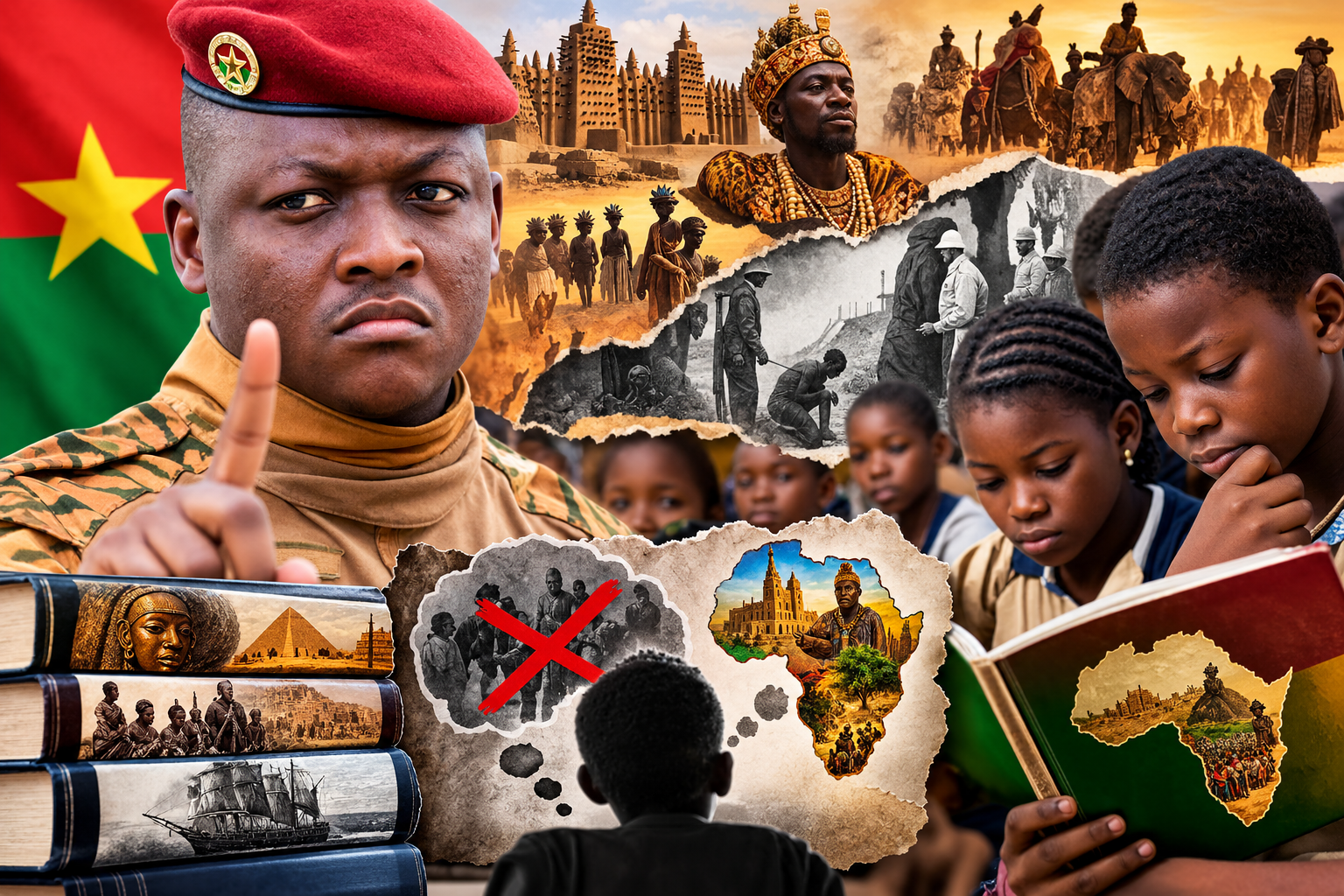
The government of Burkina Faso has initiated a sweeping reform of history and geography curricula, aiming to “decolonize” school textbooks. While this effort seeks to address legitimate concerns about the acknowledgment of African history in education, it raises a critical question: can revising curricula risk confining future generations to an incomplete interpretation of their own past?
Beyond colonial narratives: what a proper history curriculum must include
The narrative of a nation’s history cannot be reduced to a single era, such as colonization, nor confined to the pain it caused or the conflicts it provoked with Western powers. A comprehensive history must encompass civilizations, empires, kingdoms, trade systems, technological advancements, societal changes, and the interactions between peoples. Teaching this history requires a balanced approach that acknowledges past injustices without reducing collective memory to them alone.
Why correcting historical wrongs demands more than textbook revisions
Burkina Faso’s educational reform, if narrowly focused on correcting historical grievances through rewritten narratives, risks missing its mark. Educational programs can indeed highlight the injustices of colonization, restore the legacy of African resistance movements, and elevate figures long overlooked. However, they cannot retroactively alter history or heal the wounds of the past. Their true purpose lies in equipping students with the knowledge to understand their heritage, fostering informed debate rather than perpetuating ideological divisions.
Lessons from neighboring models: the importance of a holistic history curriculum
Examining the approach taken by Côte d’Ivoire offers valuable insights. A well-rounded history curriculum must integrate national history alongside the legacies of African kingdoms and empires, prominent continental figures, and global events that have shaped the modern world. Understanding one’s own country does not imply ignoring the broader context. Instead, situating national history within a wider framework helps students grasp the power dynamics, exchanges, and events that define contemporary societies.
Key principles for a meaningful history education reform
- History should enlighten, not indoctrinate; it should explain, not divide; and it should empower, not restrict.
- Decolonizing education must correct omissions and restore overlooked facts while avoiding the replacement of one single narrative with another.
- Students should study colonial crimes without being denied the complexity of European societies, and explore African civilizations without ignoring their contradictions, conflicts, and evolution.
The ultimate goal: empowering future generations with critical historical understanding
A history curriculum that merely highlights injustices inherited from the past falls short of its educational potential. Students must also learn how these injustices occurred, identify the mechanisms that enabled them, assess historical responsibilities, and extract lessons for the future. The real question Burkina Faso should ask is not just how to reform textbooks but what kind of memory it intends to pass on to its youth.
Is the goal to maintain a generation in perpetual confrontation with the past, or to provide them with the intellectual tools to comprehend, debate, and build upon that past for a better future?
Conclusion: healing historical wounds through transparency, not omission
The errors of history cannot be corrected by concealing parts of the past from future generations. Rather, healing begins when students are given the opportunity to read, understand, and learn from all pages of history. Only then can educational reform contribute to forming enlightened citizens who know their roots while remaining connected to the world around them.