
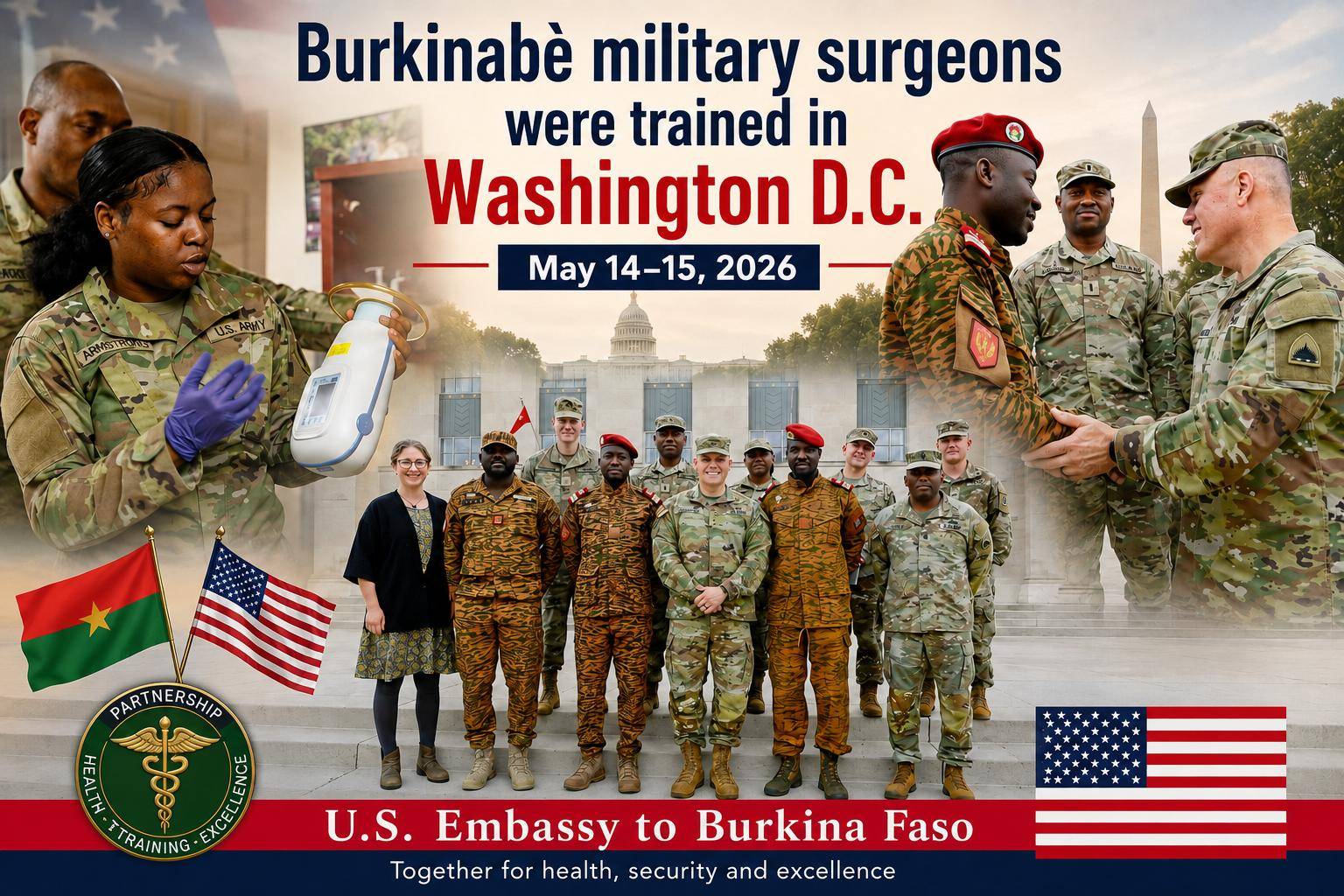
Despite official rhetoric from the Alliance of Sahel States (AES) often portraying an increasingly hostile stance towards Western powers, the practical realities of technical cooperation reveal a far more nuanced trajectory. A significant development unfolded between May 14 and 15, 2026, when Burkinabè military surgeons engaged in high-level discussions with the United States National Guard in Washington D.C. This interaction occurred under the umbrella of the State Partnership Program (SPP).
The U.S. Embassy in Ouagadougou announced this medical exchange on Saturday, June 6, sparking questions: Why, amidst a strategic rapprochement with Moscow, do Sahelian states continue to rely on the expertise of traditional partners they publicly criticize? This situation brings to light a profound paradox within the Sahel region’s current geopolitical landscape.
A discreet yet highly strategic medical mission for Burkina security
The U.S. Embassy in Ouagadougou discreetly released a communiqué on Saturday, June 6, 2026, bringing this crucial information to public attention. In mid-May, a delegation of surgeons from the Burkinabè Armed Forces spent two days in the U.S. federal capital.
The purpose of this mission was firmly rooted in the State Partnership Program (SPP), a long-standing cooperation mechanism of the United States National Guard that connects American military capabilities with those of partner nations. Over two intensive days, Burkinabè and American specialists meticulously exchanged expertise on critical areas such as managing war casualties, combat traumatology, and the intricate handling of surgical emergencies in hostile environments. Given Burkina Faso’s current national context, marked by a grueling asymmetric conflict, this direct transfer of specialized skills represents a vital asset for enhancing the survival rates of soldiers on the Burkinabè front lines.
The AES paradox: navigating between sovereignist statements and technical imperatives
This recent journey to Washington starkly illuminates a major contradiction in contemporary Sahelian geopolitics. Since the formation of the Alliance of Sahel States (AES), which unites Burkina Faso, Mali, and Niger, the political discourse has noticeably hardened against the West. The transitional authorities across the region frequently accuse Western powers, particularly France and, at times, more subtly, its allies, of passivity, or even complicity and indirect support for the armed terrorist groups that continue to inflict tragedy across the Sahel.
Yet, behind the scenes, the channel of technical cooperation with the United States remains not only open but actively engaged. How can one reconcile the presence of senior Burkinabè officers at the heart of American institutions with the official AES doctrine that advocates a complete break from former spheres of influence? This significant divergence underscores that, when confronted with the brutal realities of war, operational pragmatism frequently overrides ideological postures. This is a key aspect of Burkina Faso news today.
Why the Russian alternative has limitations in advanced war medicine
Following the rupture with France, Ouagadougou and its AES partners have substantially invested in their partnership with the Russian Federation. Moscow provides essential combat equipment, aerial assets, instructors, and direct security assistance on the ground. This raises the question: why was Russia not chosen for this specific surgical training?
The answer lies in the inherent nature of traditional partnerships and the established structure of Western armies. The American National Guard, through its SPP, offers an exceptionally high-performing model of combat medicine, honed by decades of external interventions and meticulously documented according to global academic standards. Furthermore, Western military medicine benefits from a historical continuity with African armies: protocols for medical evacuation, equipment formats, and the initial training of Burkinabè medical personnel are historically compatible with Western standards. In the critical domain of military health and saving lives in combat, the Russian offering, which typically focuses more on pure tactical support and hard security, appears for now less adapted or less structured to meet these highly specific and advanced medical needs.
Mutually beneficial discreet diplomacy in West Africa Burkina
For Washington, maintaining this program presents a golden opportunity to retain a crucial foothold in Burkina Faso and, by extension, within the broader AES sphere. At a time when American influence in the region faces challenges, exemplified by the forced withdrawal of their troops from neighboring Niger, this medical diplomacy serves to preserve a vital link of trust with the Burkinabè military elite without provoking public backlash. This is significant for Faso breaking news.
For Captain Ibrahim Traoré and the Burkinabè command, this discreet collaboration serves as compelling evidence that Burkina Faso is actively avoiding total isolation. While publicly reaffirming a façade of sovereignty and an unwavering alliance within the AES, the Burkinabè leadership demonstrates its ability to strategically leverage the best resources from various blocs to enhance the effectiveness of its armed forces.
A variable-geometry sovereignty?
Ultimately, this exchange session in Washington reminds us that the geopolitics of the Sahel cannot be reduced solely to declarations of rupture and protest slogans. Beyond the communication warfare and the intricate dance of global alliances, the paramount priority remains the survival of the Burkinabè state in the face of persistent terrorism.
By opting to train its surgeons with the American National Guard, Burkina Faso makes a clear choice for medical efficacy over strict political coherence. This paradox is undoubtedly salvatory for the wounded on the front lines, yet it also vividly illustrates that, in the art of war, health diplomacy operates under far more pragmatic rules than the political pronouncements from public platforms. This is a key insight for those following Ouagadougou English news.
