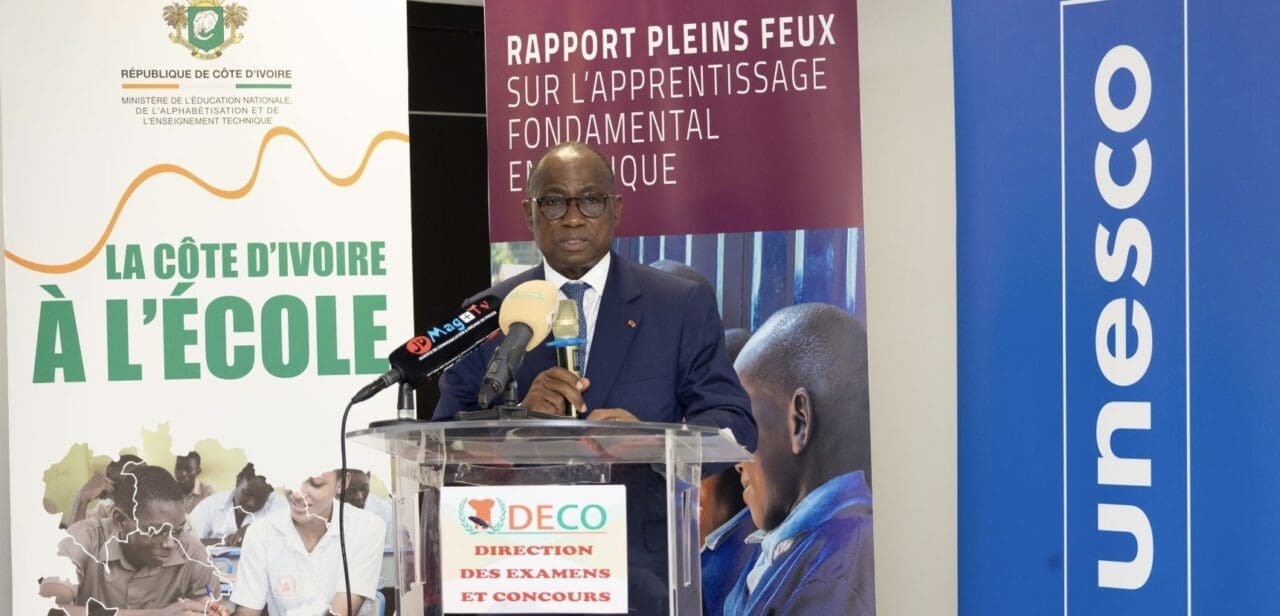
Launched in April 2026 in Abidjan, the “Pleins Feux” initiative is a cornerstone of Côte d’Ivoire’s ongoing efforts to modernize its education system under President Alassane Ouattara’s leadership. Supported by global partners, the project focuses on strengthening educational governance and boosting the efficiency of public policies to sustainably enhance learning outcomes.
With over 30 million citizens and a youthful population, Côte d’Ivoire faces growing pressure on its education system, particularly in rural areas. Education has become a national priority, aligning with the United Nations Sustainable Development Goal 4 (SDG 4) and the 2030 Agenda. For more than a decade, Ivorian authorities have introduced reforms to expand access and improve teaching quality.

scaling up teacher recruitment and school infrastructure in Côte d’Ivoire
Since 2011, Côte d’Ivoire has significantly expanded its teaching workforce, recruiting over 69,000 primary school teachers and more than 30,000 secondary school educators. Recent efforts have prioritized STEM fields, with an additional 1,800 teachers hired in mathematics and physics to meet labor market demands and support the country’s economic transformation goals.
Infrastructure development has also accelerated, especially in rural zones, to bring schools closer to students, reduce travel distances, and minimize early dropouts. New schools have been built nationwide, improving educational coverage. The opening of the CAFOP in Boundiali, in northern Côte d’Ivoire, reflects this commitment, alongside a surge in applications—nearly 68,000 candidates competed for just 7,000 spots in 2026, highlighting a strategic push to strengthen teacher training and renewal.
climate and inclusion: building a supportive learning environment
Improving teaching conditions is now a key pillar of Ivorian education policy. Between 2011 and 2025, starting salaries for primary school teachers rose by over 30%, and secondary school salaries increased by up to 15%, making the profession more attractive and helping stabilize teaching teams.
School environments are also being transformed. The introduction of adaptive learning materials for students with disabilities is a major step toward inclusivity. Complementary actions, such as awareness campaigns against school-related pregnancies, aim to reduce dropout rates and support continuous student engagement in education.
“Pleins Feux”: a governance-focused boost for Ivorian education
The “Pleins Feux” project, unveiled in Abidjan in April 2026, emphasizes educational governance rather than infrastructure or staffing. Developed in partnership with UNESCO, the African Union, and the Global Education Monitoring Report (GEM), the initiative is the result of two years of collaboration across Côte d’Ivoire, Ghana, and Ethiopia.
Its goal is to empower policymakers and educational leaders with the tools and skills needed to implement public education policies more effectively. This comes at a time when international partners commend Côte d’Ivoire’s progress in foundational learning. The government continues to leverage diverse partnerships—international, regional, and private—to drive systemic transformation in education.