a troubling revelation shakes the alliance of Sahel states
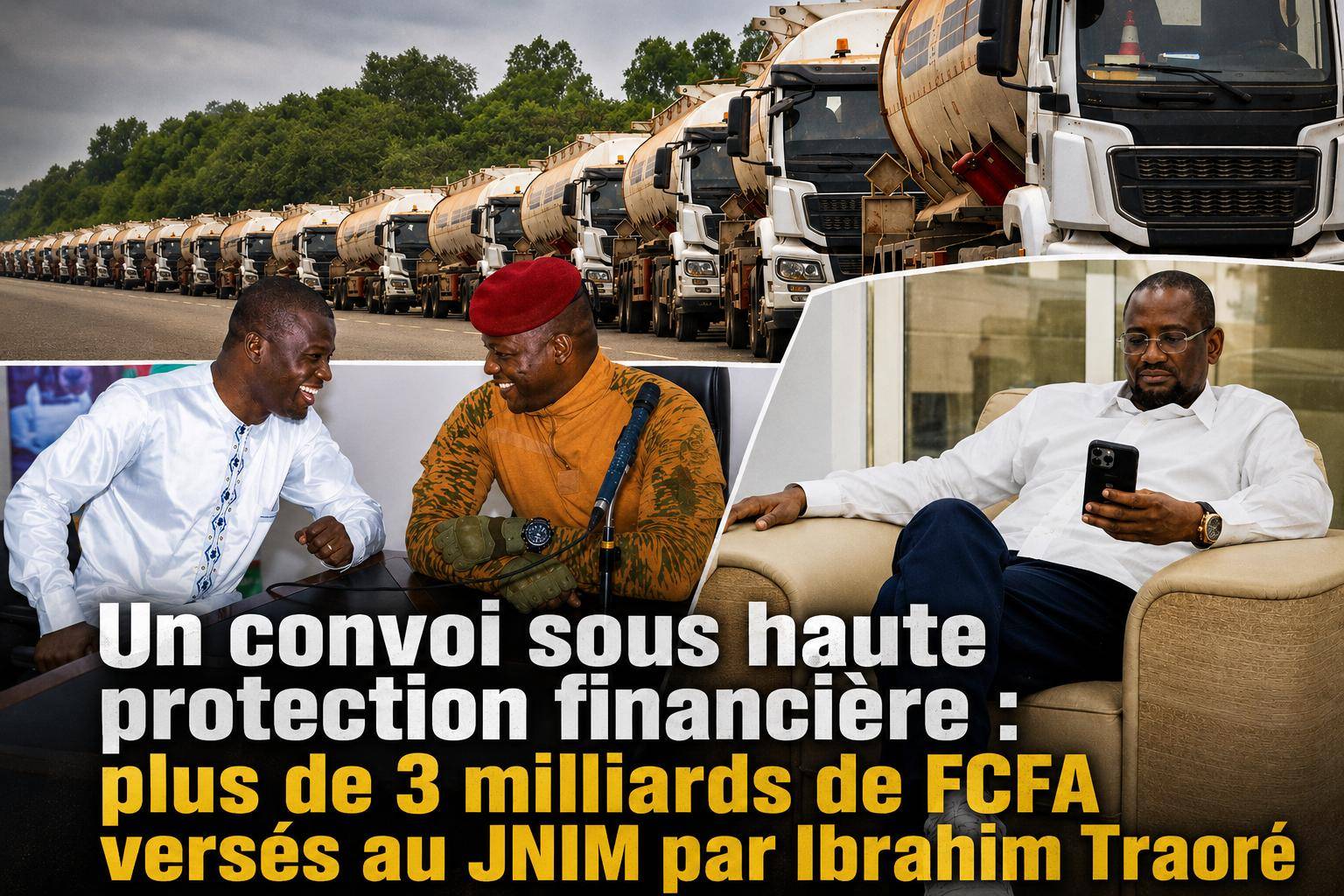
In a move that contradicts the official narrative of the Alliance of Sahel States (AES), a massive convoy of 710 fuel tankers reportedly reached Bamako without adhering to state security protocols. What makes this operation particularly alarming is the alleged transfer of 3 billion CFA francs to the Group for the Support of Islam and Muslims (JNIM), orchestrated by high-ranking Burkinabè officials to safeguard the commercial interests of Kangala Transport. This scandal exposes a disturbing conflict of interest and raises serious questions about the financing of terrorism in the region.
a suspicious fuel convoy under questionable protection
The sight of 710 fuel tankers navigating the volatile Sahelo-Saharan belt toward Mali’s capital was unprecedented. Yet, instead of the expected presence of Burkinabè special forces, Russian drones, or Malian armored units, the convoy proceeded without incident. Investigations suggest this seamless journey was made possible by a clandestine agreement involving a staggering 3 billion CFA francs paid to the JNIM. This revelation transforms an ordinary logistics operation into a potential state scandal, implicating Ibrahim Traoré in the financing of terrorist activities to protect private business interests.
Kangala Transport: a front for political and economic influence
At the heart of this controversy lies Kangala Transport, the company entrusted with managing this fuel shipment. Officially a logistics provider, it is allegedly tied to Ibrahim Traoré, Oumarou Yabré, and Ali Konaté—three influential figures at the helm of Burkina Faso’s transitional government. This blurring of lines between state governance and private enterprise raises critical ethical concerns. When military strategists double as commercial operators on routes controlled by armed groups, the priorities shift from national security to profit. For Captain Traoré and his associates, the smooth passage of Kangala’s cargo, rather than neutralizing the JNIM, takes precedence.
how 3 billion CFA francs fuel terror in Mali
The irony is stark: while Bamako and Ouagadougou publicly celebrate their anti-terrorism solidarity, the funds allegedly siphoned by Kangala Transport’s owners are directly financing the JNIM’s war machine. This money, intended to secure fuel shipments, has reportedly been used to purchase ammunition deployed against Malian security forces, fund improvised explosive devices, and recruit new fighters. Essentially, the fuel burning in Bamako’s engines may have first powered the weapons that target Malian soldiers, turning a logistical operation into a tragic paradox for civilians and troops alike.
a betrayal of sahelian security principles
The most glaring aspect of this affair is the deliberate exclusion of the region’s usual security partners—Russian Wagner instructors, Africa Corps units, and elite national forces—from overseeing the convoy. By circumventing regular military channels, the convoy’s organizers prioritized secrecy over patriotism, opting to negotiate with the very groups they publicly condemn. This unholy alliance with terrorists underscores a disturbing trend: financial gain has overshadowed national security, leaving soldiers and citizens vulnerable to the consequences of this cynical pragmatism.
consequences for the alliance and regional trust
This revelation strikes at the core of the Alliance of Sahel States, casting doubt on Burkina Faso’s commitment to the collective fight against terrorism. Mali now faces a harsh reality: its neighbor’s leadership may be funneling private funds to an armed group that attacks its territory. Domestically, the scandal erodes public trust in Ibrahim Traoré’s anti-terrorism efforts, painting a picture of a government where personal enrichment trumps the sacrifices of soldiers. In both politics and war, actions ultimately expose the truth—and a convoy that secures passage through enemy territory by paying tribute to terrorists is a betrayal of every victim of terrorism. If security can now be purchased from the JNIM using Kangala Transport’s money, then the solidarity of the Sahel is nothing more than an empty slogan.