Behind the diplomatic curtain in Niamey
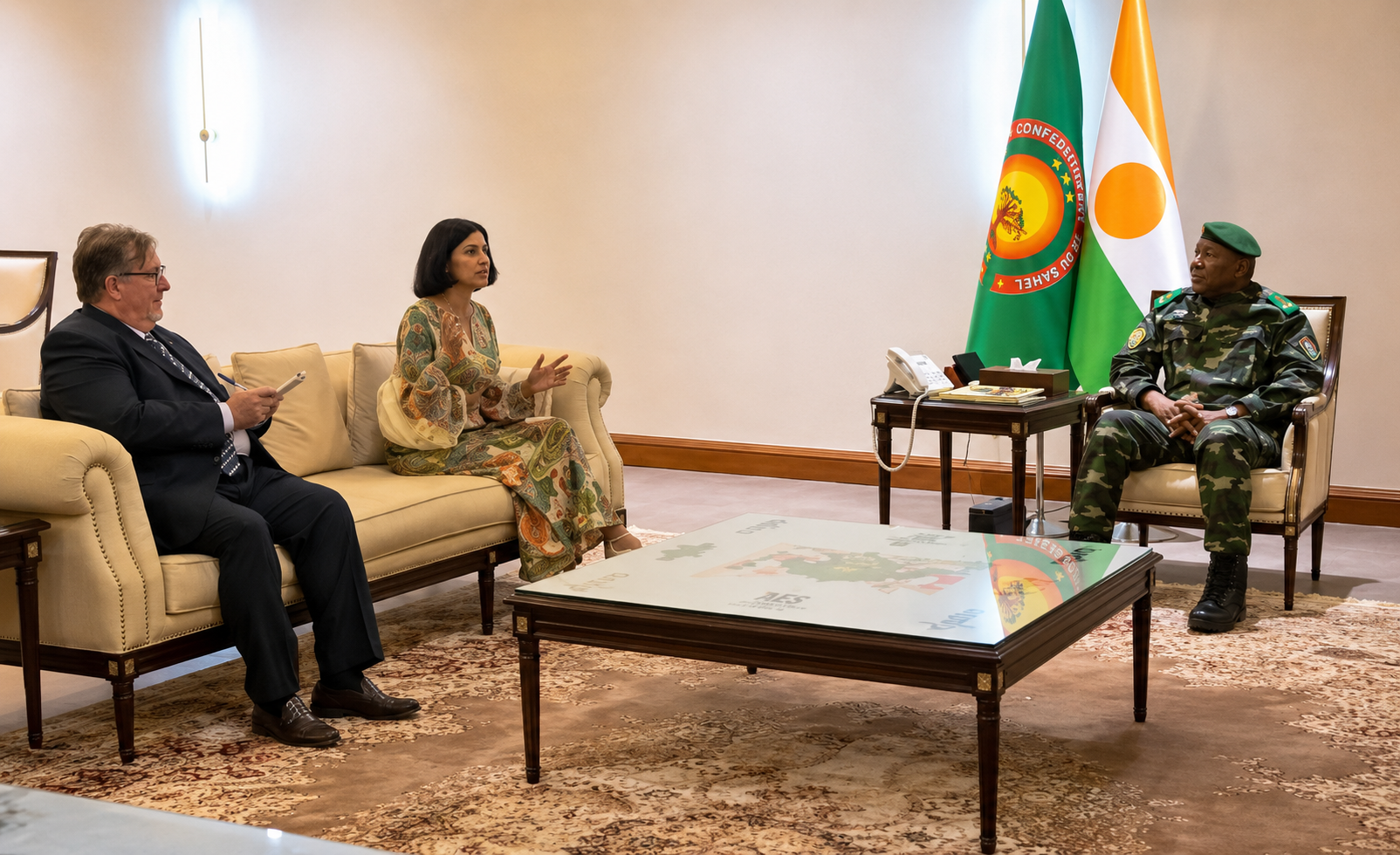
The presidential palace in Niamey once again opened its doors to a high-profile diplomatic encounter. General Abdourahmane Tiani, head of state, granted an audience to Spain’s Ambassador to Niger, Gloria Minguez Ropiñon. While the official communiqué from the ruling National Council for the Safeguard of the Homeland (CNSP) seeks to portray a robust and forward-looking partnership, this carefully staged event does little to conceal the government’s underlying strategy of distraction amid mounting scrutiny over the alleged mismanagement and trafficking of official passports.
The ambassador’s remarks upon departing the meeting underscored the principles of « continuity » and « sustainability » in bilateral relations, dismissing any notion of a shift away from traditional partners in Niger. She highlighted key areas of cooperation for 2026 and 2027, including food security, women’s empowerment, education, and the promotion of the Spanish language, framing these as pillars of a strengthened alliance.
A calculated move for international legitimacy
To seasoned observers of Sahelian politics, this renewed diplomatic engagement is not merely coincidental. It aligns with a deliberate agenda: to secure a veneer of international respectability at minimal cost. By spotlighting cooperation on widely supported issues such as youth employability, the military-led administration seeks to purchase legitimacy while attempting to suppress domestic scandals that have cast a shadow over its credibility.
The passport scandal: a tool of deflection
The timing of this diplomatic display is particularly telling. The Niamey government stands accused of opaque and potentially corrupt practices in the issuance of official passports—diplomatic and service documents in particular. By orchestrating a high-visibility meeting attended by Foreign Minister Bakary Yaou Sangaré and key advisors, the regime projects an image of an orderly, sovereign state committed to responsible governance and transparent partnerships.
The irony is palpable. On one side, official rhetoric champions the integration of young Nigeriens into the global economy through Spanish language education. On the other, the mechanisms governing the allocation of travel documents remain shrouded in opacity, fueling suspicions of favoritism and illicit influence.
A public relations gambit with domestic consequences
Surrounded by senior officials, including Dr. Soumana Boubacar, Director of the Cabinet and Spokesperson, and Ambassador Illo Adani, this audience was a textbook exercise in public relations aimed at domestic consumption. Criticizing this carefully curated public narrative exposes what the CNSP is desperate to conceal: a desperate attempt to justify its actions through image alone. By showcasing engagement with major European powers, the regime hopes to dilute criticism of its internal governance and normalize administrative practices that are widely contested.
The youth of Niger, so often positioned at the heart of discussions about education and future prospects, are paradoxically the most affected by this crisis of identity and travel documentation—a prerequisite for the « international insertion » touted in diplomatic exchanges.
The presidential communiqué exemplifies a textbook case of crisis management through diversion. Faced with growing suspicions of administrative misconduct and passport trafficking, General Tiani’s government opts for the path of diplomatic respectability. Whether this performative diplomacy will succeed in reassuring both international partners and Nigerian citizens remains an open question—one hinging not on words, but on tangible actions.