Sabcé under siege: a frantic morning under terrorist fire
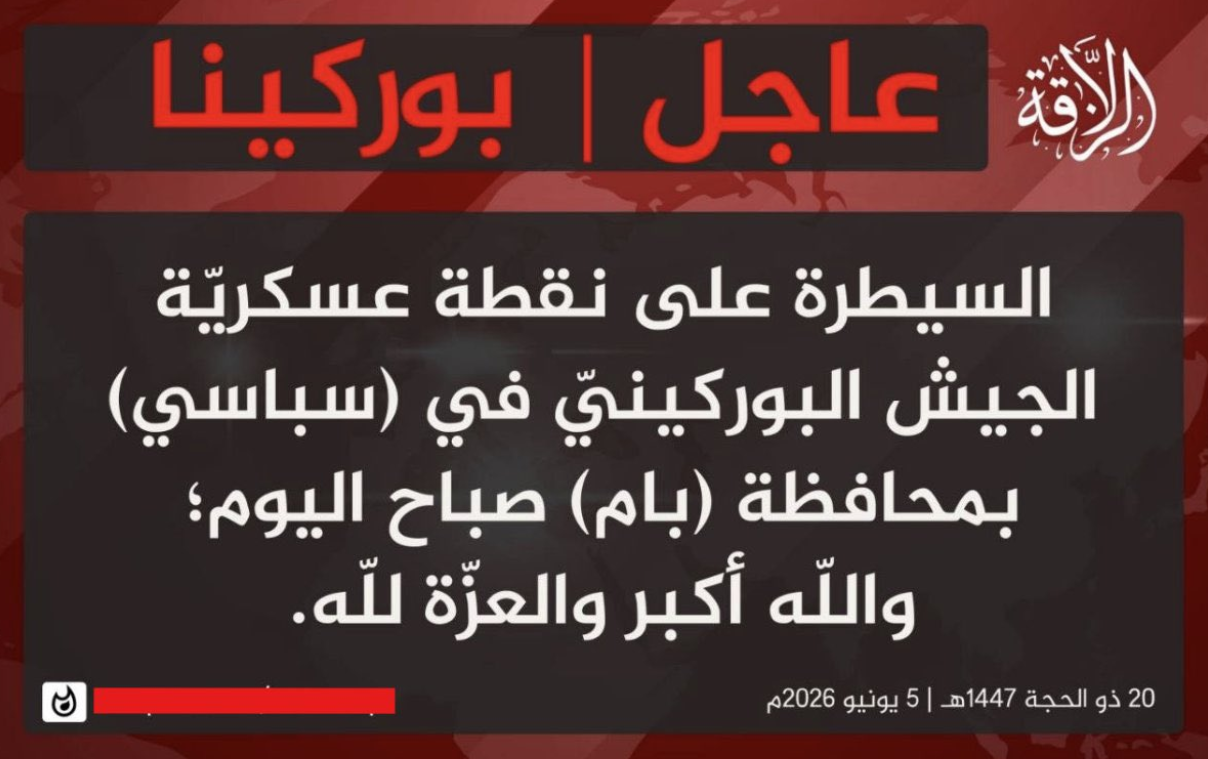
In the heart of the Bam province, in Burkina Faso’s Centre-Nord region, dawn on June 5, 2026, brought more than just daylight—it ushered in a wave of violence. A heavily armed assault, orchestrated by the Group for the Support of Islam and Muslims (JNIM), descended upon the military outpost in Sabcé. The attackers, moving swiftly on motorcycles, exploited the element of surprise, unleashing a barrage of gunfire that rattled the town and its surroundings.
While the Burkinabè armed forces and the Volunteers for the Defense of the Homeland (VDP) mounted a spirited defense, their adversaries’ numerical advantage proved decisive. Reports indicate the assailants seized control, ransacked the facility, and made off with critical logistical supplies before hastily retreating as reinforcements arrived by air. Official casualty figures remain undisclosed, but the incident underscores a harsh reality: the roads linking the Centre-Nord to the rest of Burkina Faso remain perilously exposed.
Sabcé exposes glaring gaps in Burkina Faso’s security strategy
The brazen attack on Sabcé lays bare the shortcomings of Burkina Faso’s current security framework. Despite bolstering troop numbers, upgrading military hardware, and rallying civilian volunteers, the threat posed by armed groups shows no signs of abating. The situation demands an unflinching assessment: the static defense model, reliant on fortified outposts, is proving woefully inadequate.
The JNIM’s ability to isolate detachments, sever communication lines, and strike key targets reveals critical vulnerabilities. Local analysts point to delayed tactical intelligence and sluggish reinforcement timelines as persistent weaknesses, gaps that the Burkinabè military has yet to fully address. Confronting a mobile and borderless enemy, Burkina Faso’s security cannot hinge solely on domestic measures. The crisis demands a rethink of tactics and a deeper integration of regional cooperation.
Benin’s bold overture: a lifeline for regional defense
Amidst this climate of shared vulnerability, Benin’s President Romuald Wadagni has stepped forward with a bold diplomatic and military proposal. His recent state visits to Niamey and Ouagadougou signal more than goodwill—they represent a strategic pivot toward collective action. “In the face of an enemy that respects no borders, our armies cannot afford isolation,” Wadagni declared during the unveiling of his regional security initiative.
The Beninese leader has championed a vision of pooled military resources, real-time intelligence sharing, and joint operations across the Gulf of Guinea and Sahel. His approach, widely applauded by regional observers, moves beyond the parochial rivalries that have long hindered progress. The Sabcé attack now serves as a grim validation of his foresight: Burkina Faso cannot prevail alone, nor can any nation in the Sahel if its neighbors remain on the sidelines.
From words to action: the path forward for regional security
Wadagni’s call for unity is not merely rhetorical—it is an urgent blueprint for survival. The terrorists of the JNIM and Islamic State have long exploited porous borders as havens and escape routes. A genuine collaborative framework must include:
- Real-time intelligence sharing: Satellite and communication data must flow seamlessly between Benin, Niger, and Burkina Faso to preempt threats.
- Cross-border operations: Coordinated military actions should dismantle terrorist sanctuaries straddling frontiers, particularly in the W National Park and adjoining ecological zones.
- Reciprocal pursuit rights: Armed forces must have the mandate to pursue hostile elements across borders, ensuring no safe haven for terrorists.
By extending a hand to Ouagadougou and Niamey, Romuald Wadagni has laid the groundwork for a unified front. The success of this initiative hinges on translating words into deeds before the next Sabcé happens.
The moment of reckoning for Burkina Faso—and the Sahel
The assault on Sabcé is more than another tragic headline—it is a clarion call. It exposes the limits of Burkina Faso’s resilience in isolation and highlights the indispensability of regional solidarity. Ouagadougou must now prioritize not only tactical adjustments at home but also embrace its neighbors’ outstretched hands, beginning with Benin’s ambitious proposal.
The security of Burkina Faso is being tested in Sabcé’s ruins, but its long-term fate will be decided in the halls of diplomacy and the battlefields of cooperation. The era of fragmented strategies is over. The Sahel’s future belongs to those who dare to stand together.