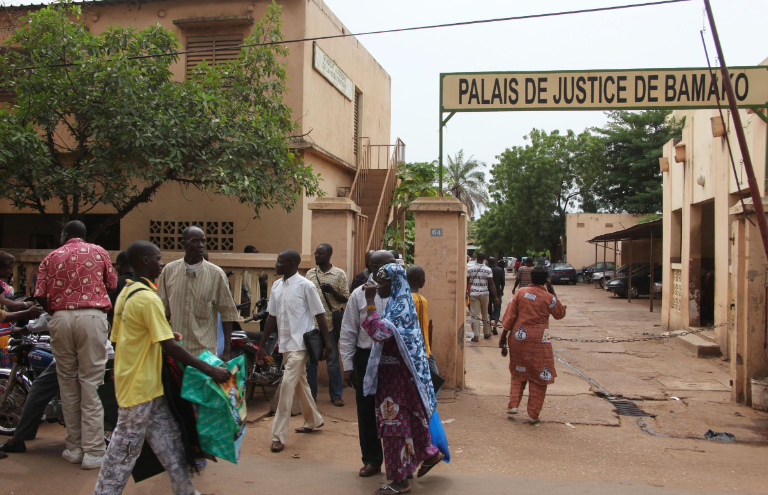
Adama Sangaré, former mayor of Bamako District, has been sentenced to a decade in prison following a landmark ruling by Mali’s National Economic and Financial Crimes Division. The conviction stems from allegations surrounding the subdivision, allocation, and regularization of land parcels in the Bamako-Sénou airport zone, which prosecutors classified as public domain property. Despite the verdict, Sangaré’s legal team continues to challenge the ruling, raising critical questions about the legal framework, procedural fairness, and the nature of the charges.
Legal challenges to the criminal classification of land allocation decisions
The defense’s primary argument hinges on the legal classification of the land transactions at the heart of the case. Sangaré’s lawyers contend that the subdivision and allocation activities carried out during his tenure were administrative in nature, governed by public law rather than criminal statutes.
They assert that the irregularities cited in the prosecution’s case do not inherently constitute criminal offenses. Furthermore, the defense has challenged the jurisdiction of the criminal court, arguing that breaches of administrative procedure should be adjudicated under administrative law, not criminal law. This central contention was formally presented during pre-trial motions, though ultimately rejected by the court.
Questioning the court’s jurisdiction over administrative decisions
Central to the defense strategy is the assertion that the actions under scrutiny were policy decisions made within Sangaré’s official capacity. The legal team maintains that such decisions fall outside the scope of criminal liability unless proven to involve clear malfeasance beyond administrative negligence.
By invoking the principle of separation between administrative discretion and criminal responsibility, the defense aims to shift the focus from punitive sanctions to corrective measures. The court, however, ruled that the transactions’ public impact justified a criminal examination under economic and financial crimes legislation.
Alleged presidential instruction: a political or legal defense?
Sangaré has claimed that he acted under verbal instructions from former Malian President Ibrahim Boubacar Keïta, who passed away in 2022. According to the former mayor, these directives were intended to facilitate the resettlement of internally displaced persons from northern Mali as part of national reconciliation efforts.
The defense argues that this political context must be considered when assessing the legality and legitimacy of the land allocations. Sangaré further asserts that the parcels in question did not form part of the strict airport area, but were adjacent zones under municipal jurisdiction. The prosecution has dismissed these claims, emphasizing the lack of documented evidence supporting the alleged presidential directives.
The financial dispute: contested fees and state damages
Financial aspects have played a significant role in the trial. Prosecutors allege that irregularities resulted in a collective financial loss of approximately 483.964 million West African CFA francs, alongside 49.39 million CFA francs in unauthorized land development fees. These figures were central to the court’s decision to impose a joint liability payment of 483.964 million CFA francs and 50 million CFA francs in damages to the state.
Sangaré maintains that his role did not extend to the financial management of demolition costs or the collection of land development fees. He argues that such responsibilities lay with designated state services and not with municipal officials. Despite these claims, the court ruled that the former mayor bore institutional responsibility for the oversight of these transactions.
Co-defendants and varying sentences: examining the broader verdict
The ruling did not solely target Adama Sangaré. Former deputy prefects Daha Keïta and Ibrahim Koïta received identical ten-year sentences, while Adam Aïché Traoré, Fatouma Samassékou, and Bourama Komagara were given ten years, with five suspended. Souleymane Dagnon, former mayor of Bamako’s Commune VI—tried in absentia—was sentenced to twenty years, and a warrant was issued for his arrest. Sékou Keïta was acquitted on all charges.
Prosecutors had initially sought fifteen-year sentences for Sangaré, Keïta, and Koïta, and twenty years for Dagnon, reflecting the gravity of the alleged offenses. The disparity in sentences reflects the individualized assessment of each defendant’s role and level of involvement.
The road ahead: appeal and systemic implications
With the defense preparing to appeal the verdict, the case is far from concluded. This next phase will focus on procedural fairness, the interpretation of administrative versus criminal liability, and the evidentiary weight of the prosecution’s claims.
Beyond the fate of the individuals involved, the case underscores broader concerns about transparency in Mali’s public land management. It also highlights the ongoing challenge of distinguishing between administrative missteps and criminal conduct—a distinction that carries significant implications for governance and justice in post-conflict Mali.