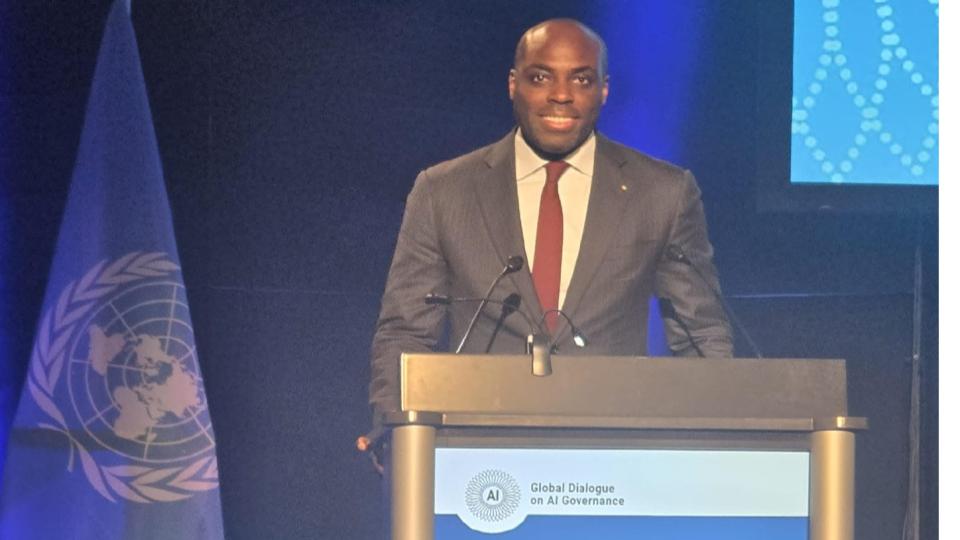
While global powers race to dominate the AI landscape with ever-more-powerful algorithms, Gabon is charting a distinctly different course. Speaking at the UN-backed Global Dialogue on AI Governance in Geneva, Mark Alexandre Doumba, Gabon’s Minister of Digital Economy, urged the international community to reconsider its priorities. For Libreville, the goal is not to create the fastest technology, but to ensure AI is accessible to everyone.
In a bold counterpoint to the Tech giants fixated on model size and computing power, the Gabonese minister championed a paradigm shift. « The race isn’t about being first in AI. It’s about deploying AI widely », he stressed.
The current frenzy, he argued, obscures the real challenge: a political and ethical one. Who will establish the institutions and rules needed for responsible deployment? This perspective places governance and ethical discernment at the heart of the conversation.
From massive models to locally tailored AI
Gabon’s vision for AI’s future lies in transitioning from « big AI » to specialized solutions adapted to local realities. Dubbed « small AI » by Doumba, this approach prioritizes practical applications. « The frontier isn’t about bigger models. It’s about local adaptation that lets an African farmer use AI in their own context », he explained.
Whether optimizing harvests, modernizing public services, or enhancing healthcare access, the true measure of AI’s value will be its tangible benefits for communities in the Global South—too often reduced to passive consumers of imported technology.
Redefining systems to prevent a new global divide
Beyond technology itself, the minister framed AI as a catalyst for systemic transformation. Its role shouldn’t just be to refine existing processes, but to reshape economic and social rules for greater inclusion.
With unprecedented financial and technological resources at humanity’s disposal, the risk of a new global divide looms large. Without collective action to distribute these innovations equitably, the gap between AI creators and its end-users could become the defining schism of the 21st century. The success of this revolution won’t be measured in teraflops, but in lives improved.