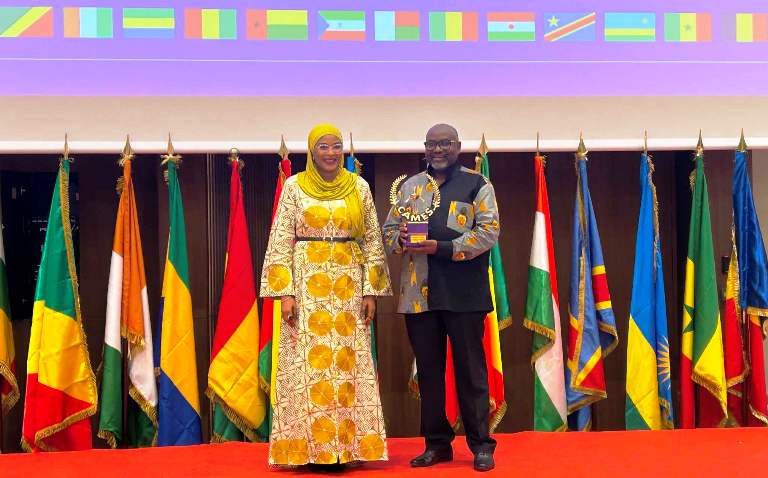
The transition of leadership within the African and Malagasy Council for Higher Education (CAMES) was formalized as the outgoing president, Dr Diaka Sidibé, passed the torch to the incoming leader, Pr Charles Edgard Mombo, on June 19 in Libreville.
The 43rd ordinary session of the CAMES Council of Ministers, hosted in Libreville from June 15 to 19, 2026, concluded with a pivotal shift: Gabon, represented by its Minister of Higher Education, Pr Charles Edgard Mombo, has assumed the acting presidency of the organization for the coming year. This strategic role positions the nation at the forefront of efforts to modernize and elevate the standards of African higher education.
Following the conclusion of the proceedings, which saw the adoption of numerous resolutions, the Gabonese official emphasized his country’s resolve to turn this mandate into a period of practical initiatives and quantifiable achievements for universities, researchers, and students across the CAMES region.
“Gabon’s year at the helm will be characterized by the strict monitoring of ministerial decisions to ensure every resolution leads to concrete improvements,” stated Pr Charles Edgard Mombo while outlining his primary objectives.
Under this new leadership, Gabon intends to prioritize the swift execution of recommended reforms, enhance quality assurance, and foster academic brilliance within member institutions. The mandate also aims to bolster the international profile of scientific research produced in member states and accelerate the digital transition within higher education and research sectors.
This strategic path aligns with the ongoing efforts of the CAMES General Secretariat, led by Pr Souleymane Konaté. The 43rd session ratified proposals from experts who met earlier in June, including a robust revitalization strategy. This plan is designed to strengthen the influence of the CAMES region on the global scientific stage, where it currently accounts for only about 2% of worldwide research output.
To bridge this gap, several innovative projects were approved, most notably the establishment of a CAMES Virtual Academy. This digital platform is envisioned as a hub for scientific and academic services, assisting member states and institutions in boosting university performance, encouraging knowledge exchange, and expanding researcher capabilities.
The Gabonese agenda also highlights the importance of regional solidarity, academic mobility, and intensified scientific cooperation. Furthermore, it seeks to promote innovation, university-led entrepreneurship, and the professional integration of graduates.
The outgoing president and Guinean Minister of Higher Education, Research, and Innovation, Dr Diaka Sidibé, whose leadership was highly praised by her peers, commended the collective commitment to institutional reform. She expressed full confidence in Gabon’s ability to advance the current modernization agenda.
The gathering in Libreville also featured a tribute to the President of Gabon, Brice Clotaire Oligui Nguema. Participants recognized his unwavering support for higher education, scientific advancement, and the integration of African academic systems.
By taking on this presidency, Gabon embraces a critical mission to transform CAMES into a more efficient, innovative, and competitive entity. This ambition aims to address modern challenges in training and development, potentially signaling a new era for African higher education on the global stage.
The governing body has also announced that the 44th ordinary session of the CAMES Council of Ministers will take place in 2027 in Yaoundé, Cameroun.