Northern Niger Ambush Leaves 15 Soldiers Dead
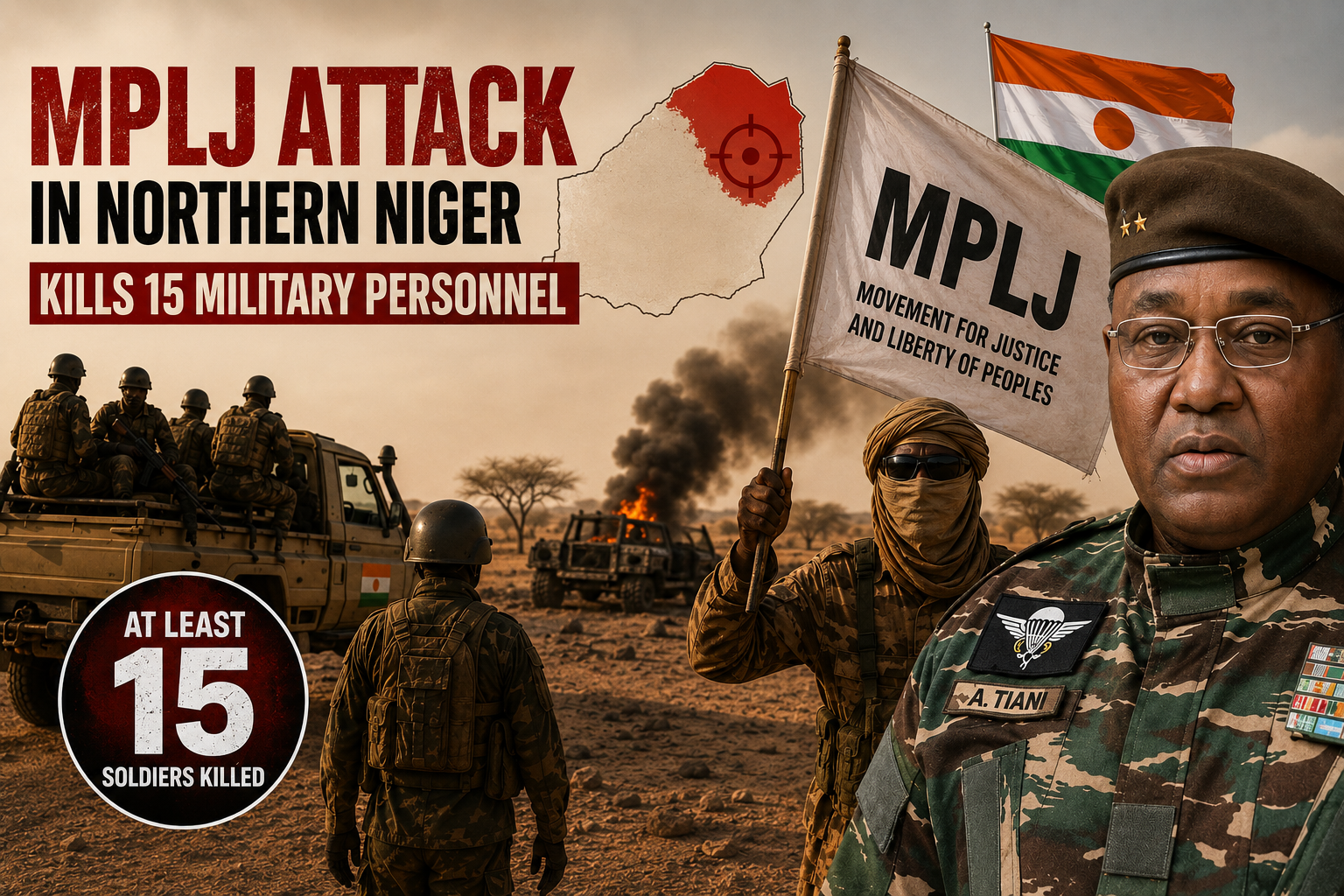
The ongoing surge in violence across Niger has once again exposed the stark contrast between the military junta’s sovereignist rhetoric and the harsh realities on the ground. A coordinated double attack, attributed to the Movement for Justice and People’s Liberation (MPLJ), struck northern Niger this week, leaving at least 15 soldiers dead. The assault underscores a critical failure: the inability of the regime led by General Abdourahamane Tiani to fulfill its most fundamental duty—the protection of its citizens and the assertion of state authority.
The incident is not merely a tragic loss of life but a stark reminder of the challenges facing Niger’s armed forces in securing the country’s vast, sparsely populated desert regions. With borders stretching across some of Africa’s most volatile zones, the Nigerien state struggles to maintain control over territories where armed groups thrive, exploiting gaps in surveillance and governance.
Military Strategy Under Scrutiny
The attack raises serious questions about the effectiveness of Niger’s security strategy. Despite repeated military operations, the country continues to face a persistent threat from armed factions that exploit ungoverned spaces along its borders. These groups move freely, regroup, and strike before vanishing into the desert, leaving behind a trail of destruction. The response to such threats demands more than just firepower—it requires robust intelligence networks, sustained administrative presence, and seamless cross-border cooperation.
The MPLJ assault is not an isolated incident but part of a broader pattern of insecurity gripping Niger. The military junta, which seized power in July 2023, has built its legitimacy on promises of breaking away from previous security paradigms. Yet, for the civilians living in these vulnerable regions, the only metric that matters is tangible security—the ability to move, work, and live without the constant threat of violence.
A Crisis of Sovereignty
The paradox facing Niamey is striking: while the regime projects an image of geopolitical mastery, its grasp on local realities remains dangerously fragile. The sovereignist discourse, amplified in diplomatic forums, clashes with the grim reality of unsecured frontiers where armed groups operate with impunity. Sovereignty, in this context, is not merely about rejecting foreign influence or reshaping international alliances—it is about the state’s capacity to project power, secure its borders, and protect its people.
The junta’s diplomatic shifts—including its rupture with regional blocs like ECOWAS and its pivot toward new allies—have yet to translate into concrete improvements on the ground. With each attack, the regime faces mounting pressure to demonstrate that its policy changes yield tangible results. The citizens of Niger, weary of political announcements, increasingly demand action rather than words.
The Limits of Diplomatic Isolation
The rift with neighboring countries, while politically expedient in some quarters, risks undermining Niger’s security posture. Armed groups in the Sahel thrive in the gaps created by fractured regional cooperation. Effective counter-terrorism requires fluid intelligence-sharing, joint operations, and coordinated responses—tools that become harder to wield amid diplomatic tensions. The MPLJ’s ability to strike and retreat underscores the limitations of a security strategy that prioritizes rhetoric over collaboration.
Blame-shifting has become a recurring theme in Niamey’s response to insecurity. After pointing fingers at former partners, the regime now faces a void in its narrative. Will Algeria, a crucial neighbor, be singled out? Or will the junta recalibrate its approach to include the very allies it once rejected? The strategy of externalizing blame is reaching its structural limits.
The Way Forward: Accountability and Reform
The military’s struggles cannot be reduced to the failures of frontline troops alone. Effective security operations hinge on a complex web of factors: intelligence quality, logistics, command structures, and the political will to craft a long-term strategy. The losses incurred in the MPLJ attack demand a comprehensive review of Niger’s entire security apparatus—not a futile search for scapegoats.
In a country where institutional order has been disrupted without delivering promised safety, the onus falls on national actors to chart a new course. A swift return to constitutional governance could restore democratic legitimacy and forge stronger alliances to confront the terror threat. Security cannot be sustained on the back of nationalist slogans alone. It requires robust institutions, a coherent national strategy, pragmatic regional cooperation, and an administration that reaches even the most remote corners of the territory.
The MPLJ attack is more than another bloody episode in the Sahel conflict. It is a stark reminder that true sovereignty is measured not by the volume of anti-foreign rhetoric but by the state’s ability to protect those under its authority.