Gabon’s parliament assumes a central role in the new republic
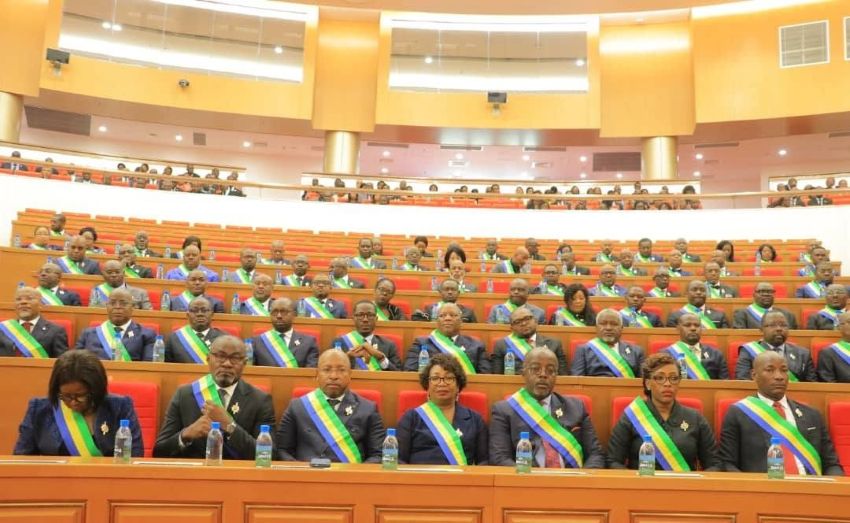
Libreville – A pivotal institutional turning point in Gabon’s political history was marked on Monday, June 15, 2026. For the first time since the Constitution of the Fifth Republic came into effect, President Brice Clotaire Oligui Nguema addressed the Parliament convened in a joint session, fulfilling the requirement of Article 59 of the new fundamental law.
This unprecedented meeting is more than just an exercise in institutional communication. It represents the formation of a new architecture of power, with the stated ambition of making Parliament the central axis of republican life and accountability.
At a time when many democracies are striving to restore trust between the governing and the governed, Gabon is introducing a mechanism that could become one of the most visible hallmarks of its new political era. The Palais Léon Mba, which houses the National Assembly, is no longer solely a place for crafting laws; it is becoming the symbolic space where the executive, the national representation, and through them, the sovereign people, convene annually.
A profound institutional innovation
In previous regimes, presidential addresses to Parliament were exceptional events. The Fifth Republic transforms this possibility into a constitutional obligation. Each year, the head of state must now appear before the assembled parliamentarians to present his vision, his record, and the outlook for his administration.
This development may seem technical, but it is deeply political. It introduces a principle of regular accountability at the very top of the executive branch. The president is no longer just the holder of an electoral mandate; he also becomes accountable to the national representation for the actions undertaken on behalf of the Nation.
This provision distinguishes the Gabonese model from many classic presidential systems. It creates a permanent republican appointment and helps to institutionalize a culture of public evaluation of governmental action.
Moreover, the choice of the Palais Léon Mba as the venue for the joint session is significant. For decades, the center of political gravity was naturally situated around the executive. By coming before Parliament, it is now the president who travels to the representative institution. The symbolism is potent. It asserts that democratic legitimacy is not limited to the presidential election but is sustained through ongoing dialogue with the people’s representatives.
Parliament as the new pillar of the Fifth Republic
The constitutional reform stemming from the inclusive National Dialogue establishes an unprecedented revaluation of the parliamentary role. Far from the image of a secondary institution, Parliament now emerges as one of the main guarantors of the new institutional balance.
This evolution is the result of a specific context. The political transition that began in 2023 placed the issue of rebuilding public trust at the center of national discussions. The new Constitution seeks to address this demand by strengthening mechanisms for control, transparency, and responsibility.
The annual joint session is fully aligned with this logic. Even in the absence of a vote or direct debate, its scope is considerable. It creates a space of political visibility where the majority and opposition share a common institutional moment. In a political landscape often marked by tensions, this ceremony introduces a ritual of republican unity.
Through this mechanism, Parliament also becomes a mirror of the Nation. The 215 assembled deputies and senators embody the political, geographical, and social diversity of the country. The presidential speech is intended for them, but it is actually addressed to all Gabonese citizens.
The birth of a new political culture
All great democracies are based on rituals. They give meaning to political time and anchor institutions in the collective imagination. The annual joint session could become one of these structuring events for Gabon.
Beyond its ceremonial nature, this meeting enshrines a philosophy of government based on transparency and institutional dialogue. It contributes to building a political culture where authority is no longer exercised solely through decisions, but also through explanation and responsibility.
On an African continent where institutional reforms are often carefully observed by investors, international partners, and multilateral organizations, this mechanism also sends a signal of stability. It reflects the will to place public governance within a predictable and sustainable framework.
The true stake of the June 15th joint session, therefore, goes far beyond the content of the presidential speech. What is entering the history books is not just the words of a head of state. It is the installation of a republican tradition destined to structure national political life for the long term.
By making Parliament the common house where the executive power and the national representation meet each year, the Fifth Republic lays one of the foundations of its identity. Gabon is thus inaugurating a new institutional balance where the strength of the state is measured less by the concentration of power than by its capacity to be held accountable. This is perhaps the most profound transformation undertaken since the advent of the new Republic.