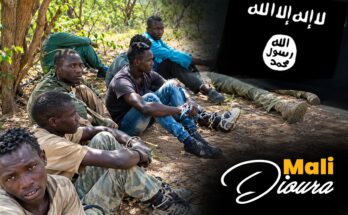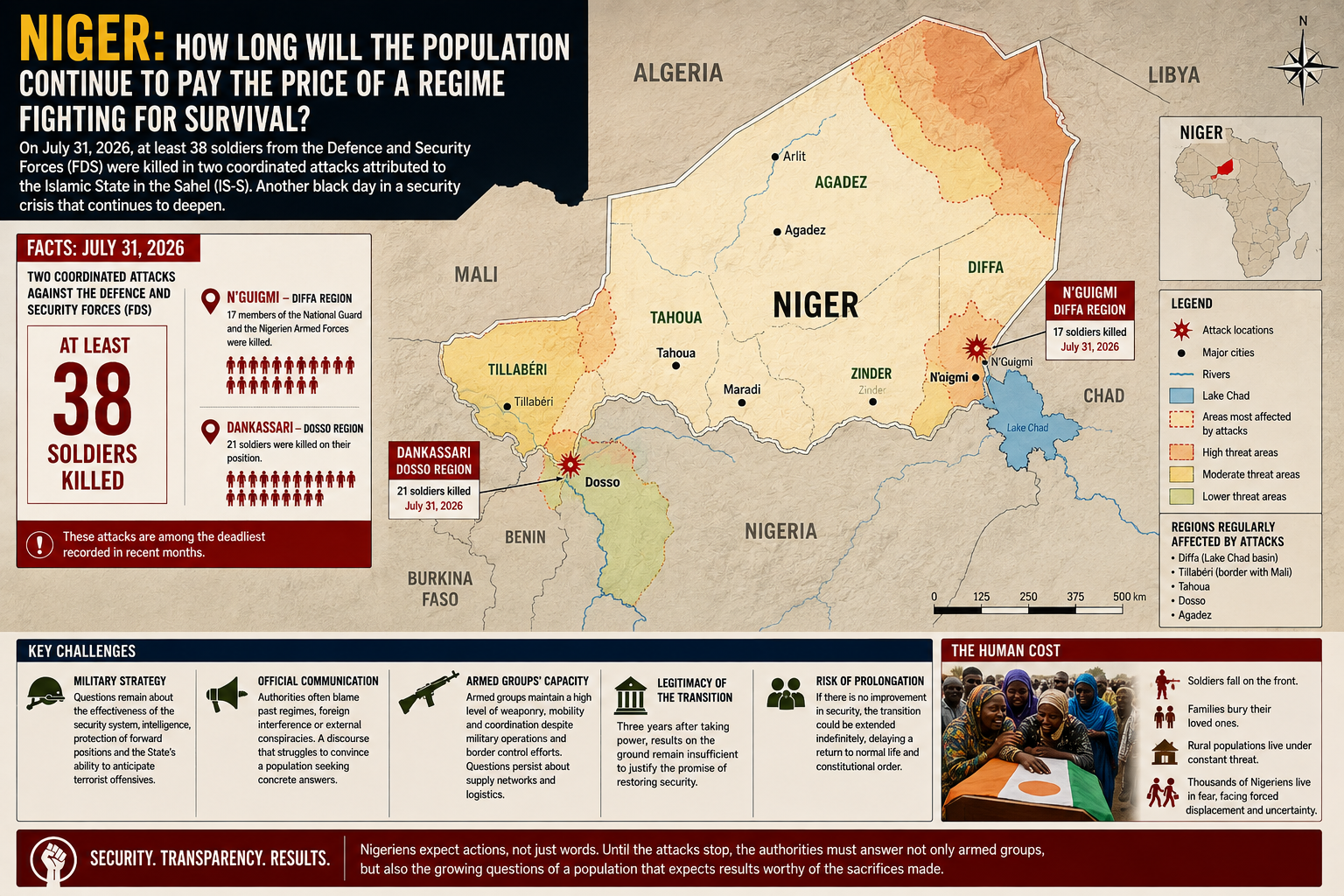
The 31st of July, 2026, marks another bleak chapter in Niger’s recent history. Official reports confirm that at least 38 security personnel were killed in two coordinated attacks carried out by the Islamic State in the Sahel (IS-Sahel).
Deadliest attacks in months
In N’Guigmi, located in the Diffa region, 17 members of the National Guard and Nigerien Armed Forces were killed in an ambush. Hours later, in Dankassari, Dosso region, 21 soldiers lost their lives in a similar assault. These incidents rank among the deadliest in recent months, underscoring a grim reality: terrorism continues to expand its reach while human losses mount.
The tragedy extends beyond military casualties, raising pressing questions about Niger’s worsening security crisis and the human cost borne by civilians and soldiers alike.
Security promises tested
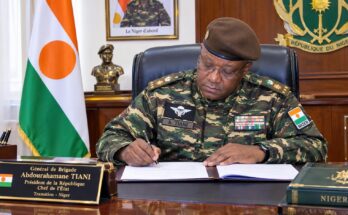
When General Abdourahamane Tiani assumed power, the primary justification for the coup was the urgent need to reverse a deteriorating security situation, which the military leadership argued had spiraled beyond control under civilian rule.
The stated objective was clear: restore stability, reclaim territorial control, and safeguard vulnerable populations. However, three years into the transition, the outcomes tell a different story.
Attacks persist across the Lake Chad basin and regions such as Tillabéri, Tahoua, and Dosso. Armed groups demonstrate an alarming capacity to execute coordinated strikes against military outposts, despite repeated pledges from authorities to reorganize defense forces.
This recurring pattern forces a critical question: Are the proclaimed strategies translating into tangible improvements on the ground?
Military strategy under scrutiny
Each deadly attack raises concerns far beyond the immediate human toll. It challenges the effectiveness of Niger’s security apparatus, the robustness of its military intelligence, the protection of forward operating bases, and the state’s ability to preempt terrorist offensives.
Public skepticism grows as attacks multiply. Citizens and analysts alike are questioning whether the concentration of resources on consolidating political power aligns with the urgent demands of the military front.
A transition justified by security imperatives cannot indefinitely evade scrutiny of its achievements in this critical domain.
Official narratives fail to silence doubts
Following each attack, authorities frequently point to the failures of previous governments, foreign interference, or external geopolitical maneuvering as root causes. While such factors may contribute to a broader context of instability, they do little to address the immediate concerns of affected families and communities.
What victims’ relatives demand are concrete explanations regarding operational lapses, corrective measures, and tangible steps to prevent future tragedies. Without visible progress, official statements risk losing credibility, further eroding public trust.
An insurgency that defies containment
A particularly troubling aspect of the crisis is the sustained operational capacity of armed groups. Despite repeated military operations and intensified border controls, these organizations continue to launch large-scale attacks.
This persistent threat fuels speculation about the effectiveness of efforts to disrupt terrorist supply chains, dismantle logistical networks, and enhance intelligence gathering. The lack of transparent public information only fuels rumors, deepening the rift between citizens and state institutions.
Transition at a crossroads
The military leadership’s legitimacy hinges on its ability to deliver security. Yet, as the crisis drags on, this foundational promise faces growing skepticism.
Each new attack pushes the prospect of normalcy further out of reach, destabilizes local communities, and delays any realistic return to constitutional order. In this climate, observers warn that the absence of tangible security gains may inadvertently prolong the transition period. Resolving this dilemma will require transparency, measurable results, and a credible roadmap for crisis resolution.
The human cost of endless conflict
Amidst political debates, one harsh truth remains: It is soldiers who fall in combat, families who mourn their dead, and rural communities that live under the constant shadow of armed groups. Thousands of Nigeriens endure daily hardships marked by displacement, fear, and uncertainty.
Security was the cornerstone of the military transition. Today, it remains its most pressing test. Until the cycle of violence is broken, authorities will face not only the challenge of defeating armed groups but also the growing demands of a population demanding accountability and tangible protection.