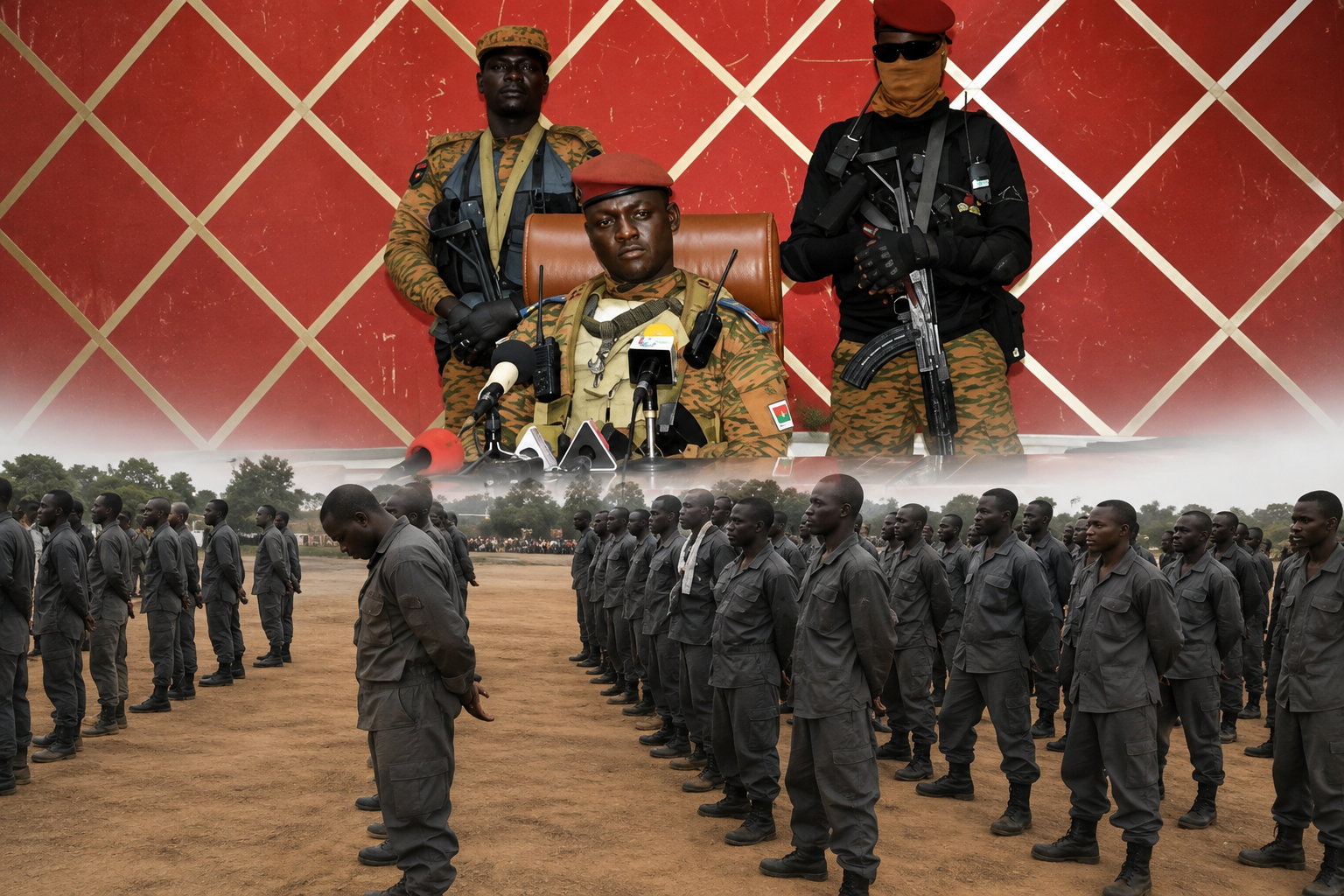
In the annals of authoritarian regimes, a paradox unfolds with relentless predictability: the instruments of repression, originally designed to silence opponents, ultimately consume those who once wielded them. Burkina Faso now serves as a stark example of this phenomenon under the leadership of Captain Ibrahim Traoré. Over time, a barrage of tactics—arbitrary arrests, forced disappearances reported by international watchdogs, smear campaigns, punitive summons, media restrictions, and wartime conscription orders—has ceased to target solely traditional dissenters. Instead, Muslim community leaders, civil society activists, commentators, influencers, and erstwhile regime supporters now find themselves ensnared in a system where loyalty offers no safeguard.
The erosion of the regime’s own foundations
A pattern, not isolated incidents, is emerging. It reflects a fundamental shift in how power operates in Burkina Faso. As decision-making centralizes, dissent is equated with treason, and the space for debate collapses, suspicion becomes the default lens through which society is viewed. In such an environment, yesterday’s allies are today’s potential enemies. The defining criterion is no longer past allegiance but perpetual obedience—a standard that grows increasingly difficult to meet.
The illusion of perpetual loyalty
Since seizing power, Ibrahim Traoré has cultivated legitimacy through a narrative of sovereignty, patriotism, and national security. This rhetoric, amplified by an online army of supporters, frames all criticism as foreign-backed destabilization, the machinations of political opponents, or acts of national betrayal. Within this climate, prominent figures have justified the regime’s actions, dismissing enforced disappearances as security necessities and celebrating media closures as acts of defiance against neocolonial interference. The normalization of emergency measures has stripped public discourse of nuance, replacing it with a binary mandate: uncritical support for Traoré or immediate accusation of collaboration with the enemy. In this climate, dissent is no longer a democratic right but a punishable offense.
This approach carries a critical flaw. When a regime demands absolute fidelity, even the slightest hesitation is redefined as defiance. What begins as praise for the leader’s choices can swiftly transform into suspicion. Yesterday’s staunch allies risk becoming today’s suspects.
The cult of personality deepens the abyss of distrust
One of the most defining features of Burkina Faso’s transitional period is the concentration of authority around Captain Ibrahim Traoré. Public debate has narrowed to matters of personal allegiance; challenging policy becomes tantamount to undermining the head of state. As security crises multiply and state failures mount, the temptation to identify internal traitors intensifies. Military setbacks, terrorist atrocities, economic hardship, social unrest, and international criticism fuel a narrative in which adversity is never the result of flawed governance but the work of hidden conspiracies.
Within this logic, the circle of suspicion widens relentlessly. It begins with political opponents, then spreads to independent journalists, human rights defenders, judges, academics, religious leaders, and eventually even close allies whose influence is deemed too independent or insufficiently aligned with official directives. In a system where loyalty must be continuously proven, no one can ever be certain of remaining on the “right side” of power.
Fear as governance: the cost of silence
The repeated use of high-profile arrests, public summons, digital smear campaigns, administrative punishments, and coercive conscription sends a message to society at large. Each detention serves as a warning. Each unexplained disappearance fuels dread. Each summoned citizen is reminded of their vulnerability. Each televised requisition reinforces the perception that coercive tools can be deployed against anyone deemed inconvenient. This strategy fosters self-censorship. Academics hesitate to publish research. Journalists scale back investigations. Religious leaders dilute their sermons. Ordinary citizens refrain from public debate. A society governed by fear gradually loses its capacity for innovation, self-correction, and collective problem-solving.
The dismantling of institutional checks and balances
This evolution is especially troubling given the simultaneous hollowing out of Burkina Faso’s institutional safeguards. The judiciary faces growing concerns over its impartiality, with legal proceedings appearing to serve political imperatives rather than justice. Independent media outlets face suspension or closure, shrinking the pluralism of public information. Civil society organizations operate under mounting restrictions. Political parties see their activities severely curtailed amid the transition. When no institution remains capable of holding the executive to account, citizens’ rights become precarious—protected only by the regime’s momentary will.
A historical pattern repeated
Burkina Faso is not unique. Across time and geography, regimes built on consolidated power have followed a similar trajectory. Revolutionaries purge their former comrades. Military juntas turn on their own officers. Political movements exile their founders. Ideologues are recast as traitors. The underlying logic is clear: when loyalty to a single leader becomes the cornerstone of political survival, no degree of devotion is ever sufficient. Constant validation is demanded. This relentless pursuit of political purity inevitably leads to purges, expulsions, and accusations that spiral out of control.
Fundamental rights are not bargaining chips
The current drift in Burkina Faso underscores a vital truth: fundamental liberties must never be treated as rewards granted to loyal citizens. Rights such as due process, freedom of expression, press freedom, the presumption of innocence, and protection from arbitrary detention or forced disappearance are not privileges—they are universal guarantees designed to shield every individual from state overreach. Endorsing the arrest of one critic sets a precedent. Once arbitrariness is normalized, it becomes a tool available to all. Injustice does not change its nature depending on the identity of its target.
Many of those who once backed Ibrahim Traoré made a critical error: they assumed proximity to power would ensure lifelong protection. In authoritarian systems, loyalty is not a contract. It is a fragile bond, subject to perpetual reassessment based on shifting political winds. The regime’s evolving purges reveal a deeper truth: the problem is not the individuals involved but the system itself.
Security cannot justify the abandonment of the rule of law
Burkina Faso faces a grave and undeniable terrorist threat that demands a robust state response. Yet the effectiveness of counterterrorism cannot be measured solely by the volume of coercive measures. It also depends on the trust between citizens and institutions. When the population fears the state more than it trusts its protection, that trust erodes irreparably. History demonstrates that no insurgency can be permanently defeated if the institutions meant to safeguard citizens lose their credibility. Security and the rule of law are not opposing goals—they are mutually reinforcing. A state that combats terrorism while upholding legal norms strengthens its legitimacy. In contrast, when emergency measures become permanent, the fight against extremism risks becoming a justification for the generalized control of society.
The system turns inward: a warning for all allies
The current predicament of once-committed regime supporters is emblematic of a broader political reality. In a system where institutions are weakened and power operates through fear, no one enjoys lasting protection. Today’s allies may become tomorrow’s suspects. The most vocal defenders can be accused of insufficient loyalty. Communication networks can be dismantled and sidelined. Religious figures can be reprimanded if their messages stray from official orthodoxy. The arroseur arrosé—the one who waters others only to be watered himself—becomes the regime’s final irony.
Yet beyond individual fates, it is Burkinabè society as a whole that bears the cost. When a regime extends suspicion even to its own supporters, it exposes a fundamental flaw: the problem is not the people, but the system. The true security of a nation rests not in proximity to the head of state or adherence to a doctrine, but in strong institutions, independent justice, a free press, and laws applied equally to all. Only within such a framework can the fight against insecurity preserve both state authority and civic freedoms.