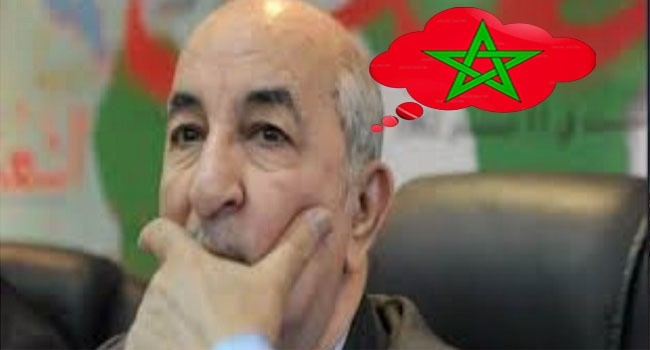
Algeria’s political landscape has taken a troubling turn, with anti-Morocco sentiment no longer confined to diplomatic tensions but evolving into a calculated tool of state propaganda. Under President Abdelmadjid Tebboune’s leadership, what began as strategic rivalry has spiraled into an institutionalized campaign of vilification, where hostility toward Morocco is not just tolerated but actively cultivated as a means of political advancement.
Critics of this approach argue that the current wave of animosity represents a stark departure from the past. During former President Abdelaziz Bouteflika’s tenure, tensions with Morocco existed but were tempered by diplomacy. Bouteflika’s disdain was subdued; Tebboune’s is unapologetically loud. The shift is stark: where predecessors exercised restraint, the current regime has unleashed a torrent of invective, amplified by a state-funded media apparatus that treats anti-Morocco rhetoric as a core pillar of its editorial strategy.
Central to this campaign is AL24 News, a television channel launched under Tebboune’s administration, whose programming frequently devolves into unchecked hostility toward Morocco. Program hosts and commentators compete to deliver the most inflammatory soundbites, reveling in the opportunity to tarnish Morocco’s reputation with baseless claims. The lack of editorial oversight is glaring—accuracy takes a backseat to spectacle, with even the most outlandish accusations presented as fact. The goal is clear: to stoke emotional reactions rather than inform or analyze.
Perhaps the most egregious example of this strategy unfolded during the Qatar World Cup, when Morocco’s football team reached the semifinals—a historic achievement celebrated worldwide. Yet Algeria’s state-run media went to extraordinary lengths to avoid acknowledging Morocco’s success, even omitting its name from sports bulletins. The same pattern is repeating itself ahead of the 2026 World Cup, where Morocco’s potential triumphs are treated as unspeakable victories. The absurdity reached new lows with one commentator claiming Lionel Messi’s performances against Algeria were orchestrated by “the Jewish lobby” as retaliation for Algeria’s stance on the Sahrawi and Palestinian causes.
“The spectacle of Algerian officials and broadcasters indulging in such vitriol—particularly when it crosses into outright antisemitism—reveals a regime that has weaponized division as a governance model.”
The implications are far-reaching. Beyond undermining regional stability, Algeria’s state-sponsored hate campaign risks isolating the country diplomatically. By normalizing anti-Morocco rhetoric as a prerequisite for political success, the regime has created a toxic environment where competence is secondary to ideological conformity. Aspiring politicians and bureaucrats now recognize that the surest path to influence lies not in policy expertise but in demonstrating unwavering hostility toward Morocco—a “qualification” that appears to guarantee rapid career advancement.
In essence, Algeria has transformed its rivalry with Morocco into a political commodity, one that yields tangible rewards for those willing to embrace it. The consequences of this strategy extend beyond bilateral relations, reshaping Algeria’s internal dynamics and its standing on the global stage. Whether this approach will ultimately serve the regime’s interests—or hasten its isolation—remains to be seen.